‹ PrevQuestion 58 / 58 · latest first
✓ Board-verified
Physics · 2023 · 4 marks
CBSE 2023 · Region 4 · Set 1 · Q34
Electrostatics deals with the study of forces, fields and potentials arising from static charges. Force and electric field, due to a point charge is…
Electrostatics deals with the study of forces, fields and potentials arising from static charges. Force and electric field, due to a point charge is basically determined by Coulomb's law. For symmetric charge configurations, Gauss's law, which is also based on Coulomb's law, helps us to find the electric field. A charge/a system of charges like a dipole experience a force/torque in an electric field. Work is required to be done to provide a specific orientation to a dipole with respect to an electric field. Answer the following questions based on the above :
(a)
Consider a uniformly charged thin conducting shell of radius R. Plot a graph showing the variation of $\displaystyle |\vec{\mathrm{E}}|$ with distance $\displaystyle \mathrm{r}$ from the centre, for points $\displaystyle 0 \leq \mathrm{r} \leq 3 \mathrm{R}$.
(b)
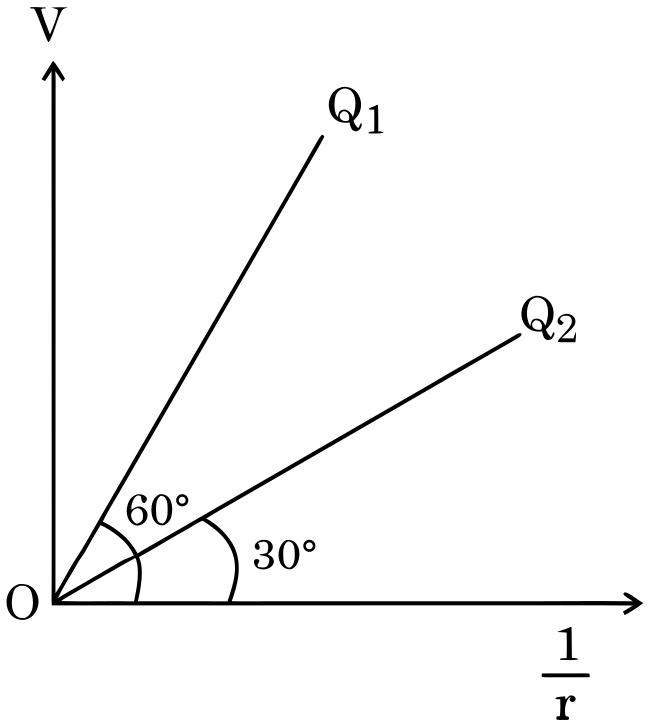
The figure shows the variation of potential V with $\displaystyle \frac{1}{\mathrm{r}}$ for two point charges $\displaystyle \mathrm{Q}_{1}$ and $\displaystyle \mathrm{Q}_{2}$, where V is the potential at a distance r due to a point charge. Find $\displaystyle \frac{\mathrm{Q}_{1}}{\mathrm{Q}_{2}}$.
An electric dipole of dipole moment of $\displaystyle 6 \times 10^{-7} \mathrm{C}-\mathrm{m}$ is kept in a uniform electric field of $\displaystyle 10^{4} \mathrm{~N} / \mathrm{C}$ such that the dipole moment and the electric field are parallel. Calculate the potential energy of the dipole.
An electric dipole of dipole moment $\displaystyle \overrightarrow{\mathrm{p}}$ is initially kept in a uniform electric field $\displaystyle \overrightarrow{\mathrm{E}}$ such that $\displaystyle \overrightarrow{\mathrm{p}}$ is perpendicular to $\displaystyle \overrightarrow{\mathrm{E}}$. Find the amount of work done in rotating the dipole to a position at which $\displaystyle \overrightarrow{\mathrm{p}}$ becomes antiparallel to $\displaystyle \overrightarrow{\mathrm{E}}$.
Marking-scheme solution
(a)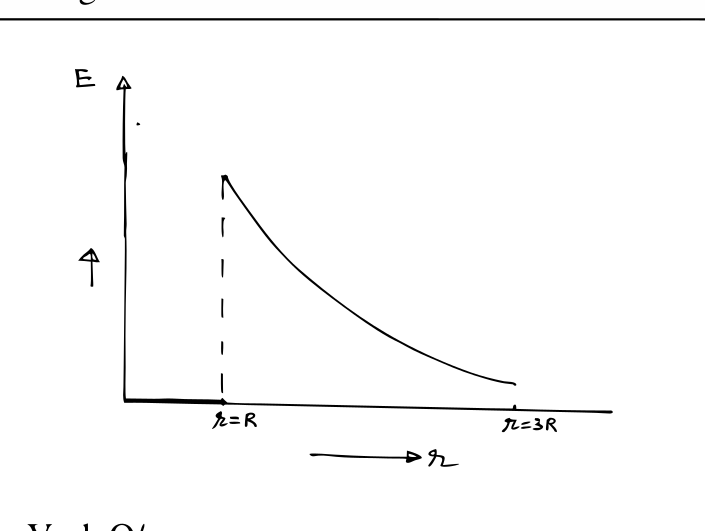
(b)
$\displaystyle \because\ V = kQ/r$
Slope of graph is proportional to Q
$$\frac{Q_1}{Q_2} = \frac{\tan 60^{0}}{\tan 30^{0}} = 3$$
(c)
$\displaystyle U = -\,p\,E\cos\theta$
$\displaystyle \theta = 0^{0}$
$\displaystyle U = -\,(6 \times 10^{-7}) \times (10^{4})$
$\displaystyle U = -\,6 \times 10^{-3}\ \text{J}$
OR$\displaystyle \because$ Work done $\displaystyle W = -\,p\,E\,(\cos\theta_2 - \cos\theta_1)$
where $\displaystyle \theta_2 = 180^\circ$, $\displaystyle \theta_1 = 90^\circ$
$\displaystyle \Rightarrow W = -\,p\,E\,(\cos 180^\circ - \cos 90^\circ)$
$\displaystyle W = +\,p\,E$
All Electric Charges and Fields questions2023 question paperNCERT solutions: Electric Charges and FieldsPractice Electric Charges and Fields →
More from Electric Charges and Fields
- (i) Two point charges +q and -q are held at (a, 0) and ( -a, 0 ) in x-y plane. Obtain an expression for the net electric field due to the charges at…2025
- An electric dipole of dipole moment 1.0 × 10^-12 Cm lies along x -axis. An electric field of magnitude 2.0 × 10^4 NC^-1 is switched on at an instant…2025
- An electric dipole consists of two point charges q and -q separated by a distance 2a. Derive an expression for the electric field E due to this…2026
- Depict the orientation of an electric dipole in stable and unstable equilibrium in an external uniform electric field. Write the potential energy of…2023
- (i) Define electric flux and write its SI unit. (ii) Use Gauss' law to obtain the expression for the electric field due to a uniformly charged…2023
- Two small solid metal balls A and B of radii R and 2 R having charge densities 2 σ and 3 σ respectively are kept far apart. Find the charge densities…2025
- Define the term 'electric flux' and write its dimensions. A plane surface, in shape of a square of side 1 cm is placed in an electric field E=(100…2024
- Three small charged spheres X, Y and Z carrying charges +q,-q and +q respectively are placed equidistant from each other, as shown in the figure. The…2024
CBSE Class 12 Physics past-paper question from the 2023 board exam, with the answer as CBSE’s own marking scheme gives it. Where our answers come from.