✓ Board-verified
Physics · 2023 · 3 marks
CBSE 2023 · Region 4 · Set 2 · Q27
(a) (i) In diffraction due to a single slit, the phase difference between light waves reaching a point on the screen is 5 π. Explain whether a bright…
(a)(i)
In diffraction due to a single slit, the phase difference between light waves reaching a point on the screen is $\displaystyle 5 \pi$. Explain whether a bright or a dark fringe will be formed at the point.
(ii)
What should the width (a) of each slit be to obtain eight maxima of two double-slit patterns (slit separation d ) within the central maximum of the single slit pattern?
(iii)
Draw the plot of intensity distribution in a diffraction pattern due to a single slit.
(b)(i)
In a Young's double-slit experiment $\displaystyle \mathrm{SS}_{2}-\mathrm{SS}_{1}=\frac{\lambda}{4}$, where $\displaystyle \mathrm{S}_{1}$ and $\displaystyle \mathrm{S}_{2}$ are the two slits as shown in the figure. Find the path difference $\displaystyle \left(\mathrm{S}_{2} \mathrm{P}-\mathrm{S}_{1} \mathrm{P}\right)$ for constructive and destructive interference at $\displaystyle \mathrm{P}$. 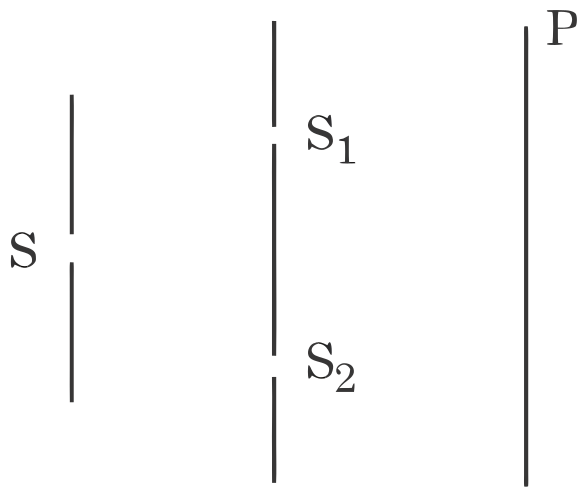
(ii)
What is the effect on the interference fringes in a Young's double-slit experiment, if the monochromatic source S is replaced by a source of white light?
Marking-scheme solution
(a)
For constructive interference \(\displaystyle \Delta \mathrm{x}=\mathrm{n} \lambda\)
\[\therefore\left(\mathrm{S}_{2} \mathrm{P}-\mathrm{S}_{1} \mathrm{P}\right)=\mathrm{n} \lambda-\frac{\lambda}{4}=\lambda(\mathrm{n}-1 / 4)
\]
For destructive interference
\[\begin{aligned}
\Delta \mathrm{x} & =(2 \mathrm{n}-1) \frac{\lambda}{2} \\
\Delta \mathrm{x} & =\frac{\lambda}{4}+\left(\mathrm{S}_{2} \mathrm{P}-\mathrm{S}_{1} \mathrm{P}\right)
\end{aligned}
\](i) For Bright fringe , \(\displaystyle \phi=(2 \mathrm{n}+1) \pi=5 \pi\) for \(\displaystyle \mathrm{n}=2\)
Alternatively:
\[\begin{aligned}
\Delta \phi & =\frac{2 \pi}{\lambda} \times \Delta \mathrm{x} \\
\Delta \mathrm{x} & =\frac{5}{2} \lambda
\end{aligned}
\]
(ii) We want, \(\displaystyle \mathrm{a} \theta=\lambda, \theta=\lambda / \mathrm{a}\)
\[8 \frac{\lambda}{d}=2 \frac{\lambda}{\mathrm{a}} \Rightarrow \mathrm{a}=\frac{d}{4}
\]
More from Wave Optics
- Define 'wavefront' of a light wave. A plane wavefront is refracted from a convex lens. Draw the shape of the refracted wavefront. A plane wave…2025
- A double slit set-up was initially placed in a tank filled with water and the interference pattern was obtained using a laser light. When water is…2025
- The phenomenon of interference is shown by2026
- Assertion: In interference and diffraction of light, light energy reduces in one region producing a dark fringe. It increases in another region and…2024
- Using the Huygens' principle, briefly describe reflection of a plane wavefront from a reflecting surface. Hence, prove the laws of reflection.2025
- Assertion: In a Young's double-slit experiment, interference pattern is not observed when two coherent sources are infinitely close to each other.…2024
- (i) Give any two differences between the interference pattern obtained in Young's double-slit experiment and a diffraction pattern due to a single…2024
- A plane wave-front propagating in a medium of refractive index ' μ_1 ' is incident on a plane surface making an angle of incidence (i). It enters…2023
CBSE Class 12 Physics past-paper question from the 2023 board exam, with the answer as CBSE’s own marking scheme gives it. Where our answers come from.