✓ Board-verified
Physics · 2023 · 4 marks
CBSE 2023 · Region 3 · Set 1 · Q35
Diffraction of light is bending of light around the corners of an object whose size is comparable with the wavelength of light. Diffraction actually…
Diffraction of light is bending of light around the corners of an object whose size is comparable with the wavelength of light. Diffraction actually defines the limits of ray optics. This limit for optical instruments is set by the wavelength of light. An experimental arrangement is set up to observe the diffraction pattern due to a single slit. Answer the following questions based on the above :
(a)
How will the width of central maximum be affected if the wavelength of light is increased?
(b)
Under what condition is the first minimum obtained ?
(c)
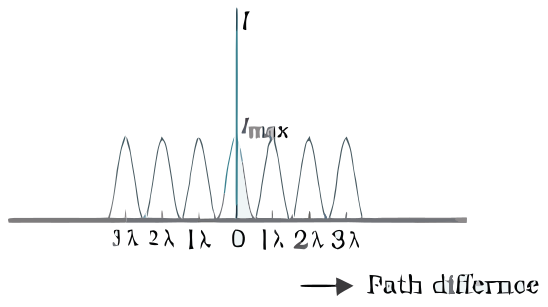
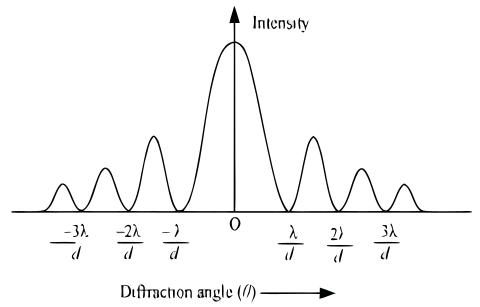
Write two points of difference between interference and diffraction patterns.
OR
(c)
Two students are separated by a $\displaystyle 7$ m partition wall in a room $\displaystyle 10$ m high. If both light and sound waves can bend around obstacles, how is it that the students are unable to see each other even though they can converse easily?
Marking-scheme solution
\begin{itemize}
\item[(a)] \(\displaystyle \beta_{o} \propto \lambda\)
\(\displaystyle \beta_{o}\) will increase with increase in wavelength.
\item[(b)] When path difference \(\displaystyle a \theta=\lambda\) or at an angle ; \(\displaystyle \theta \approx \lambda / a\)
\item[(c)] Differences
|
More from Wave Optics
- Define 'wavefront' of a light wave. A plane wavefront is refracted from a convex lens. Draw the shape of the refracted wavefront. A plane wave…2025
- A double slit set-up was initially placed in a tank filled with water and the interference pattern was obtained using a laser light. When water is…2025
- The phenomenon of interference is shown by2026
- Assertion: In interference and diffraction of light, light energy reduces in one region producing a dark fringe. It increases in another region and…2024
- Using the Huygens' principle, briefly describe reflection of a plane wavefront from a reflecting surface. Hence, prove the laws of reflection.2025
- Assertion: In a Young's double-slit experiment, interference pattern is not observed when two coherent sources are infinitely close to each other.…2024
- (i) Give any two differences between the interference pattern obtained in Young's double-slit experiment and a diffraction pattern due to a single…2024
- A plane wave-front propagating in a medium of refractive index ' μ_1 ' is incident on a plane surface making an angle of incidence (i). It enters…2023
CBSE Class 12 Physics past-paper question from the 2023 board exam, with the answer as CBSE’s own marking scheme gives it. Where our answers come from.