✓ Board-verified
Physics · 2023 · 3 marks
CBSE 2023 · Region 5 · Set 1 · Q30
(a) (i) Differentiate between 'distance of closest approach' and 'impact parameter'. (ii) Determine the distance of closest approach when an alpha…
(a)(i)
Differentiate between 'distance of closest approach' and 'impact parameter'.
(ii)
Determine the distance of closest approach when an alpha particle of kinetic energy $\displaystyle 3.95$ MeV approaches a nucleus of $\displaystyle \mathrm{Z}=79$, stops and reverses its directions.
OR
(b)(i)
State three postulates of Bohr's theory of hydrogen atom.
(ii)
Find the angular momentum of an electron revolving in the second orbit in Bohr's hydrogen atom.
Marking-scheme solution
(a)(i)
Distance of closest approach: It is the minimum distance of α-particle from the centre of nucleus at which its total kinetic energy gets converted into electrostatic potential energy.
Alternatively: Distance of closest approach
\[r_o = \frac{1}{4\pi \varepsilon_o}\frac{2Ze^2}{E_K} \]
Impact parameter: Perpendicular distance of the initial velocity vector of the α-particle from the centre of the nucleus.
Alternatively:
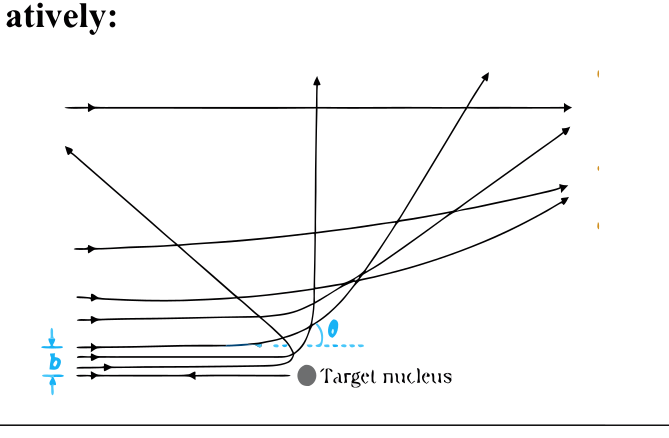
(ii)
\[r_o = \frac{1}{4\pi \varepsilon_o}\frac{2Ze^2}{E_K} \]
\[r_o = \frac{9\times 10^{9}\times 2\times 79\times (1.6\times 10^{-19})^{2}}{3.95\times 1.6\times 10^{-13}} \]
\[= 57.6\times 10^{-15}\, m \]
OR(b) (i)
(1) An electron in an atom revolves in certain stable orbit without the emission of radiant energy.
(2)
The electron revolves around the nucleus only in those orbits for which the angular momentum is integral multiple of $\displaystyle \dfrac{h}{2\pi}$ where h is the Planck's constant.
(3)
When an electron makes a transition from one of its specified non-radiating orbits to another of lower energy orbit a photon is emitted having energy equal to the energy difference between the initial and final states.
(ii)
Angular momentum $\displaystyle = \dfrac{nh}{2\pi}$
For n = $\displaystyle 2$
Angular momentum $\displaystyle = \dfrac{2h}{2\pi}$
\[= \frac{6.63\times 10^{-34}}{\pi} \]
\[= 2.1\times 10^{-34}\ kg\, m^{2} s^{-1} \]
More from Atoms
- Define the term - Distance of closest approach. How will it be affected, for an α - particle, if kinetic energy of the particle is doubled?2022
- Define the'distance of closest approach'. An α -particle of kinetic energy K is bombarded on a thin gold foil. Derive an expression for the'distance…2025
- State Bohr's postulate to explain stable orbits in a hydrogen atom. Prove that the speed with which the electron revolves in n^th orbit is…2022
- In Bohr's model of hydrogen atom, find the percentage change in the radius of its orbit when an electron makes a transition from n=3 state to n=2…2025
- Calculate the de Broglie wavelength associated with an electron revolving in the second excited state of hydrogen atom. The ground state energy of…2026
- State Bohr's first and second postulates. Use them to derive an expression for the radius of the n^th orbit in a hydrogen atom.2024
- Assertion: An alpha particle is moving towards a gold nucleus. The impact parameter is maximum for the scattering angle of 180^°. Reason (R): The…2024
- The radius of the n^th orbit in Bohr model of hydrogen atom is proportional to2023
CBSE Class 12 Physics past-paper question from the 2023 board exam, with the answer as CBSE’s own marking scheme gives it. Where our answers come from.