✓ Board-verified
Physics · 2026 · 4 marks
CBSE 2026 · Region 1 · Set 1 · Q30
A researcher performs an experiment on photo-electric effect using two metals A and B with unknown work functions. She illuminates the surfaces of A…
A researcher performs an experiment on photo-electric effect using two metals A and B with unknown work functions. She illuminates the surfaces of A and B with monochromatic radiation of various frequencies and records the value of corrosponding stopping potentials $\displaystyle \left(\mathrm{V}_{\mathrm{s}}\right)$. The graph shows the variation of stopping potential $\displaystyle \left(\mathrm{V}_{\mathrm{s}}\right)$ with the frequency of incident radiation ( $\displaystyle \mathrm{v}$ ) for metals A and B.
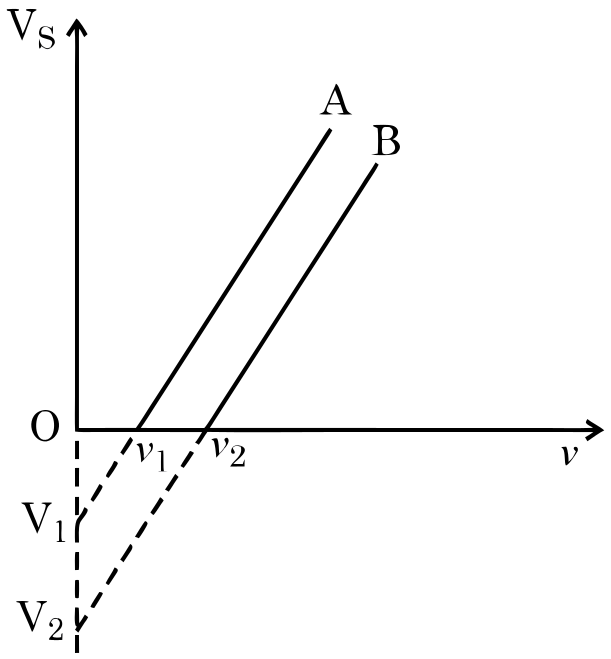
Answer the following questions :
(I)
From the graph, the work functions of A and B are (h is Planck's constant and e value of charge on an electron)
(A)
$\displaystyle \mathrm{v}_{1}$ and $\displaystyle \mathrm{v}_{2}$
(B)
$\displaystyle \mathrm{V}_{1}$ and $\displaystyle \mathrm{V}_{2}$
(C)
$\displaystyle \mathrm{h} \mathrm{v}_{1}$ and $\displaystyle \mathrm{h} \mathrm{v}_{2}$
(D)
$\displaystyle \frac{\mathrm{h} \mathrm{v}_{1}}{\mathrm{e}}$ and $\displaystyle \frac{\mathrm{h} \mathrm{v}_{2}}{\mathrm{e}}$
(II)
For radiation of frequency $\displaystyle \mathrm{v}>\mathrm{v}_{2}$ incident on the surfaces of A and B, the maximum kinetic energy of ejected electron is
(A)
greater for metal A because it has a smaller work function.
(B)
greater for metal B because it has a larger work function.
(C)
greater for metal B because it has higher threshold frequency.
(D)
the same for both metal A and metal B because it is independent of work functions of metals.
(III)
If the intensity of the incident radiation for both metals A and B, is doubled keeping its frequency constant, then
(A)
the slope of the parallel lines will increase.
(B)
the slope of the parallel lines will decrease.
(C)
the threshold frequencies for both A and B will decrease.
(D)
the slope of the parallel lines will not change but more electrons will be emitted per second.
(IV)
The threshold frequency for a metal surface is $\displaystyle \mathrm{v}_{0}$. If the radiation of frequency $\displaystyle 3 \mathrm{v}_{0}$ illuminates the surface, the maximum kinetic energy (KE) of photoelectrons is $\displaystyle \mathrm{E}_{1}$. If the frequency were increased to $\displaystyle 6 \mathrm{v}_{0}$, the maximum KE of the photoelectrons becomes $\displaystyle \mathrm{E}_{2}$. Then $\displaystyle \left(\frac{\mathrm{E}_{1}}{\mathrm{E}_{2}}\right)$ equals
(A)
$\displaystyle 1$/$\displaystyle 3$
(B)
$\displaystyle 1$/$\displaystyle 2$
(C)
$\displaystyle 2$/$\displaystyle 5$
(D)
$\displaystyle 3$/$\displaystyle 4$
OR Let m be the slope of the graph line for metal B. If e is the value of electron charge, then Planck's constant ' $\displaystyle \mathrm{h}$ ' is given by
(A)
me
(B)
$\displaystyle \frac{1}{\mathrm{me}}$
(C)
$\displaystyle \frac{\mathrm{m}}{\mathrm{e}}$
(D)
$\displaystyle \frac{\mathrm{e}}{\mathrm{m}}$
Marking-scheme solution
(I)(C)
$\displaystyle \mathrm{h} \nu_{1}$ and $\displaystyle \mathrm{h} \nu_{2}$
(II)(A)
greater for metal A because it has a smaller work function.
(III)(D)
the slope of the parallel lines will not change but more electrons will be emitted per second.
(IV)
(C)
$\displaystyle \dfrac{2}{5}$
OR
(A)
$\displaystyle m_{e}$
All Dual Nature of Radiation and Matter questions2026 question paperNCERT solutions: Dual Nature of Radiation and MatterPractice Dual Nature of Radiation and Matter →
More from Dual Nature of Radiation and Matter
- The de-Broglie wavelength associated with an electron is 0.30 nm. Calculate: the speed, and the kinetic energy (in eV), of the electron.2022
- In a photoelectric experiment, the emitter plate is irradiated with radiation of 200 nm. The photocurrent becomes zero when the collector plate…2026
- Draw a plot of frequency v of incident radiations as a function of stopping potential V_0 for a given photo emissive material. What information can…2025
- A particle is associated with a de Broglie wave of wavelength 1.2 nm. The kinetic energy of the particle is made four times. Calculate the new value…2023
- de Broglie wavelength λ as a function of 1/(√ K), for two particles of masses m_1 and m_2 are shown in the figure. Here, K is the energy of the…2024
- The energy of a photon of wavelength 663 nm is2023
- Consider a neutron (mass m ) of kinetic energy E and a photon of the same energy. Let λ_n and λ_p be the de Broglie wavelength of neutron and the…2024
- Mention any three features of results of experiment on photoelectric effect which cannot be explained using the wave theory of light. In his…2025
CBSE Class 12 Physics past-paper question from the 2026 board exam, with the answer as CBSE’s own marking scheme gives it. Where our answers come from.