✓ Board-verified
Mathematics · 2025 · 4 marks
CBSE 2025 · Region 7 · Set 1 · Q36
Three friends A, B and C move out from the same location O at the same time in three different directions to reach their destinations. They move out…
Three friends $\displaystyle \mathrm{A}, \mathrm{B}$ and C move out from the same location O at the same time in three different directions to reach their destinations. They move out on straight paths and decide that A and B after reaching their destinations will meet up with C at his predecided destination, following straight paths from $\displaystyle \mathrm{A}$ to $\displaystyle C$ and $\displaystyle \mathrm{B}$ to $\displaystyle C$ in such a way that $\displaystyle \overrightarrow{O \mathrm{A}}=\vec{\mathrm{a}}$, $\displaystyle \overrightarrow{\mathrm{OB}}=\overrightarrow{\mathrm{b}}$ and $\displaystyle \overrightarrow{\mathrm{OC}}=5 \overrightarrow{\mathrm{a}}-2 \overrightarrow{\mathrm{~b}}$ respectively.
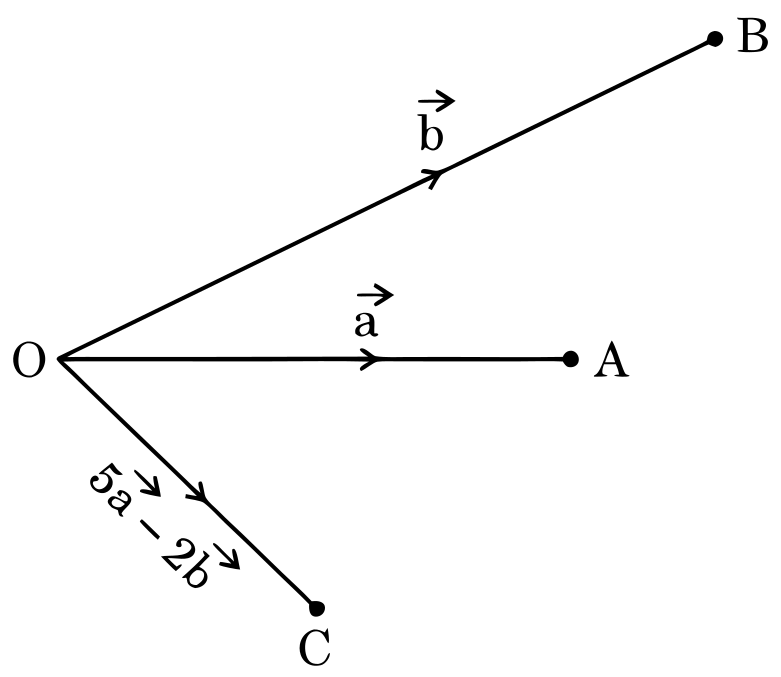
Based upon the above information, answer the following questions :
(i)
Complete the given figure to explain their entire movement plan along the respective vectors. Case Study - $\displaystyle 2$
Marking-scheme solution
(i) The Complete figure of their entire movement plan is: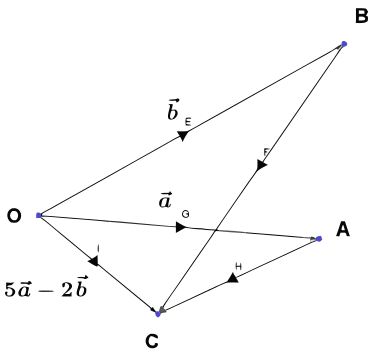
(ii) \(\displaystyle \overrightarrow{\mathbf{A C}}=\overrightarrow{\mathbf{O C}}-\overrightarrow{\mathbf{O A}}=\mathbf{4} \overrightarrow{\mathbf{a}}-\mathbf{2 b}, \overrightarrow{\mathbf{B C}}=\overrightarrow{\mathbf{O C}}-\overrightarrow{\mathbf{O B}}=\mathbf{5} \overrightarrow{\mathbf{a}}-\mathbf{3} \overrightarrow{\mathbf{b}}\)
(iii) (a) we are given:
\[\begin{array}{r}
\theta=\cos ^{-1}\left(\frac{\overrightarrow{\mathbf{a}} \cdot \overrightarrow{\mathbf{b}}}{|\overrightarrow{\mathbf{a}}||\overrightarrow{\mathbf{b}}|}\right)=\cos ^{-1} \frac{1}{1 \times 2}=\cos ^{-1} \frac{1}{2} \\
|\overrightarrow{\mathbf{a}} \times \overrightarrow{\mathbf{b}}|=|\overrightarrow{\mathbf{a}}||\overrightarrow{\mathbf{b}}| \sin \theta=1(2) \frac{\sqrt{3}}{2}=\sqrt{3}
\end{array}
\]
All Vector Algebra questions2025 question paperNCERT solutions: Vector AlgebraPractice Vector Algebra →
More from Vector Algebra
- If a and b are two non-collinear vectors, then find x, such that α=(x-2) a+ b and β=(3+2 x) a-2 b are collinear.2025
- If a+ b+ c= 0 such that | a|=3,| b|=5,| c|=7, then find the angle between a and b. OR If a and b are unit vectors inclined with each other at an…2025
- Find a vector of magnitude 4 units perpendicular to each of the vectors 2 i- j+ k and i+ j- k and hence verify your answer.2024
- The position vectors of points P and Q are p and q respectively. The point R divides line segment PQ in the ratio 3: 1 and S is the mid-point of line…2024
- If | a × b|=√3 and a · b=-3, then angle between a and b is2023
- Let p and q be two unit vectors and α be the angle between them. Then ( p+ q) will be a unit vector for what value of α?2025
- Using vectors, find the value of 'b' if the points A(-1, -1, 2), B(2, b, 5) and C(3, 11, 6) are collinear. Also, determine the ratio in which the…2022
- If PQ × PR=4 i+8 j-8 k, then the area ( PQR ) is2025
CBSE Class 12 Mathematics past-paper question from the 2025 board exam, with the answer as CBSE’s own marking scheme gives it. Where our answers come from.