✓ Board-verified
Mathematics · 2025 · 5 marks
CBSE 2025 · Region 4 · Set 1 · Q35
(a) Show that the area of a parallelogram whose diagonals are represented by a and b is given by 1/2| a × b |. Also find the area of a parallelogram…
Show that the area of a parallelogram whose diagonals are represented by $\displaystyle \overrightarrow{\mathrm{a}}$ and $\displaystyle \overrightarrow{\mathrm{b}}$ is given by $\displaystyle \frac{1}{2}|\overrightarrow{\mathrm{a}} \times \overrightarrow{\mathrm{b}}|$. Also find the area of a parallelogram whose diagonals are $\displaystyle 2 \hat{\mathrm{i}}-\hat{\mathrm{j}}+\hat{\mathrm{k}}$ and $\displaystyle \hat{\mathrm{i}}+3 \hat{\mathrm{j}}-\hat{\mathrm{k}}$.
Find the equation of a line in vector and cartesian form which passes through the point ( $\displaystyle 1,2,-4$ ) and is perpendicular to the lines $\displaystyle \frac{x-8}{3}=\frac{y+19}{-16}=\frac{z-10}{7}$, and $\displaystyle \vec{r}=15 \hat{\mathrm{i}}+29 \hat{\mathrm{j}}+5 \hat{\mathrm{k}}+\mu(3 \hat{\mathrm{i}}+8 \hat{\mathrm{j}}-5 \hat{\mathrm{k}})$.
Marking-scheme solution
Let $\displaystyle A B C D$ be the parallelogram with diagonals $\displaystyle \overrightarrow{A B}=\vec{\mathrm{a}}$ and $\displaystyle \overrightarrow{B D}=\vec{\mathrm{b}}$.
$\displaystyle \therefore \overrightarrow{A B}=\frac{1}{2}(\vec{\mathrm{a}}-\vec{\mathrm{b}})$ and $\displaystyle \overrightarrow{A D}=\frac{1}{2}(\vec{\mathrm{a}}+\vec{\mathrm{b}})$
Area of $\displaystyle A B C D$
$\displaystyle =|\overrightarrow{A B} \times \overrightarrow{A D}|$
$\displaystyle =\left|\frac{1}{2}(\vec{\mathrm{a}}-\vec{\mathrm{b}}) \times \frac{1}{2}(\vec{\mathrm{a}}+\vec{\mathrm{b}})\right|$
$\displaystyle =\frac{1}{4}|\vec{\mathrm{a}} \times \vec{\mathrm{a}}+\vec{\mathrm{a}} \times \vec{\mathrm{b}}-\vec{\mathrm{b}} \times \vec{\mathrm{a}}-\vec{\mathrm{b}} \times \vec{\mathrm{b}}|$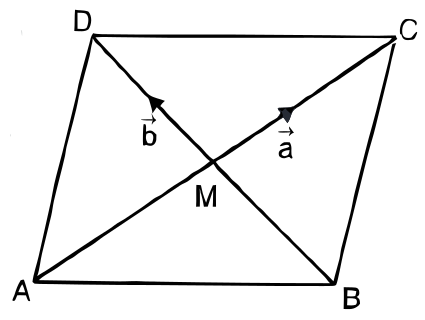 Given lines are $\displaystyle \frac{x-8}{3}=\frac{y+19}{-16}=\frac{z-10}{7}$
and $\displaystyle \vec{r}=(15 \hat{\mathrm{i}}+29 \hat{\mathrm{j}}+5 \hat{\mathrm{k}})+\mu(3 \hat{\mathrm{i}}+8 \hat{\mathrm{j}}-5 \hat{\mathrm{k}})$
The first line in vector form is $\displaystyle \vec{r}=(8 \hat{\mathrm{i}}-19 \hat{\mathrm{j}}+10 \hat{\mathrm{k}})+\lambda(3 \hat{\mathrm{i}}-16 \hat{\mathrm{j}}+7 \hat{\mathrm{k}})$
\[\vec{\mathrm{a}}_{1}=8 \hat{\mathrm{i}}-19 \hat{\mathrm{j}}+10 \hat{\mathrm{k}}, \vec{\mathrm{a}}_{2}=15 \hat{\mathrm{i}}+29 \hat{\mathrm{j}}+5 \hat{\mathrm{k}}
\]
$\displaystyle \vec{\mathrm{b}}_{1}=3 \hat{\mathrm{i}}-16 \hat{\mathrm{j}}+7 \hat{\mathrm{k}}, \vec{\mathrm{b}}_{2}=3 \hat{\mathrm{i}}+8 \hat{\mathrm{j}}-5 \hat{\mathrm{k}}$
$\displaystyle \vec{\mathrm{b}}_{1} \times \vec{\mathrm{b}}_{2}=\left|\begin{array}{ccc} \hat{\mathrm{i}} & \hat{\mathrm{j}} & \hat{\mathrm{k}} \\ 3 & -16 & 7 \\ 3 & 8 & -5 \end{array}\right|=24 \hat{\mathrm{i}}+36 \hat{\mathrm{j}}+72 \hat{\mathrm{k}}$
∴ Equation of line passing through ( $\displaystyle 1,2,-4$ ) and parallel to $\displaystyle \vec{\mathrm{b}}$ is
\[\vec{r}=(\hat{\mathrm{i}}+2 \hat{\mathrm{j}}-4 \hat{\mathrm{k}})+t(24 \hat{\mathrm{i}}+36 \hat{\mathrm{j}}+72 \hat{\mathrm{k}}) \text { or } \vec{r}=(\hat{\mathrm{i}}+2 \hat{\mathrm{j}}-4 \hat{\mathrm{k}})+t^{\prime}(2 \hat{\mathrm{i}}+3 \hat{\mathrm{j}}+6 \hat{\mathrm{k}})
\]
Cartesian formof lineis $\displaystyle \frac{x-1}{24}=\frac{y-2}{36}=\frac{z+4}{72}$ or $\displaystyle \frac{x-1}{2}=\frac{y-2}{3}=\frac{z+4}{6}$
Given lines are $\displaystyle \frac{x-8}{3}=\frac{y+19}{-16}=\frac{z-10}{7}$
and $\displaystyle \vec{r}=(15 \hat{\mathrm{i}}+29 \hat{\mathrm{j}}+5 \hat{\mathrm{k}})+\mu(3 \hat{\mathrm{i}}+8 \hat{\mathrm{j}}-5 \hat{\mathrm{k}})$
The first line in vector form is $\displaystyle \vec{r}=(8 \hat{\mathrm{i}}-19 \hat{\mathrm{j}}+10 \hat{\mathrm{k}})+\lambda(3 \hat{\mathrm{i}}-16 \hat{\mathrm{j}}+7 \hat{\mathrm{k}})$
\[\vec{\mathrm{a}}_{1}=8 \hat{\mathrm{i}}-19 \hat{\mathrm{j}}+10 \hat{\mathrm{k}}, \vec{\mathrm{a}}_{2}=15 \hat{\mathrm{i}}+29 \hat{\mathrm{j}}+5 \hat{\mathrm{k}}
\]
$\displaystyle \vec{\mathrm{b}}_{1}=3 \hat{\mathrm{i}}-16 \hat{\mathrm{j}}+7 \hat{\mathrm{k}}, \vec{\mathrm{b}}_{2}=3 \hat{\mathrm{i}}+8 \hat{\mathrm{j}}-5 \hat{\mathrm{k}}$
$\displaystyle \vec{\mathrm{b}}_{1} \times \vec{\mathrm{b}}_{2}=\left|\begin{array}{ccc} \hat{\mathrm{i}} & \hat{\mathrm{j}} & \hat{\mathrm{k}} \\ 3 & -16 & 7 \\ 3 & 8 & -5 \end{array}\right|=24 \hat{\mathrm{i}}+36 \hat{\mathrm{j}}+72 \hat{\mathrm{k}}$
∴ Equation of line passing through ( $\displaystyle 1,2,-4$ ) and parallel to $\displaystyle \vec{\mathrm{b}}$ is
\[\vec{r}=(\hat{\mathrm{i}}+2 \hat{\mathrm{j}}-4 \hat{\mathrm{k}})+t(24 \hat{\mathrm{i}}+36 \hat{\mathrm{j}}+72 \hat{\mathrm{k}}) \text { or } \vec{r}=(\hat{\mathrm{i}}+2 \hat{\mathrm{j}}-4 \hat{\mathrm{k}})+t^{\prime}(2 \hat{\mathrm{i}}+3 \hat{\mathrm{j}}+6 \hat{\mathrm{k}})
\]
Cartesian formof lineis $\displaystyle \frac{x-1}{24}=\frac{y-2}{36}=\frac{z+4}{72}$ or $\displaystyle \frac{x-1}{2}=\frac{y-2}{3}=\frac{z+4}{6}$
Given lines are $\displaystyle \frac{x-8}{3}=\frac{y+19}{-16}=\frac{z-10}{7}$
and $\displaystyle \vec{r}=(15 \hat{\mathrm{i}}+29 \hat{\mathrm{j}}+5 \hat{\mathrm{k}})+\mu(3 \hat{\mathrm{i}}+8 \hat{\mathrm{j}}-5 \hat{\mathrm{k}})$
The first line in vector form is $\displaystyle \vec{r}=(8 \hat{\mathrm{i}}-19 \hat{\mathrm{j}}+10 \hat{\mathrm{k}})+\lambda(3 \hat{\mathrm{i}}-16 \hat{\mathrm{j}}+7 \hat{\mathrm{k}})$
\[\vec{\mathrm{a}}_{1}=8 \hat{\mathrm{i}}-19 \hat{\mathrm{j}}+10 \hat{\mathrm{k}}, \vec{\mathrm{a}}_{2}=15 \hat{\mathrm{i}}+29 \hat{\mathrm{j}}+5 \hat{\mathrm{k}}
\]
$\displaystyle \vec{\mathrm{b}}_{1}=3 \hat{\mathrm{i}}-16 \hat{\mathrm{j}}+7 \hat{\mathrm{k}}, \vec{\mathrm{b}}_{2}=3 \hat{\mathrm{i}}+8 \hat{\mathrm{j}}-5 \hat{\mathrm{k}}$
$\displaystyle \vec{\mathrm{b}}_{1} \times \vec{\mathrm{b}}_{2}=\left|\begin{array}{ccc} \hat{\mathrm{i}} & \hat{\mathrm{j}} & \hat{\mathrm{k}} \\ 3 & -16 & 7 \\ 3 & 8 & -5 \end{array}\right|=24 \hat{\mathrm{i}}+36 \hat{\mathrm{j}}+72 \hat{\mathrm{k}}$
∴ Equation of line passing through ( $\displaystyle 1,2,-4$ ) and parallel to $\displaystyle \vec{\mathrm{b}}$ is
\[\vec{r}=(\hat{\mathrm{i}}+2 \hat{\mathrm{j}}-4 \hat{\mathrm{k}})+t(24 \hat{\mathrm{i}}+36 \hat{\mathrm{j}}+72 \hat{\mathrm{k}}) \text { or } \vec{r}=(\hat{\mathrm{i}}+2 \hat{\mathrm{j}}-4 \hat{\mathrm{k}})+t^{\prime}(2 \hat{\mathrm{i}}+3 \hat{\mathrm{j}}+6 \hat{\mathrm{k}})
\]
Cartesian formof lineis $\displaystyle \frac{x-1}{24}=\frac{y-2}{36}=\frac{z+4}{72}$ or $\displaystyle \frac{x-1}{2}=\frac{y-2}{3}=\frac{z+4}{6}$All Vector Algebra questions2025 question paperNCERT solutions: Vector AlgebraPractice Vector Algebra →
More from Vector Algebra
- If a and b are two non-collinear vectors, then find x, such that α=(x-2) a+ b and β=(3+2 x) a-2 b are collinear.2025
- Three friends A, B and C move out from the same location O at the same time in three different directions to reach their destinations. They move out…2025
- If a+ b+ c= 0 such that | a|=3,| b|=5,| c|=7, then find the angle between a and b. OR If a and b are unit vectors inclined with each other at an…2025
- Find a vector of magnitude 4 units perpendicular to each of the vectors 2 i- j+ k and i+ j- k and hence verify your answer.2024
- The position vectors of points P and Q are p and q respectively. The point R divides line segment PQ in the ratio 3: 1 and S is the mid-point of line…2024
- If | a × b|=√3 and a · b=-3, then angle between a and b is2023
- Let p and q be two unit vectors and α be the angle between them. Then ( p+ q) will be a unit vector for what value of α?2025
- Using vectors, find the value of 'b' if the points A(-1, -1, 2), B(2, b, 5) and C(3, 11, 6) are collinear. Also, determine the ratio in which the…2022
CBSE Class 12 Mathematics past-paper question from the 2025 board exam, with the answer as CBSE’s own marking scheme gives it. Where our answers come from.