✓ Board-verified
Mathematics · 2024 · 4 marks
Inverse Trigonometric FunctionsBasic Concepts of Inverse Trigonometric Functions4 marksApplycase study
CBSE 2024 · Region 1 · Set 3 · Q36
If a function f: X → Y defined as f ( x )= y is one-one and onto, then we can define a unique function g: Y → X such that g( y )= x, where x ∈ X and…
If a function $\displaystyle \mathrm{f}: \mathrm{X} \rightarrow \mathrm{Y}$ defined as $\displaystyle \mathrm{f}(\mathrm{x})=\mathrm{y}$ is one-one and onto, then we can define a unique function $\displaystyle g: \mathrm{Y} \rightarrow \mathrm{X}$ such that $\displaystyle g(\mathrm{y})=\mathrm{x}$, where $\displaystyle \mathrm{x} \in \mathrm{X}$ and $\displaystyle \mathrm{y}=\mathrm{f}(\mathrm{x}), \mathrm{y} \in \mathrm{Y}$. Function $\displaystyle g$ is called the inverse of function $\displaystyle \mathrm{f}$. The domain of sine function is $\displaystyle R$ and function sine $\displaystyle : R \rightarrow R$ is neither one-one nor onto. The following graph shows the sine function.
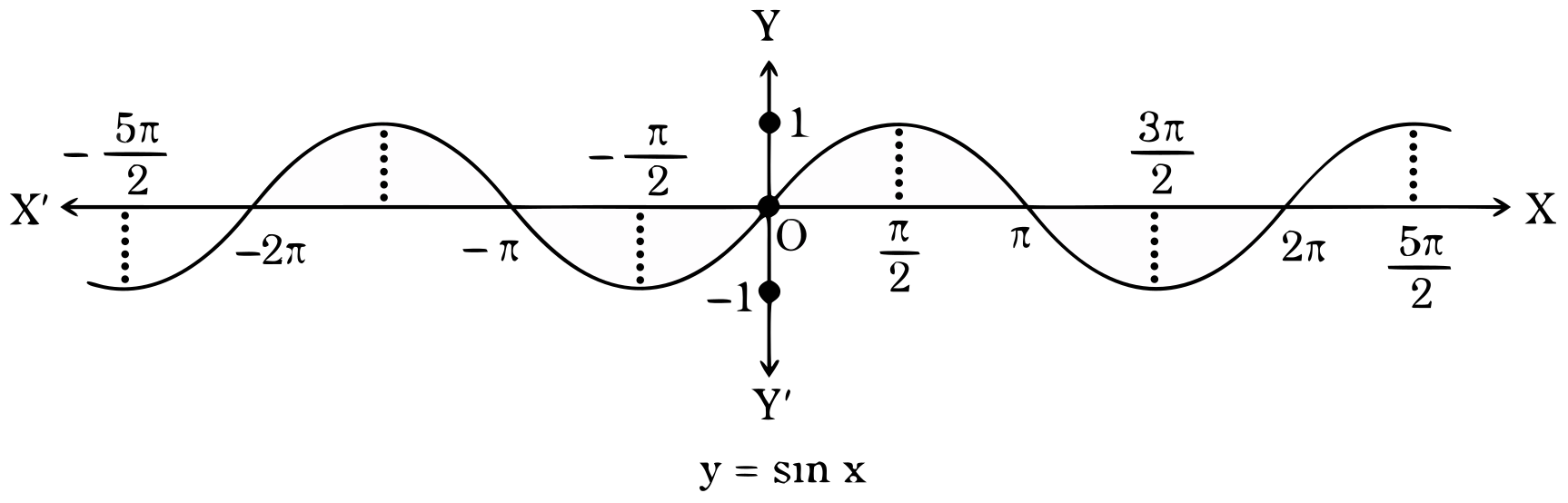
Let sine function be defined from set A to $\displaystyle [-1,1]$ such that inverse of sine function exists, i.e., $\displaystyle \sin ^{-1} \mathrm{x}$ is defined from $\displaystyle [-1,1]$ to A . On the basis of the above information, answer the following questions :
(i)
If A is the interval other than principal value branch, give an example of one such interval.
(ii)
If $\displaystyle \sin ^{-1}(\mathrm{x})$ is defined from [-$\displaystyle 1,1$] to its principal value branch, find the value of $\displaystyle \sin ^{-1}\left(-\frac{1}{2}\right)-\sin ^{-1}(1)$.
(iii)
(a)
Draw the graph of $\displaystyle \sin ^{-1} \mathrm{x}$ from $\displaystyle [-1,1]$ to its principal value branch.
OR
(b)
Find the domain and range of $\displaystyle \mathrm{f}(\mathrm{x})=2 \sin ^{-1}(1-\mathrm{x})$. Case Study - $\displaystyle 2$
Marking-scheme solution
(i)
$\displaystyle \left[\frac{\pi}{2}, \frac{3 \pi}{2}\right]$ or any other interval corresponding to the domain $\displaystyle [-1,1]$
(ii)
$\displaystyle \boldsymbol{\operatorname { s i n }}^{-\mathbf{1}}\left(\frac{-\mathbf{1}}{2}\right)-\boldsymbol{\operatorname { s i n }}^{-\mathbf{1}}(\mathbf{1})$
$$\begin{aligned}
& =\frac{-\pi}{6}-\frac{\pi}{2}
& =\frac{-4 \pi}{6} \text { or } \frac{-2 \pi}{3}
\end{aligned}
All Inverse Trigonometric Functions questions2024 question paperNCERT solutions: Inverse Trigonometric FunctionsPractice Inverse Trigonometric Functions →
More from Inverse Trigonometric Functions
- Find the domain of g(x)= cos^-1(x^2-1). Hence, find the value of x for which g(x)=(π)/3. Also, write the range of cos^-1 x other than its principal…2026
- The principal value of cot^-1(-1/(√3)) is:2025
- Evaluate sin^-1( sin (3 π)/4)+ cos^-1( cos π)+ tan^-1(1) OR Draw the graph of cos^-1 x, where x ∈[-1,0]. Also, write its range. 22023
- The principal value of sec^-1(√2)+2 cosec^-1(-√2) is:2026
- Assertion: Maximum value of ( cos^-1 x)^2 is π^2. Reason (R): Range of the principal value branch of cos^-1 x is [(-π)/2, (π)/2].2023
- The value of cos ((π)/6+ cot^-1(-√3)) is2025
- Find the value of [ sin^2{ cos^-1(3/5)}+ tan^2{ sec^-1(3)}].2024
- Write the domain and range (principle value branch) of the following functions: f(x)= tan^-1 x2023
CBSE Class 12 Mathematics past-paper question from the 2024 board exam, with the answer as CBSE’s own marking scheme gives it. Where our answers come from.