‹ PrevQuestion 141 / 141 · latest first
✓ Board-verified
Chemistry · 2022 · 5 marks
CBSE 2022 · Region 5 · Set 1 · Q12
Read the passage given below and answer the questions that follow: Oxidation-reduction reactions are commonly known as redox reactions. They involve…
Read the passage given below and answer the questions that follow:
Oxidation-reduction reactions are commonly known as redox reactions. They involve transfer of electrons from one species to another. In a spontaneous reaction, energy is released which can be used to do useful work. The reaction is split into two half reactions. Two different containers are used and a wire is used to drive the electrons from one side to the other and a Voltaic/Galvanic cell is created. It is an electrochemical cell that uses spontaneous redox reactions to generate electricity. A salt bridge also connects to the half cells. The reading of the voltmeter gives the cell voltage or cell potential or electromotive force. If $\displaystyle \mathrm{E}_{\text {cell }}^{\mathrm{o}}$ is positive the reaction is spontaneous and if it is negative the reaction is non-spontaneous and is referred to as electrolytic cell. Electrolysis refers to the decomposition of a substance by an electric current. One mole of electric charge when passed through a cell will discharge half a mole of a divalent metal ion such as $\displaystyle \mathrm{Cu}^{2+}$. This was first formulated by Faraday in the form of laws of electrolysis. The conductance of material is the property of materials due to which a material allows the flow of ions through itself and thus conducts electricity. Conductivity is represented by k and it depends upon nature and concentration of electrolyte, temperature etc. A more common term molar conductivity of a solution at a given concentration is conductance of the volume of solution containing one mole of electrolyte kept between two electrodes with the unit area of cross-section and distance of unit length. Limiting molar conductivity of weak electrolytes cannot be obtained graphically.
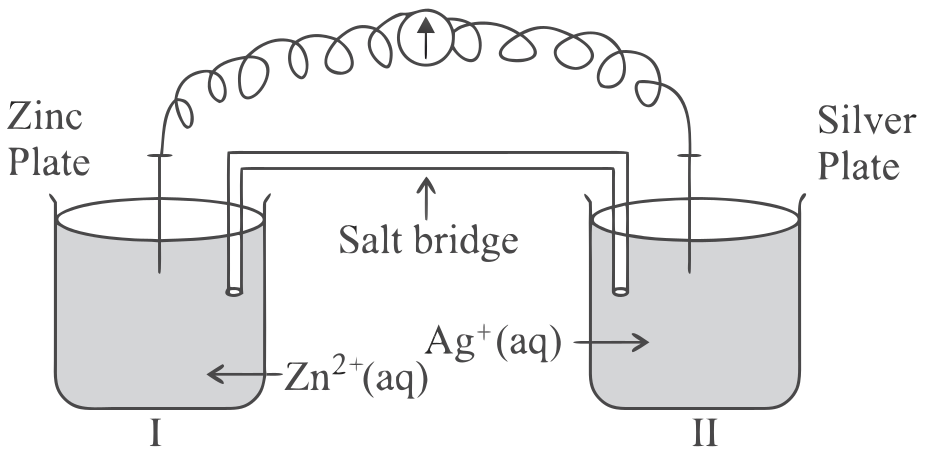
(a)
Is silver plate the anode or cathode? $\displaystyle 1$
(b)
What will happen if the salt bridge is removed? $\displaystyle 1$
(c)
When does electrochemical cell behaves like an electrolytic cell? $\displaystyle 1$
(d)(i)
What will happen to the concentration of $\displaystyle \mathrm{Zn}^{2+}$ and $\displaystyle \mathrm{Ag}^{+}$when $\displaystyle \mathrm{E}_{\text {cell }}=0$.
(ii)
Why does conductivity of a solution decreases with dilution?
OR
(d)
The molar conductivity of a $\displaystyle 1.5$ M solution of an electrolyte is found to be $\displaystyle 138.9 \mathrm{~S} \mathrm{~cm}^{2} \mathrm{~mol}^{-1}$. Calculate the conductivity of this solution.
Marking-scheme solution
(a)
Ag acts as cathode
(b)
Cell will stop working /No current flows / \(\displaystyle \mathrm{E}_{\text {cell }}\) become zero / Electrical neutrality gets disturbed.
(c)
\(\displaystyle E_{\text {external }}>E_{\text {cell }} / \mathrm{E}_{\text {ext }}>\mathrm{E}_{\text {int }}\).
(d)(i)
Concentration of \(\displaystyle \mathrm{Zn}^{2+}\) and \(\displaystyle \mathrm{Ag}^{+}\)ions will not change / Cell attains equilibrium.
(ii)
Because the number of ions per unit volume decreases.
\[\mathbf{\Lambda}_{m}=\frac{\kappa \times 1000}{M}
\]
\(\displaystyle \kappa=\frac{\mathbf{\Lambda}_{m} \times M}{1000}\)
\[\kappa=\frac{1389 \mathrm{~S} \mathrm{~cm}^{2} \mathrm{~mol}^{-1} \times 15 \mathrm{~mol} \mathrm{~L}^{-1}}{1000 \mathrm{~cm}^{3} \mathrm{~L}^{-1}}
\]
\(\displaystyle =0.208 \mathrm{~S} \mathrm{~cm}^{-1}\)
All Electrochemistry questions2022 question paperNCERT solutions: ElectrochemistryPractice Electrochemistry →
More from Electrochemistry
- Kohlrausch gave the following relation for strong electrolytes: Λ_m=Λ_m^°-A √C Which of the following equality holds true?2025 · asked 2×
- Assertion: E_Cu^° 2+/ Cu is positive (+0.34 V). Reason (R): Copper has high Δ_a H^° and low Δ_hyd H^°.2023 · asked 2×
- During the electrolysis of aqueous NaCl, the cathodic reaction is:2024
- Calculate the standard Gibbs energy (Δ_r G^°) of the following reaction at 25 °C: 3 + 2 Au( s)+Ca^2+(1 M) → Au^3+(1 M)+Ca( s); E_Au^3+ / Au^°=+1.5 V,…2025
- (i) What should be the signs (positive/negative) for E^°_Cell and Δ G^° for a spontaneous redox reaction occurring under standard conditions? (ii)…2023
- Batteries and fuel cells are very useful forms of galvanic cell. Any battery or cell that we use as a source of electrical energy is basically a…2024
- (i) Why on dilution the Λ_m of CH_3 COOH increases very fast, while that of CH_3 COONa increases gradually? (ii) What happens if external potential…2022
- During electrolysis of dilute H_2 SO_4, using platinum electrodes, the gas evolved at the anode is:2025
CBSE Class 12 Chemistry past-paper question from the 2022 board exam, with the answer as CBSE’s own marking scheme gives it. Where our answers come from.