✓ Board-verified
Chemistry · 2023 · 3 marks
CBSE 2023 · Region 4 · Set 1 · Q28
Answer any three of the following questions: (a) Explain the type of hybridization in [ Fe ( CN )_6]^3- on the basis of valence bond theory. (Given:…
Answer any three of the following questions :
(a)
Explain the type of hybridization in $\displaystyle \left[\mathrm{Fe}(\mathrm{CN})_{6}\right]^{3-}$ on the basis of valence bond theory. (Given : Atomic number of $\displaystyle \mathrm{Fe}=26$ )
(b)
Draw the geometrical isomers of $\displaystyle \left[\mathrm{PtCl}_{2}(\mathrm{en})_{2}\right]^{2+}$ ion.
(c)
$\displaystyle \left[\mathrm{NiCl}_{4}\right]^{2-}$ is paramagnetic while $\displaystyle \left[\mathrm{Ni}(\mathrm{CO})_{4}\right]$ is diamagnetic though both are tetrahedral. Why ?
(d)
Name the type of isomerism when ambidentate ligands are attached to central metal ion. Give one example of ambidentate ligand.
Marking-scheme solution
(a) \(\displaystyle \mathrm{Fe}=3 \mathrm{~d}^{6} 4 \mathrm{~s}^{2}\)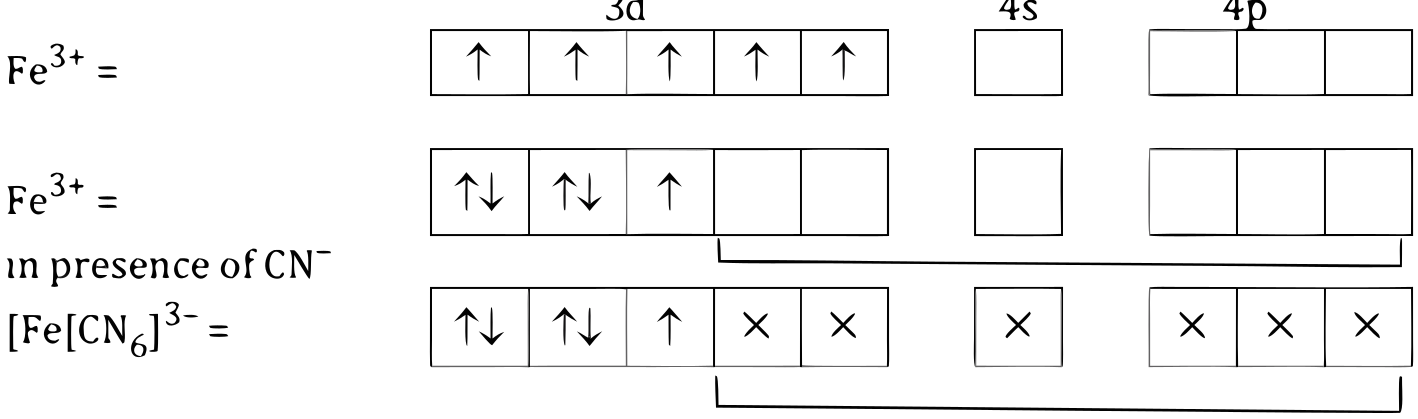 \(\displaystyle 6 \mathrm{CN}^{-}\) Hence hybridization is \(\displaystyle \mathrm{d}^{2} \mathrm{sp}^{3}\)
\(\displaystyle 6 \mathrm{CN}^{-}\) Hence hybridization is \(\displaystyle \mathrm{d}^{2} \mathrm{sp}^{3}\)(b) 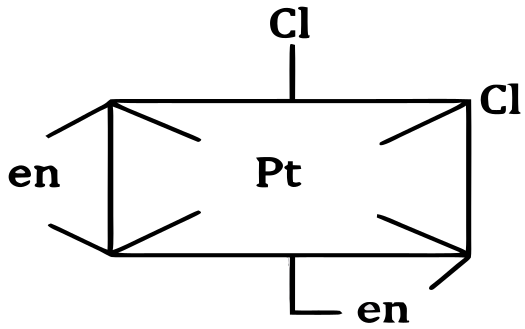 cis
cis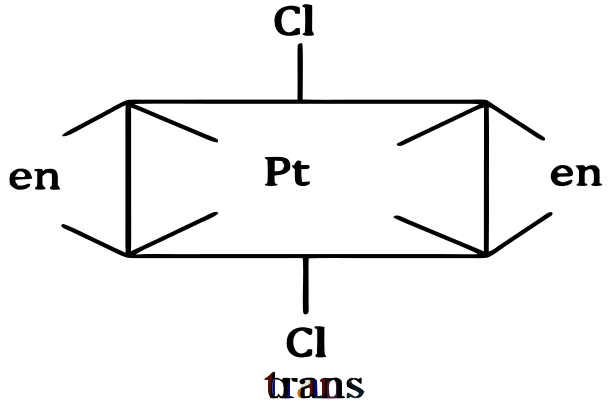
cis(c) \(\displaystyle \mathrm{Cl}^{-}\)being a weak field ligand does not cause pairing of electrons and hence \(\displaystyle \left[\mathrm{NiCl}_{4}\right]^{2-}\) is paramagnetic while CO being a strong field ligand causes pairing of electrons therefore \(\displaystyle \left[\mathrm{Ni}(\mathrm{CO})_{4}\right]\) is diamagnetic.
(d) Linkage isomerism. Example, \(\displaystyle \mathrm{CN}^{-} / \mathrm{NO}_{2}^{-} / \mathrm{SCN}^{-}\)
All Coordination Compounds questions2023 question paperNCERT solutions: Coordination CompoundsPractice Coordination Compounds →
More from Coordination Compounds
- [Co(NH_3)_6]^3+ is diamagnetic whereas [CoF_6]^3- is paramagnetic. Justify the statement. [Atomic number of Co=27 ] Write the electronic…2026
- Draw the geometrical isomers of the given complex: [Pt(en)_2 Cl_2]^2+ Write the electronic configuration for d^4 ion if Δ_0<P on the basis of crystal…2024
- On the basis of crystal field theory, write the electronic configuration for d^4 with a strong field ligand for which Δ_0>P. A solution of [Ni(H_2…2023
- Out of the following statements, the incorrect statement is:2025
- The secondary valency of Co in [Co(en)_3]^3+ is2026
- The Valence Bond Theory (VBT) explains the formation, magnetic behaviour and geometrical shapes of coordination compounds whereas 'The Crystal Field…2024
- The formula of the complex Iron (III) hexacyanidoferrate (II) is:2023
- [Fe(H_2 O)_6]^2+ is paramagnetic whereas [Fe(CO)_5] is diamagnetic. Justify the statement. [Atomic number of Fe=26 ] 2+1 On the basis of crystal…2026
CBSE Class 12 Chemistry past-paper question from the 2023 board exam, with the answer as CBSE’s own marking scheme gives it. Where our answers come from.