✓ Board-verified
Chemistry · 2024 · 4 marks
CBSE 2024 · Region 1 · Set 1 · Q30
The Valence Bond Theory (VBT) explains the formation, magnetic behaviour and geometrical shapes of coordination compounds whereas 'The Crystal Field…
The Valence Bond Theory (VBT) explains the formation, magnetic behaviour and geometrical shapes of coordination compounds whereas 'The Crystal Field Theory' for coordination compounds is based on the effect of different crystal fields (provided by ligands taken as point charges), on the degeneracy of d-orbital energies of the central metal atom/ion. The splitting of the d-orbitals provides different electronic arrangements in strong and weak crystal fields. The crystal field theory attributes the colour of the coordination compounds to d-d transition of the electron. Coordination compounds find extensive applications in metallurgical processes, analytical and medicinal chemistry. Answer the following questions :
(a)
What is crystal field splitting energy ?
(b)
Give reason for the violet colour of the complex $\displaystyle \left[\mathrm{Ti}\left(\mathrm{H}_{2} \mathrm{O}\right)_{6}\right]^{3+}$ on the basis of crystal field theory.
(c)
$\displaystyle \left[\mathrm{Cr}\left(\mathrm{NH}_{3}\right)_{6}\right]^{3+}$ is paramagnetic while $\displaystyle \left[\mathrm{Ni}(\mathrm{CN})_{4}\right]^{2-}$ is diamagnetic. Explain why. [Atomic No. : $\displaystyle \mathrm{Cr}=24, \mathrm{Ni}=28$ ]
OR
(c)
Explain why $\displaystyle \left[\mathrm{Fe}(\mathrm{CN})_{6}\right]^{3-}$ is an inner orbital complex, whereas $\displaystyle \left[\mathrm{Fe}\left(\mathrm{H}_{2} \mathrm{O}\right)_{6}\right]^{3+}$ is an outer orbital complex. [Atomic No. : $\displaystyle \mathrm{Fe}=26$ ]
Marking-scheme solution
(a) The energy used in the splitting of degenerate d- orbitals due to the presence of ligands in a definite geometry is called Crystal Field Splitting Energy.
(b) \(\displaystyle \mathrm{Ti}^{3+}=3 \mathrm{~d}^{1}\) i.e. \(\displaystyle t_{2 g}{ }^{1} e_{g}^{0}\) Due to d - d transition.
(c) 
Due to stable \(\displaystyle t_{2 g}{ }^{3}\) configuration, henceparamagnetic.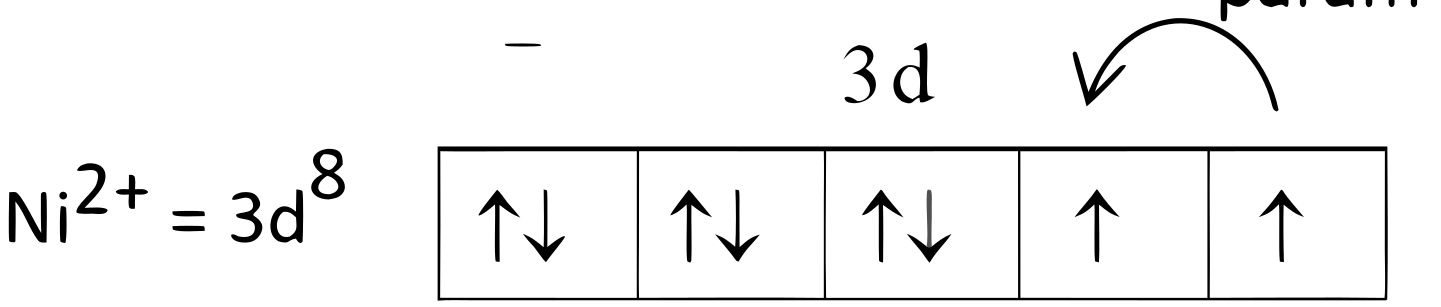 \(\displaystyle \mathrm{CN}^{-}\)being strong field ligand pair up the electrons and hence diamagnetic. OR
All Coordination Compounds questions2024 question paperNCERT solutions: Coordination CompoundsPractice Coordination Compounds →
More from Coordination Compounds
- [Co(NH_3)_6]^3+ is diamagnetic whereas [CoF_6]^3- is paramagnetic. Justify the statement. [Atomic number of Co=27 ] Write the electronic…2026
- Draw the geometrical isomers of the given complex: [Pt(en)_2 Cl_2]^2+ Write the electronic configuration for d^4 ion if Δ_0<P on the basis of crystal…2024
- On the basis of crystal field theory, write the electronic configuration for d^4 with a strong field ligand for which Δ_0>P. A solution of [Ni(H_2…2023
- Out of the following statements, the incorrect statement is:2025
- The secondary valency of Co in [Co(en)_3]^3+ is2026
- The formula of the complex Iron (III) hexacyanidoferrate (II) is:2023
- [Fe(H_2 O)_6]^2+ is paramagnetic whereas [Fe(CO)_5] is diamagnetic. Justify the statement. [Atomic number of Fe=26 ] 2+1 On the basis of crystal…2026
- Using valence bond theory, explain the hybridization and magnetic character of the following: 2 × 1 1/2=3 [Co(NH_3)_6]^3+ [Ni(CO)_4] [At. no.: Co=27,…2025
CBSE Class 12 Chemistry past-paper question from the 2024 board exam, with the answer as CBSE’s own marking scheme gives it. Where our answers come from.