✓ Board-verified
Biology · 2024 · 5 marks
CBSE 2024 · Region 4 · Set 1 · Q32
(a) Study the schematic diagram given below and answer the questions that follow: (i) Identify the polarity from 'X' to ' X̄ ' in the mRNA segment…
Study the schematic diagram given below and answer the questions that follow :
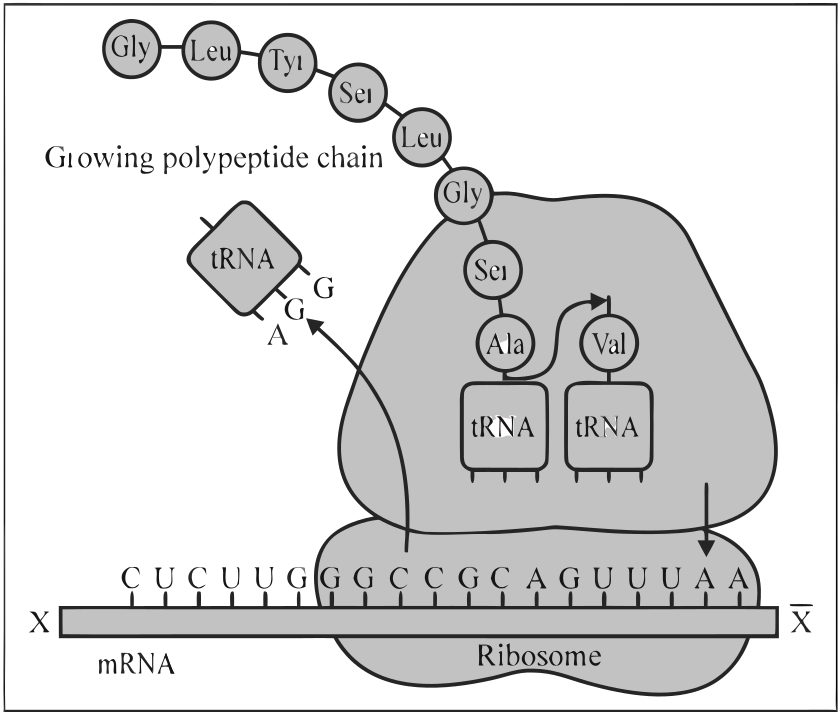
(i)
Identify the polarity from 'X' to '$\displaystyle \overline{X}$' in the mRNA segment shown. Mention how many more amino acids can be added to the polypeptide that is being translated and why.
(ii)
Write the initiating codon for translation, its anticodon and the amino acid it codes for.
(iii)
Explain the charging of an adaptor molecule. Why this molecule needs to be charged ?
(i)
Why is sickle-cell anaemia, a human blood disorder so named ?
(ii)
Explain the genetic basis that results in the expression of this disorder.
(iii)
Work out a cross to explain how normal parents may have a sickle-cell anaemic child.
Marking-scheme solution
(i)
• X to X is $\displaystyle 5$’ → $\displaystyle 3$’
• No more amino acids will be added
• as the last codon UAA is a stop codon
(ii)
• AUG
• Anticodon - UAC
• methionine
(iii)
• The amino acids are activated in the presence of ATP , and linked to
their cognate tRNA or the adapter molecule,
• Amino acids are activated so peptide bonds can be formed using this
energy.
(i)
the RBC in such patients takes up a sickle shape instead of biconcave.
(ii)
The defect is caused by the substitution of Glutamic acid (Glu) by Valine
(Val) , at the sixth position of the beta globin chain of the haemoglobin molecule /The substitution of amino acid in the globin protein results due to the single base substitution at the sixth codon of the beta globin gene, from
GAG to GUG.
(iii)

Cross: Carrier (Hb^A Hb^S) x Carrier (Hb^A Hb^S) -> gametes Hb^A, Hb^S from each parent -> offspring $\displaystyle 1$ Hb^A Hb^A (Unaffected) : $\displaystyle 2$ Hb^A Hb^S (Carrier) : $\displaystyle 1$ Hb^S Hb^S (Sickle-cell). It is an autosomal recessive disorder.
All Molecular Basis of Inheritance questions2024 question paperNCERT solutions: Molecular Basis of InheritancePractice Molecular Basis of Inheritance →
More from Molecular Basis of Inheritance
- A bacterium having radioactive thymidine in its DNA is allowed to multiply in a medium having non-radioactive thymidine for two generations. What…2026
- Assertion: Repetitive sequences are stretches of DNA sequences that are thought to have no direct coding functions. Reason (R): They shed light on…2026
- Explain how the addition of lactose in the medium regulates the switching on of the lac operon in bacteria.2025
- In a human, the average gene consists of (i) bases and the largest known human gene contains (ii) bases. Select the correct option to fill in the…2026
- In a translational unit UTRs are present at:2025
- The simplest definition of a gene in eukaryotes is - A unit of DNA that has information to mainly specify the synthesis of:2025
- Explain the processing of heterogeneous nuclear RNA (hnRNA) into a fully functional mRNA in eukaryotes. Where does this processing occur in the cell?2024
- The type of bond represented by the dotted line '-----' in a schematic polynucleotide chain is:2024
CBSE Class 12 Biology past-paper question from the 2024 board exam, with the answer as CBSE’s own marking scheme gives it. Where our answers come from.