✓ Board-verified
Biology · 2024 · 5 marks
CBSE 2024 · Region 5 · Set 1 · Q33
(a) Natural selection operates in different ways in nature. (i) Identify the type of natural selection depicted in the graph above. (ii) In England…
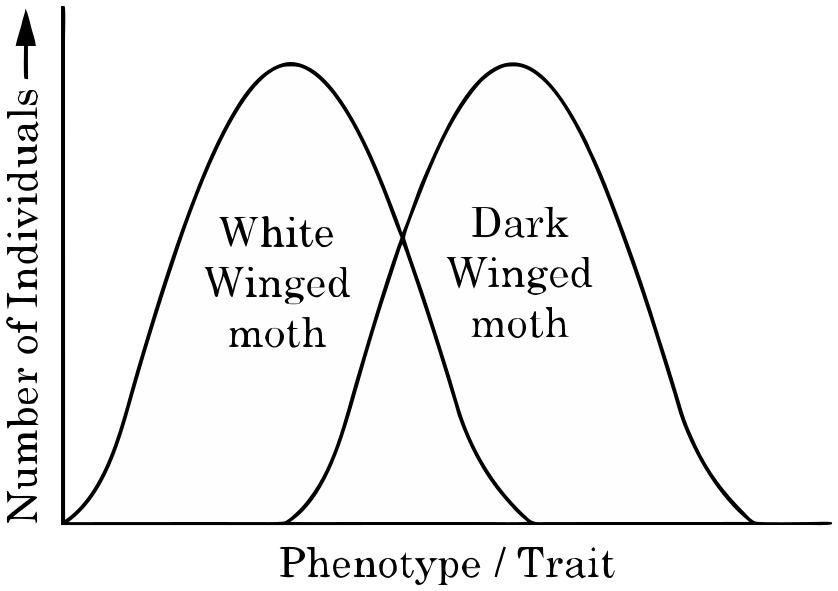
Natural selection operates in different ways in nature.
(i)
Identify the type of natural selection depicted in the graph above.
(ii)
In England after industrialisation, the population of dark winged moths were more favoured than white winged moth. Explain.
(iii)
Anthropogenic action can enhance the rate of evolution. Explain with the help of an example.
(i)
Why did Hershey and Chase use ' $\displaystyle { }^{35} \mathrm{~S}$ ' and ' $\displaystyle { }^{32} \mathrm{P}$ ' in their experiment? Explain.
(ii)
State the importance of ($\displaystyle 1$) blending and ($\displaystyle 2$) centrifugation in their experiment.
(iii)
Write the conclusion they arrived at the end of their experiment.
Marking-scheme solution
(i)
Directional Selection
(ii)
During post-industrialisation period due to smoke and soot tree trunks
became dark , lichens were not able to grow on the tree trunks , white moths were not able to camouflage and were eaten by the predators and their population size decreased, while dark moth population size increased due to their natural selection or camouflage with the background.
(iii)
Industrialisation leads to the natural selection of melanised moth, causing
dominance of dark moth over white moth / excess use of herbicides or pesticides or antibiotics or drugs, leads to selection of resistant varieties or organisms or cells or any correct example in lesser time scale
(i)
35S is a component of protein and , 32P is a component of DNA which help in
identification (and confirmation) of protein and genetic material or DNA /
To detect and confirm whether DNA or protein, passed from virus to bacteria.
(ii)(1)
Blending remove viral coat from bacteria or E.coli by agitating
(2)
Centrifugation: separation of virus coat from bacteria or E.coli by spinning in a centrifuge
(iii)
DNA is the genetic material
All Molecular Basis of Inheritance questions2024 question paperNCERT solutions: Molecular Basis of InheritancePractice Molecular Basis of Inheritance →
More from Molecular Basis of Inheritance
- A bacterium having radioactive thymidine in its DNA is allowed to multiply in a medium having non-radioactive thymidine for two generations. What…2026
- Assertion: Repetitive sequences are stretches of DNA sequences that are thought to have no direct coding functions. Reason (R): They shed light on…2026
- Explain how the addition of lactose in the medium regulates the switching on of the lac operon in bacteria.2025
- In a human, the average gene consists of (i) bases and the largest known human gene contains (ii) bases. Select the correct option to fill in the…2026
- In a translational unit UTRs are present at:2025
- The simplest definition of a gene in eukaryotes is - A unit of DNA that has information to mainly specify the synthesis of:2025
- Explain the processing of heterogeneous nuclear RNA (hnRNA) into a fully functional mRNA in eukaryotes. Where does this processing occur in the cell?2024
- The type of bond represented by the dotted line '-----' in a schematic polynucleotide chain is:2024
CBSE Class 12 Biology past-paper question from the 2024 board exam, with the answer as CBSE’s own marking scheme gives it. Where our answers come from.