SolveIt is under development
SolveItNCERT · CBSE · NEET

NCERT Exemplar · Class 12 Mathematics Application of Integrals

34 questions · 34 still being checked

EXERCISE 8.3 11–20 (part 2 of 4)

  1. Exercise 11

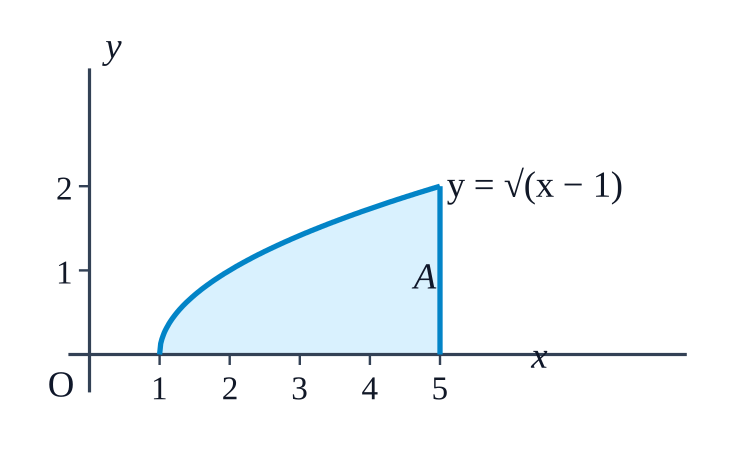
    Draw a rough sketch of the curve y=x−1\displaystyle y=\sqrt{x-1} in the interval [1,5]\displaystyle [1,5]. Find the area under the curve and between the lines x=1\displaystyle x=1 and x=5\displaystyle x=5.

    Matches the book, not yet reviewed

    This working reaches the answer NCERT prints. It has not yet been read through by hand.

    NCERT’s answer
    \(\displaystyle \frac{16}{3}\) sq.units
    The curve is the upper half of the parabola \(\displaystyle y^2=x-1\), with vertex \(\displaystyle (1,0)\).\[x=1,\ 2,\ 5\ \Rightarrow\ y=0,\ 1,\ 2 \]NCERT_Solution_Class12_Maths_Exemplar_Ch8_Ex8-3_Q11\[A=\int_1^5\sqrt{x-1}\,dx=\left[\frac23(x-1)^{3/2}\right]_1^5 \] \[=\frac23\left(4^{3/2}-0\right)=\frac23\cdot 8=\frac{16}{3} \]Answer: \(\displaystyle \dfrac{16}{3}\) square units.
  2. Exercise 12

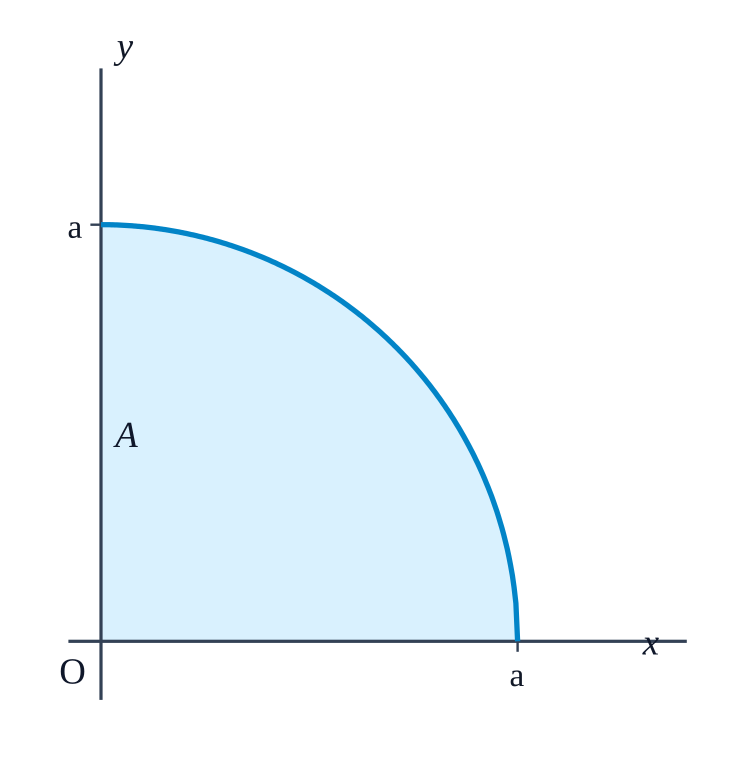
    Determine the area under the curve y=a2−x2\displaystyle y=\sqrt{a^2-x^2} included between the lines x=0\displaystyle x=0 and x=a\displaystyle x=a.

    Matches the book, not yet reviewed

    This working reaches the answer NCERT prints. It has not yet been read through by hand.

    NCERT’s answer
    \(\displaystyle \frac{\pi a^2}{4}\) sq. units
    NCERT_Solution_Class12_Maths_Exemplar_Ch8_Ex8-3_Q12\[A=\int_0^a\sqrt{a^2-x^2}\,dx=\left[\frac{x}{2}\sqrt{a^2-x^2}+\frac{a^2}{2}\sin^{-1}\frac{x}{a}\right]_0^a \] \[=\left(0+\frac{a^2}{2}\cdot\frac{\pi}{2}\right)-(0+0)=\frac{\pi a^2}{4} \]Answer: \(\displaystyle \dfrac{\pi a^2}{4}\) square units.
  3. Exercise 13

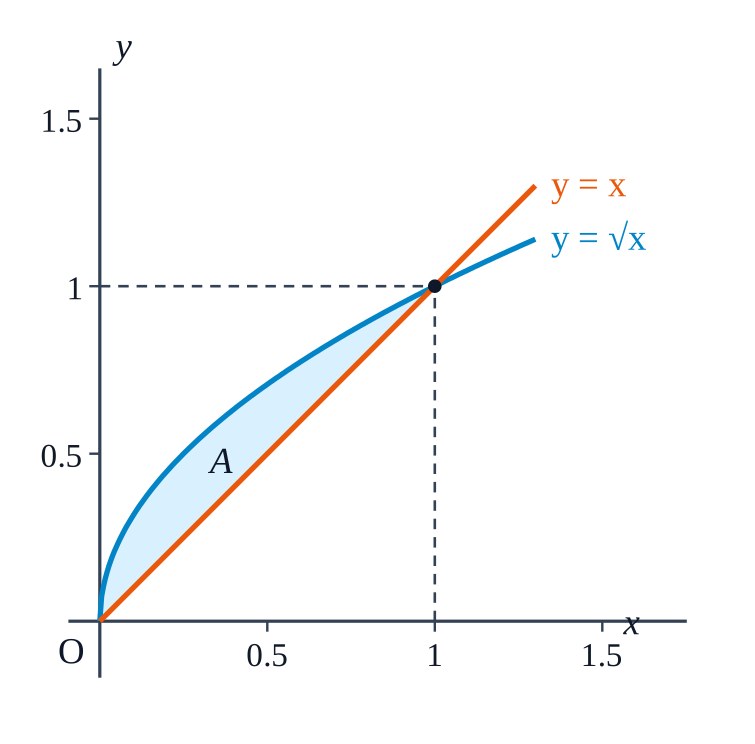
    Find the area of the region bounded by y=x\displaystyle y=\sqrt{x} and y=x\displaystyle y=x.

    Matches the book, not yet reviewed

    This working reaches the answer NCERT prints. It has not yet been read through by hand.

    NCERT’s answer
    \(\displaystyle \frac{1}{6}\) sq. units
    \[\sqrt{x}=x\ \Rightarrow\ x=x^2\ \Rightarrow\ x(x-1)=0\ \Rightarrow\ x=0,\ 1 \]The curves meet at \(\displaystyle (0,0)\) and \(\displaystyle (1,1)\), and \(\displaystyle \sqrt{x}\ge x\) on \(\displaystyle [0,1]\).NCERT_Solution_Class12_Maths_Exemplar_Ch8_Ex8-3_Q13\[A=\int_0^1\left(\sqrt{x}-x\right)dx=\left[\frac23x^{3/2}-\frac{x^2}{2}\right]_0^1 \] \[=\frac23-\frac12=\frac16 \]Answer: \(\displaystyle \dfrac{1}{6}\) square unit.
  4. Exercise 14

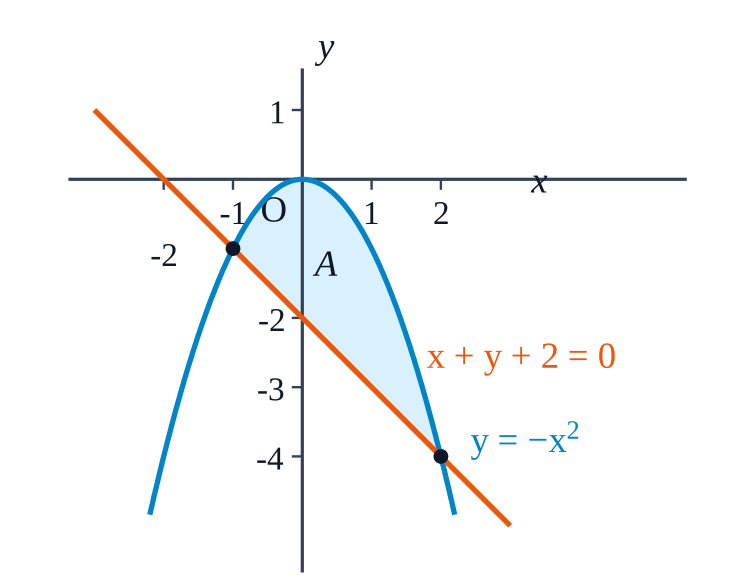
    Find the area enclosed by the curve y=−x2\displaystyle y=-x^2 and the straight lilne x+y+2=0\displaystyle x+y+2=0.

    Matches the book, not yet reviewed

    This working reaches the answer NCERT prints. It has not yet been read through by hand.

    NCERT’s answer
    \(\displaystyle \frac{9}{2}\) sq. units
    \[x+y+2=0\ \Rightarrow\ y=-x-2 \] \[-x^2=-x-2\ \Rightarrow\ x^2-x-2=0\ \Rightarrow\ (x-2)(x+1)=0 \] \[x=-1,\ 2\ \Rightarrow\ \text{points } (-1,-1),\ (2,-4) \]At \(\displaystyle x=0\) the parabola gives \(\displaystyle 0\) and the line \(\displaystyle -2\), so the parabola lies above the line on \(\displaystyle [-1,2]\).NCERT_Solution_Class12_Maths_Exemplar_Ch8_Ex8-3_Q14\[A=\int_{-1}^{2}\left[-x^2-(-x-2)\right]dx=\int_{-1}^{2}\left(-x^2+x+2\right)dx \] \[=\left[-\frac{x^3}{3}+\frac{x^2}{2}+2x\right]_{-1}^{2} \] \[=\left(-\frac83+2+4\right)-\left(\frac13+\frac12-2\right)=\frac{10}{3}+\frac76=\frac92 \]Answer: \(\displaystyle \dfrac{9}{2}\) square units.
  5. Exercise 15

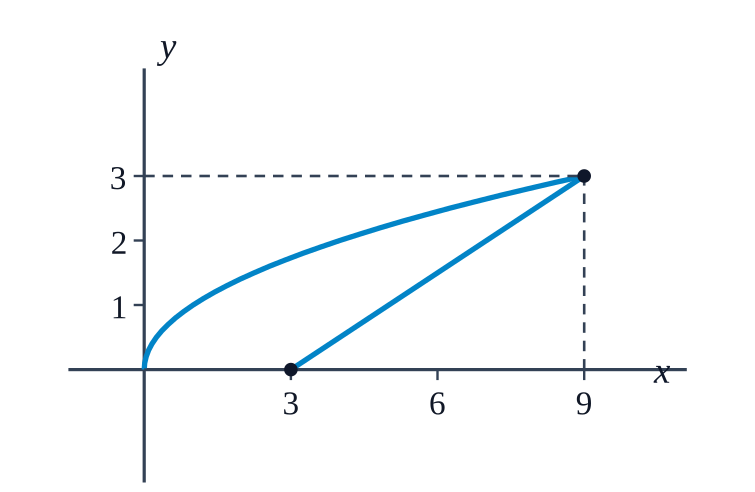
    Find the area bounded by the curve y=x,x=2y+3\displaystyle y=\sqrt{x}, x=2 y+3 in the first quadrant and x\displaystyle x-axis.

    Matches the book, not yet reviewed

    This working reaches the answer NCERT prints. It has not yet been read through by hand.

    NCERT’s answer
    $\displaystyle 9$ sq.units
    The line meets the \(\displaystyle x\)-axis at \(\displaystyle x=3\). It meets the curve \(\displaystyle x=y^2\) where\[y^2 = 2y+3 \] \[(y-3)(y+1)=0 \Rightarrow y=3 \quad (y>0) \] \[\text{Point of intersection: } (9,3) \]NCERT_Solution_Class12_Maths_Exemplar_Ch8_Ex8-3_Q15For each \(\displaystyle y\in[0,3]\), \(\displaystyle x\) runs from the curve to the line.\[\text{Area}=\int_0^3\left(2y+3-y^2\right)dy \] \[=\left[y^2+3y-\frac{y^3}{3}\right]_0^3 \] \[=9+9-9=9 \]Answer: \(\displaystyle 9\) square units
  6. Exercise 16

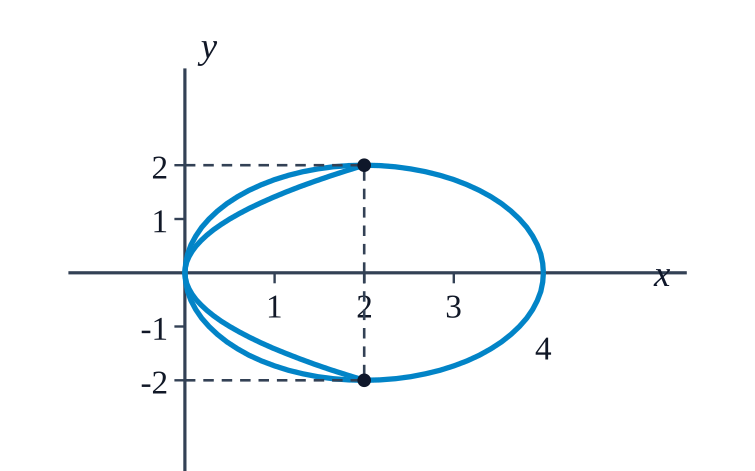
    Find the area of the region bounded by the curve y2=2x\displaystyle y^2=2 x and x2+y2=4x\displaystyle x^2+y^2=4 x.

    Matches the book, not yet reviewed

    This working reaches the answer NCERT prints. It has not yet been read through by hand.

    NCERT’s answer
    \(\displaystyle 2\left[\pi-\frac{8}{3}\right]\) sq.units
    The circle has centre \(\displaystyle (2,0)\) and radius \(\displaystyle 2\). The curves meet where\[y^2=2x \ \text{ and } \ x^2+y^2=4x \Rightarrow x^2-2x=0 \] \[x=0 \ \text{ or } \ x=2 \Rightarrow (0,0),\ (2,2),\ (2,-2) \]NCERT_Solution_Class12_Maths_Exemplar_Ch8_Ex8-3_Q16For \(\displaystyle 0\le x\le 2\) the circle lies above the parabola, and the region between them is symmetric about the \(\displaystyle x\)-axis.\[\text{Area}=2\int_0^2\left[\sqrt{4x-x^2}-\sqrt{2x}\right]dx \] \[\int_0^2\sqrt{4-(x-2)^2}\,dx=\left[\frac{x-2}{2}\sqrt{4x-x^2}+2\sin^{-1}\frac{x-2}{2}\right]_0^2=\pi \] \[\int_0^2\sqrt{2x}\,dx=\sqrt2\cdot\frac23\,x^{3/2}\Big|_0^2=\frac83 \] \[\text{Area}=2\left(\pi-\frac83\right)=2\pi-\frac{16}{3} \]Answer: \(\displaystyle \dfrac23\,(3\pi-8)\) square units
  7. Exercise 17

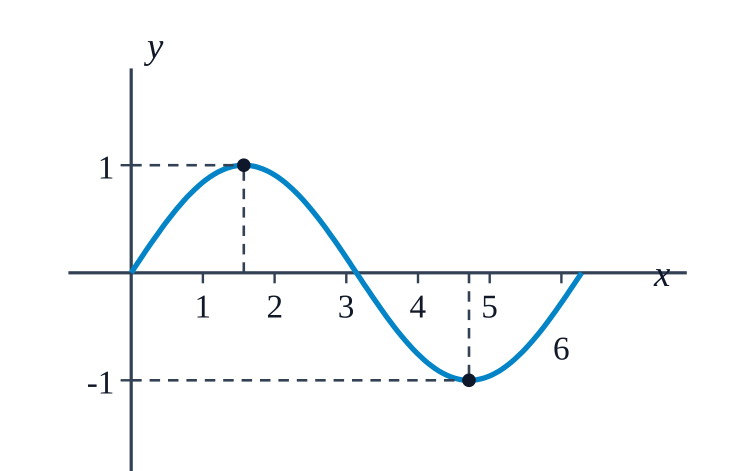
    Find the area bounded by the curve y=sin⁡x\displaystyle y=\sin x between x=0\displaystyle x=0 and x=2π\displaystyle x=2 \pi.

    Matches the book, not yet reviewed

    This working reaches the answer NCERT prints. It has not yet been read through by hand.

    NCERT’s answer
    $\displaystyle 4$ sq.units
    \(\displaystyle \sin x\ge0\) on \(\displaystyle [0,\pi]\) and \(\displaystyle \sin x\le0\) on \(\displaystyle [\pi,2\pi]\), so the second arc lies below the \(\displaystyle x\)-axis.NCERT_Solution_Class12_Maths_Exemplar_Ch8_Ex8-3_Q17\[\text{Area}=\int_0^{\pi}\sin x\,dx+\left|\int_{\pi}^{2\pi}\sin x\,dx\right| \] \[\int_0^{\pi}\sin x\,dx=\Big[-\cos x\Big]_0^{\pi}=1+1=2 \] \[\int_{\pi}^{2\pi}\sin x\,dx=\Big[-\cos x\Big]_{\pi}^{2\pi}=-1-1=-2 \] \[\text{Area}=2+|-2|=4 \]Answer: \(\displaystyle 4\) square units
  8. Exercise 18

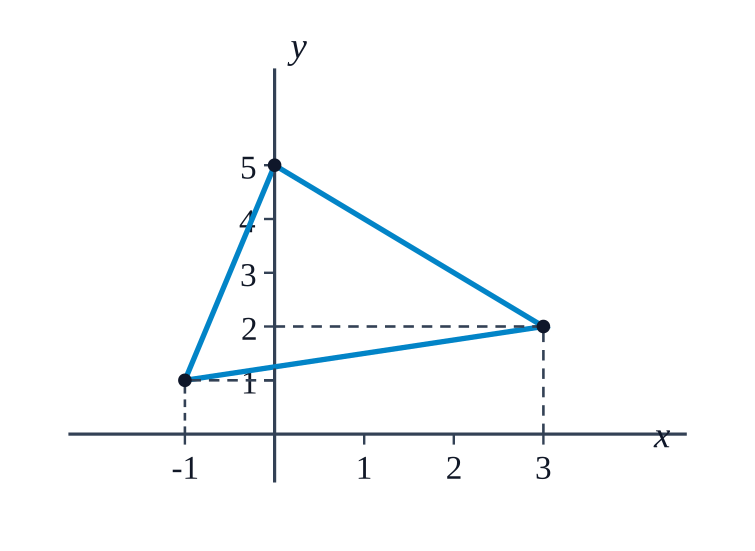
    Find the area of region bounded by the triangle whose vertices are (−1,1),(0,5)\displaystyle (-1,1),(0,5) and (3,2)\displaystyle (3,2), using integration.

    Matches the book, not yet reviewed

    This working reaches the answer NCERT prints. It has not yet been read through by hand.

    NCERT’s answer
    \(\displaystyle \frac{15}{2}\) sq. units
    Let \(\displaystyle A(-1,1)\), \(\displaystyle B(0,5)\), \(\displaystyle C(3,2)\). The sides are\[AB:\ y-1=\frac{5-1}{0+1}(x+1) \Rightarrow y=4x+5 \] \[BC:\ y-5=\frac{2-5}{3-0}\,x \Rightarrow y=5-x \] \[CA:\ y-1=\frac{2-1}{3+1}(x+1) \Rightarrow y=\frac{x+5}{4} \]NCERT_Solution_Class12_Maths_Exemplar_Ch8_Ex8-3_Q18Above \(\displaystyle CA\), the upper boundary is \(\displaystyle AB\) for \(\displaystyle -1\le x\le0\) and \(\displaystyle BC\) for \(\displaystyle 0\le x\le3\).\[\text{Area}=\int_{-1}^{0}\left[(4x+5)-\frac{x+5}{4}\right]dx+\int_0^3\left[(5-x)-\frac{x+5}{4}\right]dx \] \[=\int_{-1}^{0}\frac{15}{4}(x+1)\,dx+\int_0^3\frac54(3-x)\,dx \] \[=\frac{15}{8}\Big[(x+1)^2\Big]_{-1}^{0}-\frac58\Big[(3-x)^2\Big]_0^3 \] \[=\frac{15}{8}+\frac{45}{8}=\frac{15}{2} \]Answer: \(\displaystyle \dfrac{15}{2}\) square units
  9. Exercise 19

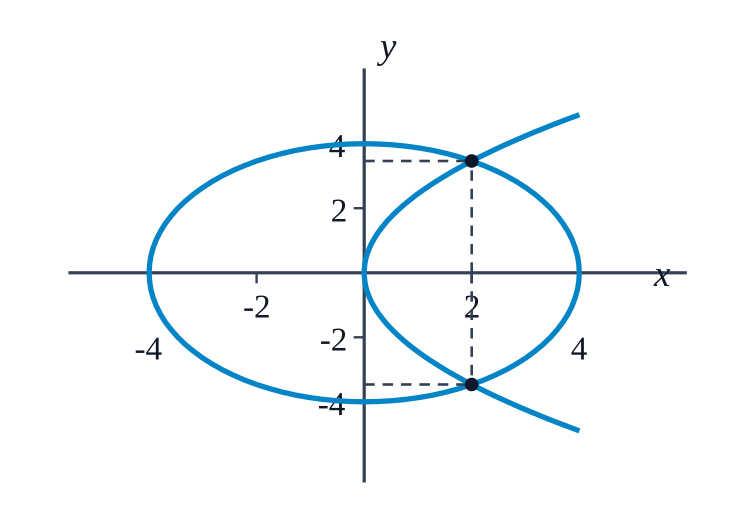
    Draw a rough sketch of the region {(x,y):y2≤6ax\displaystyle \left\{(x, y): y^2 \leq 6 a x\right. and x2+y2≤16a2}\displaystyle \left.x^2+y^2 \leq 16 a^2\right\}. Also find the area of the region sketched using method of integration.

    Check this one against your book

    NCERT’s printed answer for this exercise does not match its own question. This working follows the question as printed.

    Take \(\displaystyle a>0\). The curves \(\displaystyle y^2=6ax\) and \(\displaystyle x^2+y^2=16a^2\) meet where\[x^2+6ax-16a^2=0 \] \[(x+8a)(x-2a)=0 \Rightarrow x=2a,\ y=\pm2\sqrt3\,a \]NCERT_Solution_Class12_Maths_Exemplar_Ch8_Ex8-3_Q19The region lies inside both curves and is symmetric about the \(\displaystyle x\)-axis. The parabola bounds it for \(\displaystyle 0\le x\le 2a\), the circle for \(\displaystyle 2a\le x\le 4a\).\[\text{Area}=2\left[\int_0^{2a}\sqrt{6ax}\,dx+\int_{2a}^{4a}\sqrt{16a^2-x^2}\,dx\right] \] \[\int_0^{2a}\sqrt{6ax}\,dx=\sqrt{6a}\cdot\frac23(2a)^{3/2}=\frac{8\sqrt3}{3}a^2 \] \[\int_{2a}^{4a}\sqrt{16a^2-x^2}\,dx=\left[\frac x2\sqrt{16a^2-x^2}+8a^2\sin^{-1}\frac{x}{4a}\right]_{2a}^{4a}=\frac{8\pi}{3}a^2-2\sqrt3\,a^2 \] \[\text{Area}=2\left[\frac{8\sqrt3}{3}a^2+\frac{8\pi}{3}a^2-2\sqrt3\,a^2\right]=\frac{4a^2}{3}\left(4\pi+\sqrt3\right) \]Answer: \(\displaystyle \dfrac{4a^2}{3}\left(4\pi+\sqrt3\right)\) square units
  10. Exercise 20

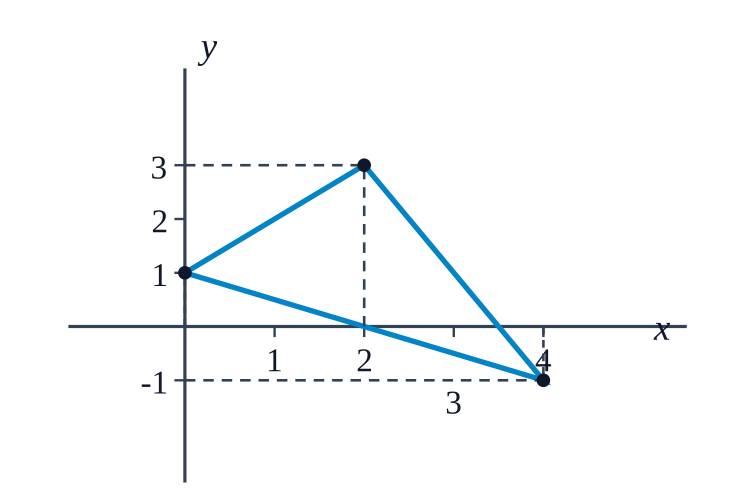
    Compute the area bounded by the lines x+2y=2,y−x=1\displaystyle x+2 y=2, y-x=1 and 2x+y=7\displaystyle 2 x+y=7.

    Matches the book, not yet reviewed

    This working reaches the answer NCERT prints. It has not yet been read through by hand.

    NCERT’s answer
    $\displaystyle 6$ sq.units
    Pairwise intersections of the lines give the vertices.\[x+2y=2,\ y-x=1 \Rightarrow A(0,1) \] \[y-x=1,\ 2x+y=7 \Rightarrow B(2,3) \] \[x+2y=2,\ 2x+y=7 \Rightarrow C(4,-1) \]NCERT_Solution_Class12_Maths_Exemplar_Ch8_Ex8-3_Q20The lower boundary is \(\displaystyle AC:\ y=\dfrac{2-x}{2}\). The upper boundary is \(\displaystyle AB:\ y=x+1\) for \(\displaystyle 0\le x\le2\) and \(\displaystyle BC:\ y=7-2x\) for \(\displaystyle 2\le x\le4\).\[\text{Area}=\int_0^2\left[(x+1)-\frac{2-x}{2}\right]dx+\int_2^4\left[(7-2x)-\frac{2-x}{2}\right]dx \] \[=\int_0^2\frac{3x}{2}\,dx+\int_2^4\left(6-\frac{3x}{2}\right)dx \] \[=\Big[\frac{3x^2}{4}\Big]_0^2+\Big[6x-\frac{3x^2}{4}\Big]_2^4 \] \[=3+3=6 \]Answer: \(\displaystyle 6\) square units