SolveIt is under development
SolveItNCERT · CBSE · NEET

NCERT Exemplar · Class 11 Mathematics Sets

58 questions · 58 still being checked

EXERCISE 1.3 31–40 (part 4 of 6)

  1. Choose the correct answers from the given four options in each Exercises $\displaystyle 29$ to $\displaystyle 43$ (M.C.Q.).

    Exercise 31

    The set (A∩B′)′∪(B∩C)\displaystyle \left(\mathrm{A} \cap \mathrm{B}^{\prime}\right)^{\prime} \cup(\mathrm{B} \cap \mathrm{C}) is equal to
    (A)
    A′∪B∪C\displaystyle \mathrm{A}^{\prime} \cup \mathrm{B} \cup \mathrm{C}
    (B)
    A′∪B\displaystyle \mathrm{A}^{\prime} \cup \mathrm{B}
    (C)
    A′∪C′\displaystyle \mathrm{A}^{\prime} \cup \mathrm{C}^{\prime}
    (D)
    A′∩B\displaystyle \mathrm{A}^{\prime} \cap \mathrm{B}

    Matches the book, not yet reviewed

    This working reaches the answer NCERT prints. It has not yet been read through by hand.

    NCERT’s answer
    B
    (B) \(\displaystyle A' \cup B\). By De Morgan's law: \[(A \cap B')' = A' \cup (B')' = A' \cup B \] \[(A' \cup B) \cup (B \cap C) = A' \cup B \quad \text{(since } B \cap C \subseteq B \text{)} \]
  2. Exercise 32

    Let F1\displaystyle \mathrm{F}_1 be the set of parallelograms, F2\displaystyle \mathrm{F}_2 the set of rectangles, F3\displaystyle \mathrm{F}_3 the set of rhombuses, F4\displaystyle \mathrm{F}_4 the set of squares and F5\displaystyle \mathrm{F}_5 the set of trapeziums in a plane. Then F1\displaystyle \mathrm{F}_1 may be equal to
    (A)
    F2∩ F3\displaystyle \mathrm{F}_2 \cap \mathrm{~F}_3
    (B)
    F3∩ F4\displaystyle \mathrm{F}_3 \cap \mathrm{~F}_4
    (C)
    F2∪ F5\displaystyle \mathrm{F}_2 \cup \mathrm{~F}_5
    (D)
    F2∪ F3∪ F4∪ F1\displaystyle \mathrm{F}_2 \cup \mathrm{~F}_3 \cup \mathrm{~F}_4 \cup \mathrm{~F}_1

    Matches the book, not yet reviewed

    This working reaches the answer NCERT prints. It has not yet been read through by hand.

    NCERT’s answer
    D
    (D) \(\displaystyle F_2 \cup F_3 \cup F_4 \cup F_1\). Rectangles, rhombuses and squares are all parallelograms: \[F_2 \subseteq F_1, \quad F_3 \subseteq F_1, \quad F_4 \subseteq F_1 \] \[F_2 \cup F_3 \cup F_4 \cup F_1 = F_1 \] The others fail: \[F_2 \cap F_3 = F_4 \neq F_1, \qquad F_3 \cap F_4 = F_4 \neq F_1 \] \(\displaystyle F_2 \cup F_5\) contains a trapezium that is not a parallelogram, so it is not \(\displaystyle F_1\).
  3. Exercise 33

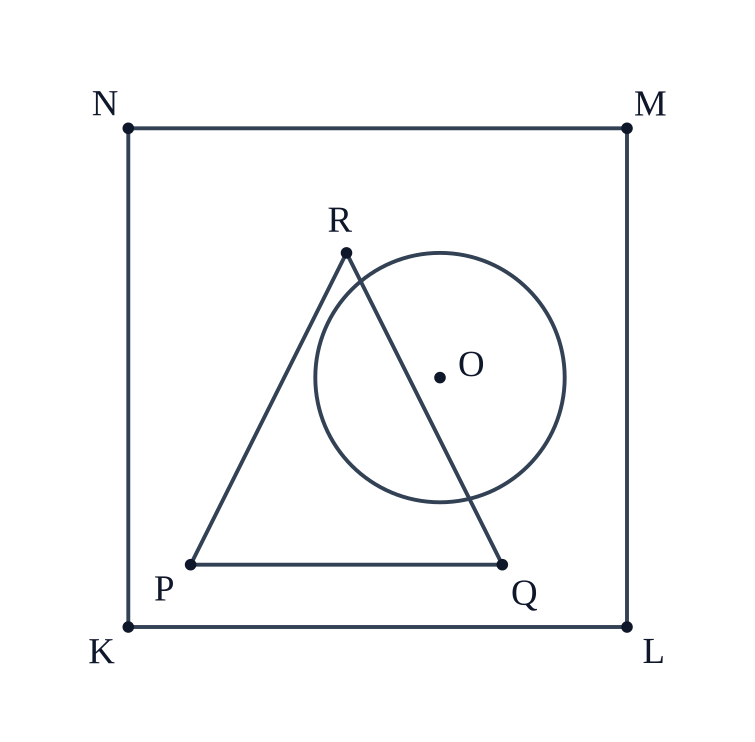
    Let S=\displaystyle \mathrm{S}= set of points inside the square, T=\displaystyle \mathrm{T}= the set of points inside the triangle and C=\displaystyle \mathrm{C}= the set of points inside the circle. If the triangle and circle intersect each other and are contained in a square. Then
    (A)
    S∩T∩C=ϕ\displaystyle \mathrm{S} \cap \mathrm{T} \cap \mathrm{C}=\phi
    (B)
    S∪T∪C=C\displaystyle \mathrm{S} \cup \mathrm{T} \cup \mathrm{C}=\mathrm{C}
    (C)
    S∪T∪C=S\displaystyle \mathrm{S} \cup \mathrm{T} \cup \mathrm{C}=\mathrm{S}
    (D)
    S∪T=S∩C\displaystyle \mathrm{S} \cup \mathrm{T}=\mathrm{S} \cap \mathrm{C}

    Matches the book, not yet reviewed

    This working reaches the answer NCERT prints. It has not yet been read through by hand.

    NCERT’s answer
    C
    (C) \(\displaystyle \mathrm{S}\cup\mathrm{T}\cup\mathrm{C}=\mathrm{S}\)NCERT_Solution_Class11_Maths_Exemplar_Ch1_Ex1-3_Q33T and C lie inside S: \[\mathrm{T}\subset\mathrm{S},\ \mathrm{C}\subset\mathrm{S} \Rightarrow \mathrm{S}\cup\mathrm{T}\cup\mathrm{C}=\mathrm{S} \] T and C intersect, so (A) fails: \[\mathrm{S}\cap\mathrm{T}\cap\mathrm{C}=\mathrm{T}\cap\mathrm{C}\neq\phi \]
  4. Exercise 34

    Let R be set of points inside a rectangle of sides a\displaystyle a and b(a,b>1)\displaystyle b(a, b>1) with two sides along the positive direction of x\displaystyle x-axis and y\displaystyle y-axis. Then
    (A)
    R={(x,y):0≤x≤a,0≤y≤b}\displaystyle \mathrm{R}=\{(x, y): 0 \leq x \leq a, 0 \leq y \leq b\}
    (B)
    R={(x,y):0≤x<a,0≤y≤b}\displaystyle \mathrm{R}=\{(x, y): 0 \leq x<a, 0 \leq y \leq b\}
    (C)
    R={(x,y):0≤x≤a,0<y<b}\displaystyle \mathrm{R}=\{(x, y): 0 \leq x \leq a, 0<y<b\}
    (D)
    R={(x,y):0<x<a,0<y<b}\displaystyle \mathrm{R}=\{(x, y): 0<x<a, 0<y<b\}

    Matches the book, not yet reviewed

    This working reaches the answer NCERT prints. It has not yet been read through by hand.

    NCERT’s answer
    D
    (D) Points inside the rectangle exclude its boundary, so both coordinates lie strictly between the sides. \[0<x<a,\quad 0<y<b \] \[\mathrm{R}=\{(x,y):0<x<a,\ 0<y<b\} \] Answer: (D)
  5. Exercise 35

    In a class of 60\displaystyle 60 students, 25\displaystyle 25 students play cricket and 20\displaystyle 20 students play tennis, and 10\displaystyle 10 students play both the games. Then, the number of students who play neither is
    (A)
    0\displaystyle 0 (B) 25\displaystyle 25
    (C)
    35\displaystyle 35
    (D)
    45\displaystyle 45

    Matches the book, not yet reviewed

    This working reaches the answer NCERT prints. It has not yet been read through by hand.

    NCERT’s answer
    B
    (B) \(\displaystyle 25\) \[n(\mathrm{C}\cup\mathrm{T})=n(\mathrm{C})+n(\mathrm{T})-n(\mathrm{C}\cap\mathrm{T})=25+20-10=35 \] \[\text{neither}=60-35=25 \] Answer: (B) $\displaystyle 25$
  6. Exercise 36

    In a town of 840\displaystyle 840 persons, 450\displaystyle 450 persons read Hindi, 300\displaystyle 300 read English and 200\displaystyle 200 read both. Then the number of persons who read neither is
    (A)
    210\displaystyle 210
    (B)
    290\displaystyle 290
    (C)
    180\displaystyle 180
    (D)
    260\displaystyle 260

    Matches the book, not yet reviewed

    This working reaches the answer NCERT prints. It has not yet been read through by hand.

    NCERT’s answer
    B
    (B) \(\displaystyle 290\) \[n(\mathrm{H}\cup\mathrm{E})=450+300-200=550 \] \[\text{neither}=840-550=290 \] Answer: (B) $\displaystyle 290$
  7. Exercise 37

    If X={8n−7n−1∣n∈N}\displaystyle \mathrm{X}=\left\{8^n-7 n-1 \mid n \in \mathbf{N}\right\} and Y={49n−49∣n∈N}\displaystyle \mathrm{Y}=\{49 n-49 \mid n \in \mathbf{N}\}. Then
    (A)
    X⊂Y\displaystyle \mathrm{X} \subset \mathrm{Y}
    (B)
    Y⊂X\displaystyle \mathrm{Y} \subset \mathrm{X}
    (C)
    X=Y\displaystyle \mathrm{X}=\mathrm{Y}
    (D)
    X∩Y=ϕ\displaystyle \mathrm{X} \cap \mathrm{Y}=\phi

    Check this one against your book

    NCERT’s printed answer for this exercise does not match its own question. This working follows the question as printed.

    (A) \(\displaystyle \mathrm{X}\subset\mathrm{Y}\) \[8^n=(1+7)^n=1+7n+49\left[\binom n2+7\binom n3+\cdots\right] \] \[8^n-7n-1=49m,\quad m=\binom n2+7\binom n3+\cdots\in\{0,1,2,\dots\} \] \[49m=49(m+1)-49,\quad m+1\in\mathbf{N} \Rightarrow \mathrm{X}\subseteq\mathrm{Y} \] Not equal: \(\displaystyle 98\in\mathrm{Y}\), but X has \[n=2:\ 49,\qquad n=3:\ 490 \] and X is increasing, so \(\displaystyle 98\notin\mathrm{X}\). Answer: (A)
  8. Exercise 38

    A survey shows that 63%\displaystyle 63 \% of the people watch a News Channel whereas 76%\displaystyle 76 \% watch another channel. If x%\displaystyle x \% of the people watch both channel, then
    (A)
    x=35\displaystyle x=35
    (B)
    x=63\displaystyle x=63
    (C)
    39≤x≤63\displaystyle 39 \leq x \leq 63
    (D)
    x=39\displaystyle x=39

    Matches the book, not yet reviewed

    This working reaches the answer NCERT prints. It has not yet been read through by hand.

    NCERT’s answer
    C
    (C) \(\displaystyle 39\le x\le63\) \[n(\mathrm{A}\cup\mathrm{B})=63+76-x=139-x \] \[n(\mathrm{A}\cup\mathrm{B})\le100 \Rightarrow 139-x\le100 \Rightarrow x\ge39 \] \[n(\mathrm{A}\cap\mathrm{B})\le n(\mathrm{A})=63 \Rightarrow x\le63 \] Answer: (C) \(\displaystyle 39\le x\le63\)
  9. Exercise 39

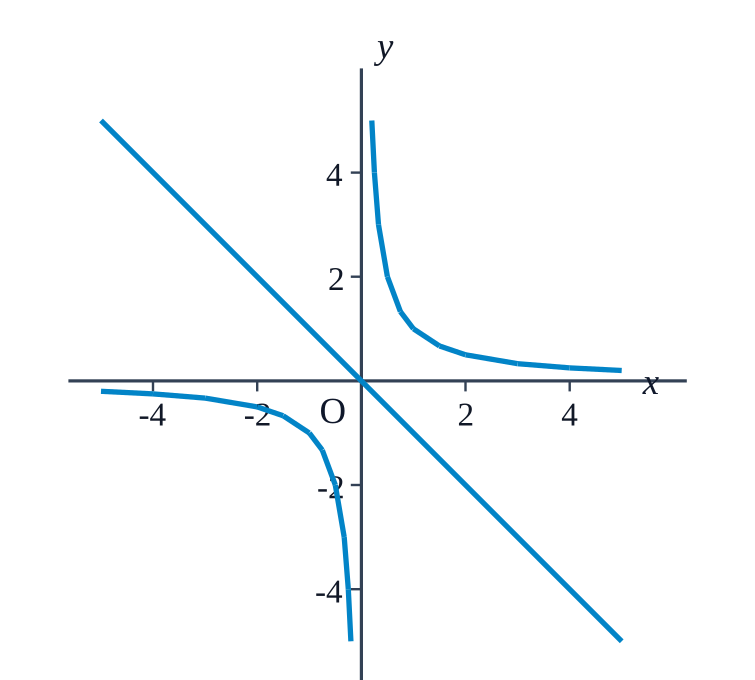
    If sets A and B are defined as A={(x,y)∣ y=1x,0≠x∈R}B={(x,y)∣y=−x,x∈R}, then \mathrm{A}=\left\{(x, y) \left\lvert\, y=\frac{1}{x}\right., 0 \neq x \in \mathbf{R}\right\} \quad \mathrm{B}=\{(x, y) \mid y=-x, x \in \mathbf{R}\} \text {, then }
    (A)
    A∩B=A\displaystyle \mathrm{A} \cap \mathrm{B}=\mathrm{A}
    (B)
    A∩B=B\displaystyle \mathrm{A} \cap \mathrm{B}=\mathrm{B}
    (C)
    A∩B=ϕ\displaystyle \mathrm{A} \cap \mathrm{B}=\phi
    (D)
    A∪B=A\displaystyle \mathrm{A} \cup \mathrm{B}=\mathrm{A}

    Matches the book, not yet reviewed

    This working reaches the answer NCERT prints. It has not yet been read through by hand.

    NCERT’s answer
    C
    (C) \(\displaystyle \mathrm{A}\cap\mathrm{B}=\phi\)NCERT_Solution_Class11_Maths_Exemplar_Ch1_Ex1-3_Q39A common point satisfies both equations: \[\frac1x=-x \Rightarrow x^2=-1 \] No real \(\displaystyle x\) exists, so the curves never meet. Answer: (C)
  10. Exercise 40

    If A and B are two sets, then A∩(A∪B)\displaystyle \mathrm{A} \cap(\mathrm{A} \cup \mathrm{B}) equals
    (A)
    A (B) B (C) ϕ\displaystyle \phi
    (D)
    A∩B\displaystyle \mathrm{A} \cap \mathrm{B}

    Matches the book, not yet reviewed

    This working reaches the answer NCERT prints. It has not yet been read through by hand.

    NCERT’s answer
    A
    (A) A \[\mathrm{A}\subset\mathrm{A}\cup\mathrm{B} \Rightarrow \mathrm{A}\cap(\mathrm{A}\cup\mathrm{B})=\mathrm{A} \] Answer: (A)