SolveIt is under development
SolveItNCERT · CBSE · NEET

NCERT Exemplar · Class 11 Mathematics Sequence and Series

36 questions · 36 still being checked

EXERCISE 9.3 1–10 (part 1 of 4)

  1. Exercise 1

    The first term of an A.P.is a\displaystyle a, and the sum of the first p\displaystyle p terms is zero, show that the sum of its next q\displaystyle q terms is −a(p+q)qp−1\displaystyle \frac{-a(p+q) q}{p-1}. [Hint: Required sum =Sp+q−Sp\displaystyle =\mathrm{S}_{p+q}-\mathrm{S}_p]

    Not cross-checked

    NCERT prints no numerical answer for this exercise, so this working has not been cross-checked against the book.

    Since \(\displaystyle S_p = 0\), the common difference follows from the sum formula.\[S_p = \frac{p}{2}\left[2a + (p-1)d\right] = 0 \]\[d = -\frac{2a}{p-1} \]The next \(\displaystyle q\) terms are terms \(\displaystyle p+1\) to \(\displaystyle p+q\), so their sum is\[S_{p+q} - S_p = S_{p+q} = \frac{p+q}{2}\left[2a + (p+q-1)d\right] \]\[2a + (p+q-1)d = 2a - \frac{2a(p+q-1)}{p-1} = \frac{2a\left[(p-1)-(p+q-1)\right]}{p-1} = \frac{-2aq}{p-1} \]\[S_{p+q} = \frac{p+q}{2}\cdot\frac{-2aq}{p-1} = \frac{-a(p+q)\,q}{p-1} \]Answer: the sum of the next \(\displaystyle q\) terms is \(\displaystyle \dfrac{-a(p+q)q}{p-1}\).
  2. Exercise 2

    A man saved Rs 66000\displaystyle 66000 in 20\displaystyle 20 years. In each succeeding year after the first year he saved Rs 200\displaystyle 200 more than what he saved in the previous year. How much did he save in the first year?

    Matches the book, not yet reviewed

    This working reaches the answer NCERT prints. It has not yet been read through by hand.

    NCERT’s answer
    Rs $\displaystyle 1400$
    The yearly savings form an A.P. with first term \(\displaystyle a\), \(\displaystyle d = 200\), \(\displaystyle n = 20\).\[S_{20} = \frac{20}{2}\left[2a + 19(200)\right] = 66000 \]\[2a + 3800 = 6600 \]\[a = 1400 \]Answer: Rs 1400.
  3. Exercise 3

    A man accepts a position with an initial salary of Rs 5200\displaystyle 5200 per month. It is understood that he will receive an automatic increase of Rs 320\displaystyle 320 in the very next month and each month thereafter.
    (a)
    Find his salary for the tenth month
    (b)
    What is his total earnings during the first year?

    Matches the book, not yet reviewed

    This working reaches the answer NCERT prints. It has not yet been read through by hand.

    NCERT’s answer
    Rs $\displaystyle 8080$ , Rs $\displaystyle 83520$
    The monthly salaries form an A.P. with \(\displaystyle a = 5200\), \(\displaystyle d = 320\).
    (a)
    \[a_{10} = a + 9d = 5200 + 9(320) = 8080 \]
    (b)
    \[S_{12} = \frac{12}{2}\left[2(5200) + 11(320)\right] \]
    \[S_{12} = 6(13920) = 83520 \]
    Answer: (a) Rs $\displaystyle 8080$; (b) Rs 83520.
  4. Exercise 4

    If the p\displaystyle pth and q\displaystyle qth terms of a G.P. are q\displaystyle q and p\displaystyle p respectively, show that its (p+q)th \displaystyle (p+q)^{\text {th }} term is (qppq)1p−q\displaystyle \left(\frac{q^p}{p^q}\right)^{\frac{1}{p-q}}.

    Not cross-checked

    NCERT prints no numerical answer for this exercise, so this working has not been cross-checked against the book.

    Let the first term be \(\displaystyle a\) and the common ratio \(\displaystyle r\).\[ar^{p-1} = q \quad (1) \]\[ar^{q-1} = p \quad (2) \]Dividing ($\displaystyle 1$) by ($\displaystyle 2$):\[r^{p-q} = \frac{q}{p} \quad\Rightarrow\quad r = \left(\frac{q}{p}\right)^{\frac{1}{p-q}} \]Using ($\displaystyle 1$) for the \(\displaystyle (p+q)\)th term:\[T_{p+q} = ar^{p+q-1} = ar^{p-1}\cdot r^{q} = q\,r^{q} \]\[T_{p+q} = q\left(\frac{q}{p}\right)^{\frac{q}{p-q}} = \frac{q^{\,1+\frac{q}{p-q}}}{p^{\frac{q}{p-q}}} = \frac{q^{\frac{p}{p-q}}}{p^{\frac{q}{p-q}}} \]\[T_{p+q} = \left(\frac{q^{p}}{p^{q}}\right)^{\frac{1}{p-q}} \]Answer: the \(\displaystyle (p+q)\)th term is \(\displaystyle \left(\dfrac{q^p}{p^q}\right)^{\frac{1}{p-q}}\).
  5. Exercise 5

    A carpenter was hired to build 192\displaystyle 192 window frames. The first day he made five frames and each day, thereafter he made two more frames than he made the day before. How many days did it take him to finish the job?

    Matches the book, not yet reviewed

    This working reaches the answer NCERT prints. It has not yet been read through by hand.

    NCERT’s answer
    $\displaystyle 12$ days
    The daily output \(\displaystyle 5, 7, 9, \dots\) is an A.P. with \(\displaystyle a = 5\), \(\displaystyle d = 2\); the total must reach 192.\[S_n = \frac{n}{2}\left[2(5) + (n-1)2\right] = 192 \]\[n(n+4) = 192 \]\[n^2 + 4n - 192 = 0 \]\[(n+16)(n-12) = 0 \]Since \(\displaystyle n > 0\), \(\displaystyle n = 12\).Answer: $\displaystyle 12$ days.
  6. Exercise 6

    We know the sum of the interior angles of a triangle is 180\displaystyle 180°. Show that the sums of the interior angles of polygons with 3\displaystyle 3, 4\displaystyle 4, 5\displaystyle 5, 6\displaystyle 6, ... sides form an arithmetic progression. Find the sum of the interior angles for a 21\displaystyle 21 sided polygon.

    Matches the book, not yet reviewed

    This working reaches the answer NCERT prints. It has not yet been read through by hand.

    NCERT’s answer
    \(\displaystyle 3420^{\circ}\)
    For an \(\displaystyle n\)-sided polygon, the angle sum is\[S_n = (n-2)\cdot 180^\circ \]\[S_3 = 180^\circ,\quad S_4 = 360^\circ,\quad S_5 = 540^\circ,\quad S_6 = 720^\circ,\ \dots \]\[S_{n+1} - S_n = (n-1)180^\circ - (n-2)180^\circ = 180^\circ \]The difference is constant, so the sums form an A.P. with \(\displaystyle a = 180^\circ\), \(\displaystyle d = 180^\circ\).The $\displaystyle 21$-sided polygon is the 19th term:\[a_{19} = 180^\circ + 18(180^\circ) = 3420^\circ \]Answer: \(\displaystyle 3420^\circ\).
  7. Exercise 7

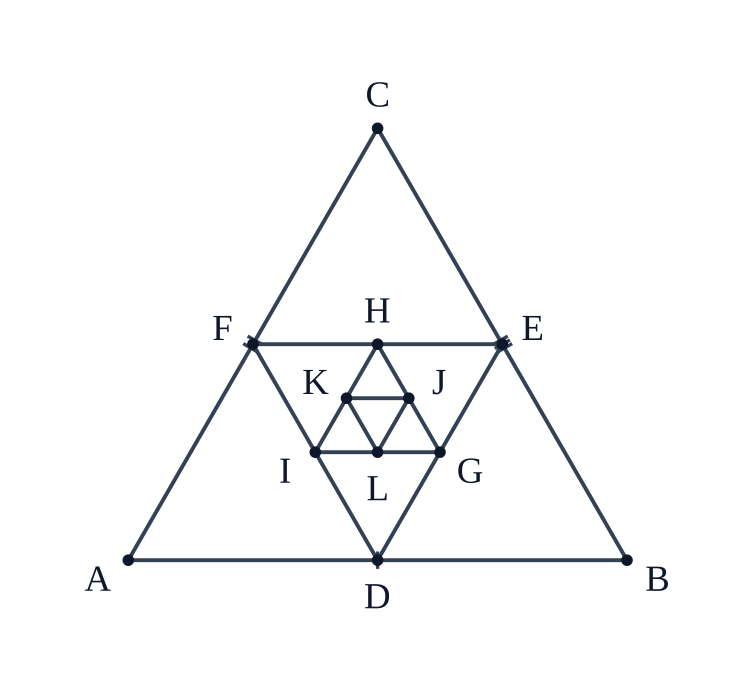
    A side of an equilateral triangle is 20cm long. A second equilateral triangle is inscribed in it by joining the mid points of the sides of the first triangle. The process is continued as shown in the accompanying diagram. Find the perimeter of the sixth inscribed equilateral triangle.

    Matches the book, not yet reviewed

    This working reaches the answer NCERT prints. It has not yet been read through by hand.

    NCERT’s answer
    \(\displaystyle \frac{15}{8} c m\)
    NCERT_Solution_Class11_Maths_Exemplar_Ch9_Ex9-3_Q7Joining midpoints halves every side:\[DE = \tfrac12 AC \quad \text{(midpoint theorem)} \]So each triangle has half the perimeter of the one before.\[T_1 = 3(20) = 60,\quad T_2 = 30,\quad T_3 = 15,\ \dots \]This is a G.P. with \(\displaystyle a = 60\), \(\displaystyle r = \tfrac12\). The sixth triangle is the sixth term.\[T_6 = 60\left(\tfrac12\right)^{5} = \frac{60}{32} = \frac{15}{8} \]Answer: \(\displaystyle \dfrac{15}{8}\) cm.
  8. Exercise 8

    In a potato race 20\displaystyle 20 potatoes are placed in a line at intervals of 4\displaystyle 4 metres with the first potato 24\displaystyle 24 metres from the starting point. A contestant is required to bring the potatoes back to the starting place one at a time. How far would he run in bringing back all the potatoes?

    Matches the book, not yet reviewed

    This working reaches the answer NCERT prints. It has not yet been read through by hand.

    NCERT’s answer
    \(\displaystyle 2480 m\)
    The potatoes are at \(\displaystyle 24, 28, 32, \dots\) m, an A.P. with \(\displaystyle d = 4\).\[d_{20} = 24 + 19(4) = 100 \]Each potato needs a trip out and back, that is twice its distance.\[\text{Total} = 2\,(24 + 28 + \cdots + 100) = 2\cdot\frac{20}{2}\,(24 + 100) \]\[\text{Total} = 2(1240) = 2480 \]Answer: $\displaystyle 2480$ m.
  9. Exercise 9

    In a cricket tournament 16\displaystyle 16 school teams participated. A sum of Rs 8000\displaystyle 8000 is to be awarded among themselves as prize money. If the last placed team is awarded Rs 275\displaystyle 275 in prize money and the award increases by the same amount for successive finishing places, how much amount will the first place team receive?

    Matches the book, not yet reviewed

    This working reaches the answer NCERT prints. It has not yet been read through by hand.

    NCERT’s answer
    Rs $\displaystyle 725$
    Prizes from the last place upward form an A.P. with \(\displaystyle a=275\), \(\displaystyle n=16\).\[S_{16}=\frac{16}{2}\left[2(275)+15d\right]=8000 \] \[550+15d=1000 \Rightarrow d=30 \] \[a_{16}=275+15(30)=725 \]Answer: Rs $\displaystyle 725$
  10. Exercise 10

    If a1,a2,a3,…,an\displaystyle a_1, a_2, a_3, \ldots, a_n are in A.P., where ai>0\displaystyle a_i>0 for all i\displaystyle i, show that 1a1+a2+1a2+a3+…+1an−1+an=n−1a1+an\frac{1}{\sqrt{a_1}+\sqrt{a_2}}+\frac{1}{\sqrt{a_2}+\sqrt{a_3}}+\ldots+\frac{1}{\sqrt{a_{n-1}}+\sqrt{a_n}}=\frac{n-1}{\sqrt{a_1}+\sqrt{a_n}}

    Not cross-checked

    NCERT prints no numerical answer for this exercise, so this working has not been cross-checked against the book.

    Let the common difference be \(\displaystyle d\), so \(\displaystyle a_{k+1}-a_k=d\).For \(\displaystyle d\neq 0\), rationalise each term: \[\frac{1}{\sqrt{a_k}+\sqrt{a_{k+1}}}=\frac{\sqrt{a_{k+1}}-\sqrt{a_k}}{a_{k+1}-a_k}=\frac{\sqrt{a_{k+1}}-\sqrt{a_k}}{d} \]Adding for \(\displaystyle k=1,\ldots,n-1\), the sum telescopes: \[\text{LHS}=\frac{\sqrt{a_n}-\sqrt{a_1}}{d} \] \[a_n-a_1=(n-1)d \Rightarrow d=\frac{\left(\sqrt{a_n}-\sqrt{a_1}\right)\left(\sqrt{a_n}+\sqrt{a_1}\right)}{n-1} \] \[\text{LHS}=\frac{n-1}{\sqrt{a_1}+\sqrt{a_n}} \]For \(\displaystyle d=0\), all terms equal \(\displaystyle a_1\): \[\text{LHS}=(n-1)\cdot\frac{1}{2\sqrt{a_1}}=\frac{n-1}{\sqrt{a_1}+\sqrt{a_n}} \]Answer: Proved.