SolveIt is under development
SolveItNCERT · CBSE · NEET

NCERT Exemplar · Class 11 Mathematics Linear Inequalities

32 questions · 32 still being checked

EXERCISE 6.3 11–20 (part 2 of 3)

  1. Solve for \(\displaystyle x\), the inequalities in Exercises $\displaystyle 1$ to 12.

    Exercise 11

    The longest side of a triangle is twice the shortest side and the third side is 2cm longer than the shortest side. If the perimeter of the triangle is more than 166\displaystyle 166 cm then find the minimum length of the shortest side.

    Matches the book, not yet reviewed

    This working reaches the answer NCERT prints. It has not yet been read through by hand.

    NCERT’s answer
    $\displaystyle 41$ cm.
    Let the shortest side be \(\displaystyle x\) cm; the other sides are \(\displaystyle x + 2\) cm and \(\displaystyle 2x\) cm.\[x + (x + 2) + 2x > 166 \]\[4x + 2 > 166 \]\[4x > 164 \]\[x > 41 \]Such a triangle exists for every \(\displaystyle x > 41\):\[x + (x + 2) > 2x \quad \text{and} \quad x + 2 < 2x \]Answer: \(\displaystyle x > 41\), i.e. the shortest side must be more than $\displaystyle 41$ cm, so its minimum length (the lower bound) is $\displaystyle 41$ cm.
  2. Exercise 12

    In drilling world's deepest hole it was found that the temperature T in degree celcius, x km\displaystyle x \mathrm{~km} below the earth's surface was given by T=30+25(x−3)\displaystyle \mathrm{T}=30+25(x-3), 3≤x≤15\displaystyle 3 \leq x \leq 15. At what depth will the temperature be between 155\displaystyle 155°C and 205\displaystyle 205°C?

    Matches the book, not yet reviewed

    This working reaches the answer NCERT prints. It has not yet been read through by hand.

    NCERT’s answer
    Between $\displaystyle 8$ km and $\displaystyle 10$ km
    \[155 < 30 + 25(x - 3) < 205 \]\[125 < 25(x - 3) < 175 \]\[5 < x - 3 < 7 \]\[8 < x < 10 \]This lies inside \(\displaystyle 3 \le x \le 15\).Answer: between $\displaystyle 8$ km and $\displaystyle 10$ km below the surface.
  3. Exercise 13

    Solve the following system of inequalities 2x+17x−1>5,x+7x−8>2\displaystyle \frac{2 x+1}{7 x-1}>5, \frac{x+7}{x-8}>2

    Matches the book, not yet reviewed

    This working reaches the answer NCERT prints. It has not yet been read through by hand.

    NCERT’s answer
    No Solution
    \[\frac{2x + 1}{7x - 1} - 5 > 0 \;\Rightarrow\; \frac{6 - 33x}{7x - 1} > 0 \;\Rightarrow\; \frac{33x - 6}{7x - 1} < 0 \]The quotient changes sign only at \(\displaystyle x = \tfrac{1}{7}\) and \(\displaystyle x = \tfrac{2}{11}\), and is negative between them.\[\tfrac{1}{7} < x < \tfrac{2}{11} \]\[\frac{x + 7}{x - 8} - 2 > 0 \;\Rightarrow\; \frac{23 - x}{x - 8} > 0 \;\Rightarrow\; \frac{x - 23}{x - 8} < 0 \;\Rightarrow\; 8 < x < 23 \]The intervals do not meet:\[\tfrac{2}{11} < 8 \quad \Rightarrow \quad \left(\tfrac{1}{7}, \tfrac{2}{11}\right) \cap (8, 23) = \varnothing \]Answer: the system has no solution.
  4. Exercise 14

    Find the linear inequalities for which the shaded region in the given figure is the solution set. NCERT_Question_Class11_Maths_Exemplar_Ch6_Ex6-3_Q14

    Matches the book, not yet reviewed

    This working reaches the answer NCERT prints. It has not yet been read through by hand.

    NCERT’s answer
    \(\displaystyle x+y \leq 20,3 x+2 y \leq 48, x \geq 0, y \geq 0\)
    Intercept form of each boundary line:\[\frac{x}{20} + \frac{y}{20} = 1 \;\Rightarrow\; x + y = 20 \]\[\frac{x}{16} + \frac{y}{24} = 1 \;\Rightarrow\; 3x + 2y = 48 \]The origin is shaded:\[(0, 0):\quad 0 \le 20, \qquad 0 \le 48 \]The shading also stays in the first quadrant.Answer: \(\displaystyle x + y \le 20,\ 3x + 2y \le 48,\ x \ge 0,\ y \ge 0\).
  5. Exercise 15

    Find the linear inequalities for which the shaded region in the given figure is the solution set. NCERT_Question_Class11_Maths_Exemplar_Ch6_Ex6-3_Q15

    Matches the book, not yet reviewed

    This working reaches the answer NCERT prints. It has not yet been read through by hand.

    NCERT’s answer
    \(\displaystyle x+y \leq 8, x+y \geq 4, x \leq 5, y \leq 5, x \geq 0, y \geq 0\)
    Intercept form of the two slanting lines:\[\frac{x}{4} + \frac{y}{4} = 1 \;\Rightarrow\; x + y = 4 \]\[\frac{x}{8} + \frac{y}{8} = 1 \;\Rightarrow\; x + y = 8 \]A shaded point lies between them, left of \(\displaystyle x = 5\) and below \(\displaystyle y = 5\):\[(2, 4):\quad 4 \le x + y = 6 \le 8, \qquad 2 \le 5, \qquad 4 \le 5 \]The shading also stays in the first quadrant.Answer: \(\displaystyle x + y \ge 4,\ x + y \le 8,\ x \le 5,\ y \le 5,\ x \ge 0,\ y \ge 0\).
  6. Exercise 16

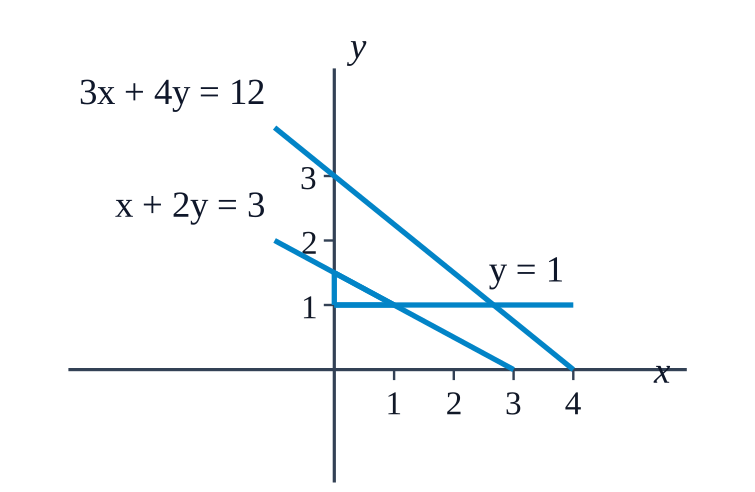
    Show that the following system of linear inequalities has no solution x+2y≤3,3x+4y≥12,x≥0,y≥1x+2 y \leq 3,3 x+4 y \geq 12, x \geq 0, y \geq 1

    Not cross-checked

    NCERT prints no numerical answer for this exercise, so this working has not been cross-checked against the book.

    \[3x + 4y = 3(x + 2y) - 2y \]\[x + 2y \le 3 \;\Rightarrow\; 3(x + 2y) \le 9 \]\[y \ge 1 \;\Rightarrow\; -2y \le -2 \]\[3x + 4y \le 9 - 2 = 7 < 12 \]This contradicts \(\displaystyle 3x + 4y \ge 12\).NCERT_Solution_Class11_Maths_Exemplar_Ch6_Ex6-3_Q16Answer: no point satisfies all four inequalities, so the system has no solution.
  7. Exercise 17

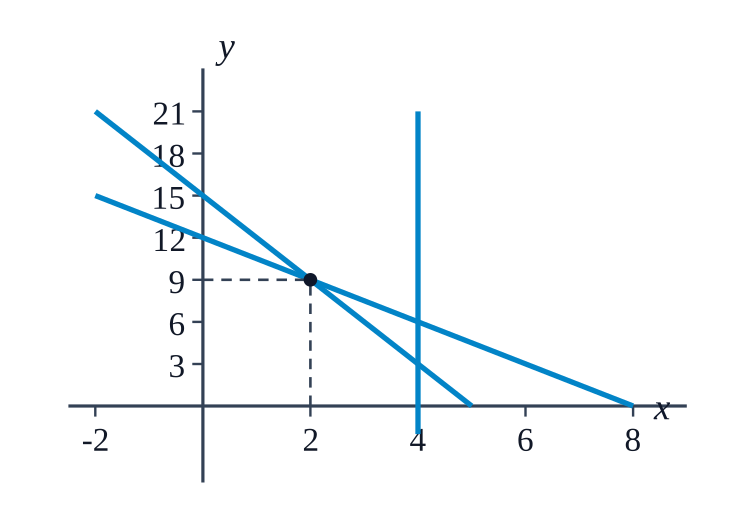
    Solve the following system of linear inequalities: 3x+2y≥24,3x+y≤15,x≥43 x+2 y \geq 24,3 x+y \leq 15, x \geq 4

    Matches the book, not yet reviewed

    This working reaches the answer NCERT prints. It has not yet been read through by hand.

    NCERT’s answer
    No Solution.
    Add the first inequality to the negative of the second:\[3x+2y\ge 24,\qquad -3x-y\ge -15 \]\[y\ge 9 \]Put this back into \(\displaystyle 3x+y\le 15\):\[3x\le 15-y\le 15-9=6 \]\[x\le 2 \]The first two inequalities hold only for \(\displaystyle x\le 2\), but \(\displaystyle x\ge 4\) is required.NCERT_Solution_Class11_Maths_Exemplar_Ch6_Ex6-3_Q17Answer: No solution; the solution set is empty (\(\displaystyle \varnothing\)).
  8. Exercise 18

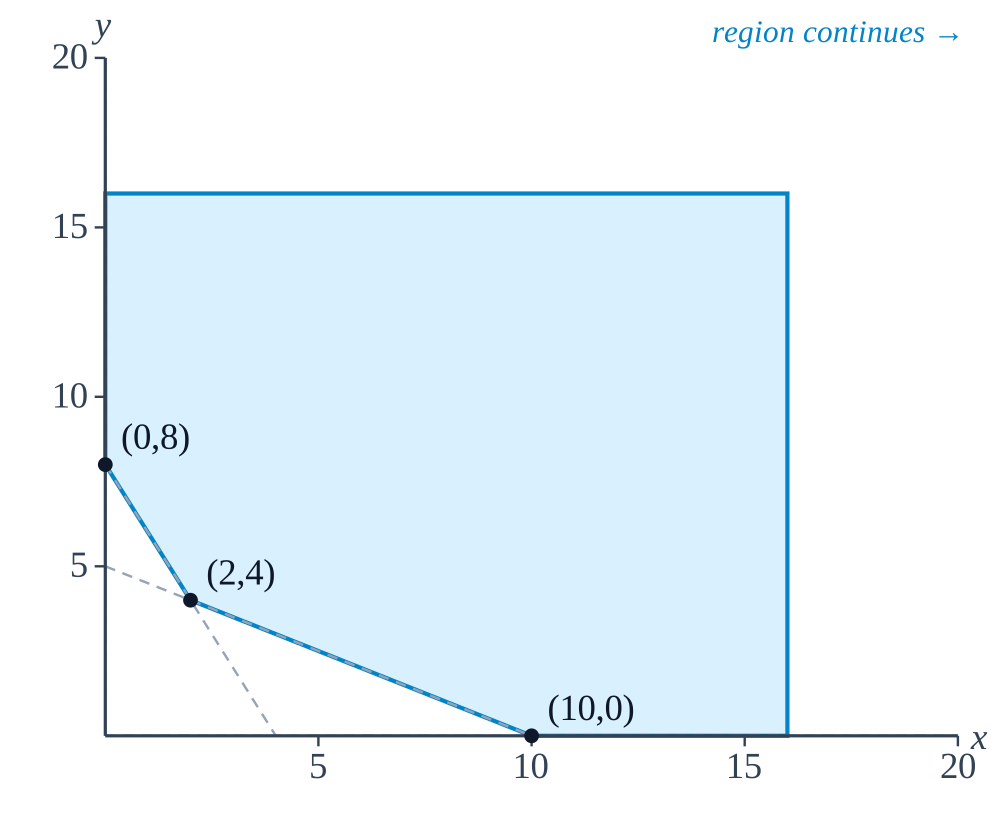
    Show that the solution set of the following system of linear inequalities is an unbounded region 2x+y≥8,x+2y≥10,x≥0,y≥02 x+y \geq 8, x+2 y \geq 10, x \geq 0, y \geq 0

    Not cross-checked

    NCERT prints no numerical answer for this exercise, so this working has not been cross-checked against the book.

    Corner points of the region:\[2x+y=8,\ x+2y=10 \ \Rightarrow\ (2,4) \]\[x=0 \text{ on } 2x+y=8 \ \Rightarrow\ (0,8) \]\[y=0 \text{ on } x+2y=10 \ \Rightarrow\ (10,0) \]NCERT_Solution_Class11_Maths_Exemplar_Ch6_Ex6-3_Q18Every point \(\displaystyle (t,t)\) with \(\displaystyle t\ge 4\) lies in the set:\[2t+t=3t\ge 12\ge 8 \]\[t+2t=3t\ge 12\ge 10 \]\(\displaystyle t\) can be as large as we please, so no circle encloses the region.Answer: The solution set is unbounded.
  9. Choose the correct answer from the given four options in each of the Exercises $\displaystyle 19$ to $\displaystyle 26$ (M.C.Q.).

    Exercise 19

    If x<5\displaystyle x<5, then
    (A)
    −x<−5\displaystyle -x<-5
    (B)
    −x≤−5\displaystyle -x \leq-5
    (C)
    −x>−5\displaystyle -x>-5
    (D)
    −x≥−5\displaystyle -x \geq-5

    Matches the book, not yet reviewed

    This working reaches the answer NCERT prints. It has not yet been read through by hand.

    NCERT’s answer
    C
    (C) \(\displaystyle -x>-5\)Multiplying by \(\displaystyle -1\) reverses the inequality:\[x<5 \ \Rightarrow\ -x>-5 \]
  10. Exercise 20

    Given that x,y\displaystyle x, y and b\displaystyle b are real numbers and x<y,b<0\displaystyle x<y, b<0, then
    (A)
    xb<yb\displaystyle \frac{x}{b}<\frac{y}{b}
    (B)
    xb≤yb\displaystyle \frac{x}{b} \leq \frac{y}{b}
    (C)
    xb>yb\displaystyle \frac{x}{b}>\frac{y}{b}
    (D)
    xb≥yb\displaystyle \frac{x}{b} \geq \frac{y}{b}

    Matches the book, not yet reviewed

    This working reaches the answer NCERT prints. It has not yet been read through by hand.

    NCERT’s answer
    C
    (C) \(\displaystyle \dfrac{x}{b}>\dfrac{y}{b}\)Dividing by the negative number \(\displaystyle b\) reverses the inequality:\[x<y,\ b<0 \ \Rightarrow\ \frac{x}{b}>\frac{y}{b} \]