SolveIt is under development
SolveItNCERT · CBSE · NEET

NCERT Exemplar · Class 10 Mathematics Quadratic Equations

28 questions · 28 still being checked

EXERCISE 4.4 1–8 (part 4 of 4)

  1. Exercise 1

    Find whether the following equations have real roots. If real roots exist, find them.
    (i)
    8x2+2x−3=0\displaystyle 8 x^2+2 x-3=0
    (ii)
    −2x2+3x+2=0\displaystyle -2 x^2+3 x+2=0
    (iii)
    5x2−2x−10=0\displaystyle 5 x^2-2 x-10=0
    (iv)
    12x−3+1x−5=1,x≠32,5\displaystyle \frac{1}{2 x-3}+\frac{1}{x-5}=1, x \neq \frac{3}{2}, 5
    (v)
    x2+55x−70=0\displaystyle x^2+5 \sqrt{5} x-70=0

    Matches the book, not yet reviewed

    This working reaches the answer NCERT prints. It has not yet been read through by hand.

    NCERT’s answer
    (i)
    Real roots exist; roots are \(\displaystyle \frac{1}{2}, \frac{-3}{4}\)
    (ii)
    Real roots exist; roots are \(\displaystyle 2,-\frac{1}{2}\)
    (iii)
    Real roots exist; roots are \(\displaystyle \frac{1}{5}+\frac{\sqrt{51}}{5}, \frac{1}{5}-\frac{\sqrt{51}}{5}\)
    (iv)
    Real roots exist; roots are \(\displaystyle 4+\frac{3 \sqrt{2}}{2}, 4-\frac{3 \sqrt{2}}{2}\)
    (v)
    Real roots exist; roots are \(\displaystyle -7 \sqrt{5}, 2 \sqrt{5}\)
    Real roots exist when \(\displaystyle D=b^2-4ac\ge 0 \).
    (i)
    \[8x^2+2x-3=0,\quad D=2^2-4(8)(-3)=100>0 \]
    \[x=\frac{-2\pm\sqrt{100}}{16}=\frac12,\ -\frac34 \]
    (ii)
    \[-2x^2+3x+2=0 \ \Rightarrow\ 2x^2-3x-2=0,\quad D=9+16=25>0 \]
    \[x=\frac{3\pm5}{4}=2,\ -\frac12 \]
    (iii)
    \[5x^2-2x-10=0,\quad D=4+200=204>0 \]
    \[x=\frac{2\pm\sqrt{204}}{10}=\frac{1\pm\sqrt{51}}{5} \]
    (iv)
    \[\frac{1}{2x-3}+\frac{1}{x-5}=1 \ \Rightarrow\ 3x-8=(2x-3)(x-5) \]
    \[2x^2-16x+23=0,\quad D=256-184=72>0 \]
    \[x=\frac{16\pm\sqrt{72}}{4}=\frac{8\pm3\sqrt2}{2} \]
    (v)
    \[x^2+5\sqrt5\,x-70=0,\quad D=125+280=405>0 \]
    \[x=\frac{-5\sqrt5\pm\sqrt{405}}{2}=\frac{-5\sqrt5\pm9\sqrt5}{2}=2\sqrt5,\ -7\sqrt5 \]
    Answer: real roots exist in all five: (i) \(\displaystyle \tfrac12,\,-\tfrac34 \) (ii) \(\displaystyle 2,\,-\tfrac12 \) (iii) \(\displaystyle \tfrac{1\pm\sqrt{51}}{5} \) (iv) \(\displaystyle \tfrac{8\pm3\sqrt2}{2} \) (v) \(\displaystyle 2\sqrt5,\,-7\sqrt5 \)
  2. Exercise 2

    Find a natural number whose square diminished by 84\displaystyle 84 is equal to thrice of 8\displaystyle 8 more than the given number.

    Matches the book, not yet reviewed

    This working reaches the answer NCERT prints. It has not yet been read through by hand.

    NCERT’s answer
    The natural number is $\displaystyle 12$
    Let the natural number be \(\displaystyle x \). \[x^2-84=3(x+8) \] \[x^2-3x-108=0 \] \[D=9+432=441=21^2 \] \[x=\frac{3\pm21}{2}=12,\ -9 \] Reject the negative value; \(\displaystyle x \) is natural.Answer: \(\displaystyle x=12 \).
  3. Exercise 3

    A natural number, when increased by 12\displaystyle 12, equals 160\displaystyle 160 times its reciprocal. Find the number.

    Matches the book, not yet reviewed

    This working reaches the answer NCERT prints. It has not yet been read through by hand.

    NCERT’s answer
    The natural number is $\displaystyle 8$
    Let the number be \(\displaystyle x \). \[x+12=\frac{160}{x} \] \[x^2+12x-160=0 \] \[D=144+640=784=28^2 \] \[x=\frac{-12\pm28}{2}=8,\ -20 \] Reject the negative root.Answer: \(\displaystyle x=8 \).
  4. Exercise 4

    A train, travelling at a uniform speed for 360\displaystyle 360 km, would have taken 48\displaystyle 48 minutes less to travel the same distance if its speed were 5\displaystyle 5 km/h more. Find the original speed of the train.

    Matches the book, not yet reviewed

    This working reaches the answer NCERT prints. It has not yet been read through by hand.

    NCERT’s answer
    Original speed of the train is $\displaystyle 45$ km/h
    Let the original speed be \(\displaystyle x \) km/h. \[\frac{360}{x}-\frac{360}{x+5}=\frac{48}{60} \] \[\frac{360\cdot5}{x(x+5)}=\frac45 \ \Rightarrow\ 4x^2+20x-9000=0 \] \[x^2+5x-2250=0,\quad D=25+9000=9025=95^2 \] \[x=\frac{-5\pm95}{2}=45,\ -50 \] Reject the negative speed.Answer: \(\displaystyle 45 \) km/h.
  5. Exercise 5

    If Zeba were younger by 5\displaystyle 5 years than what she really is, then the square of her age (in years) would have been 11\displaystyle 11 more than five times her actual age. What is her age now?

    Matches the book, not yet reviewed

    This working reaches the answer NCERT prints. It has not yet been read through by hand.

    NCERT’s answer
    Zeba's age now is $\displaystyle 14$ years
    Let Zeba's present age be \(\displaystyle x \) years. \[(x-5)^2=5x+11 \] \[x^2-15x+14=0 \] \[(x-1)(x-14)=0 \ \Rightarrow\ x=1,\ 14 \] At \(\displaystyle x=1 \), \(\displaystyle x-5 \) is negative, so this root is rejected.Answer: \(\displaystyle 14 \) years.
  6. Exercise 6

    At present Asha's age (in years) is 2\displaystyle 2 more than the square of her daughter Nisha's age. When Nisha grows to her mother's present age, Asha's age would be one year less than 10\displaystyle 10 times the present age of Nisha. Find the present ages of both Asha and Nisha.

    Matches the book, not yet reviewed

    This working reaches the answer NCERT prints. It has not yet been read through by hand.

    NCERT’s answer
    Nisha's age is $\displaystyle 5$ years and Asha's age is $\displaystyle 27$ years
    Let Nisha's present age be \(\displaystyle x \); Asha's present age is \(\displaystyle x^2+2 \). Nisha reaches Asha's present age after \(\displaystyle x^2+2-x \) years, when Asha's age is \[(x^2+2)+(x^2+2-x)=2x^2-x+4 \] \[2x^2-x+4=10x-1 \] \[2x^2-11x+5=0,\quad D=121-40=81 \] \[x=\frac{11\pm9}{4}=5,\ \frac12 \] \(\displaystyle x=\tfrac12 \) gives Asha \(\displaystyle 2\tfrac14 \) years, impossible for a mother; rejected. \[\text{Asha}=5^2+2=27 \]Answer: Nisha is \(\displaystyle 5 \) years old, Asha is \(\displaystyle 27 \) years old.
  7. Exercise 7

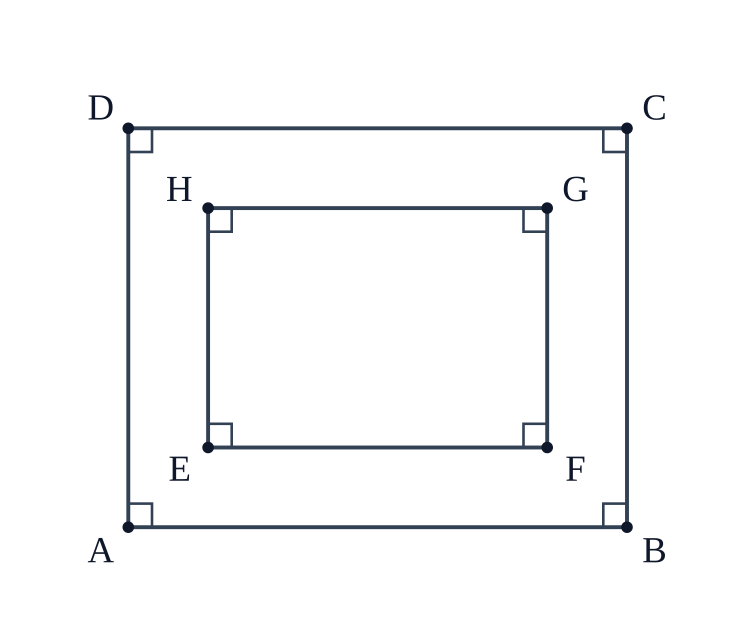
    In the centre of a rectangular lawn of dimensions 50\displaystyle 50 m × 40\displaystyle 40 m, a rectangular pond has to be constructed so that the area of the grass surrounding the pond would be 1184 m2\displaystyle 1184 \mathrm{~m}^2 [see Fig. 4.1\displaystyle 4.1]. Find the length and breadth of the pond. NCERT_Question_Class10_Maths_Exemplar_Ch4_Ex4-4_Q7

    Matches the book, not yet reviewed

    This working reaches the answer NCERT prints. It has not yet been read through by hand.

    NCERT’s answer
    Length of the pond is $\displaystyle 34$ m and breadth is $\displaystyle 24$ m
    Let the uniform border width be \(\displaystyle x \) m; the pond measures \(\displaystyle (50-2x) \) by \(\displaystyle (40-2x) \). NCERT_Solution_Class10_Maths_Exemplar_Ch4_Ex4-4_Q7 \[50\times40-(50-2x)(40-2x)=1184 \] \[2000-(2000-180x+4x^2)=1184 \] \[4x^2-180x+1184=0 \ \Rightarrow\ x^2-45x+296=0 \] \[D=2025-1184=841=29^2 \] \[x=\frac{45\pm29}{2}=37,\ 8 \] \(\displaystyle x=37 \) exceeds half the \(\displaystyle 40 \) m breadth — rejected, so \(\displaystyle x=8 \).Answer: length \(\displaystyle 34 \) m, breadth \(\displaystyle 24 \) m.
  8. Exercise 8

    At t\displaystyle t minutes past 2\displaystyle 2 pm, the time needed by the minutes hand of a clock to show 3\displaystyle 3 pm was found to be 3\displaystyle 3 minutes less than t24\displaystyle \frac{t^2}{4} minutes. Find t\displaystyle t.

    Matches the book, not yet reviewed

    This working reaches the answer NCERT prints. It has not yet been read through by hand.

    NCERT’s answer
    $\displaystyle 14$
    Let \(\displaystyle t \) be the minutes past $\displaystyle 2$ pm; the minute hand needs \(\displaystyle (60-t) \) minutes to reach $\displaystyle 3$ pm. \[60-t=\frac{t^2}{4}-3 \] \[t^2+4t-252=0 \] \[D=16+1008=1024=32^2 \] \[t=\frac{-4\pm32}{2}=14,\ -18 \] Reject the negative value.Answer: \(\displaystyle t=14 \) minutes.