SolveIt is under development
SolveItNCERT · CBSE · NEET

NCERT Exemplar · Class 10 Mathematics Polynomials

29 questions · 29 still being checked

EXERCISE 2.1 1–11 (part 1 of 4)

  1. Choose the correct answer from the given four options in the following questions:

    Exercise 1

    If one of the zeroes of the quadratic polynomial (k−1)x2+kx+1\displaystyle (k-1) x^2+k x+1 is -3\displaystyle 3, then the value of k\displaystyle k is
    (A)
    43\displaystyle \frac{4}{3}
    (B)
    −43\displaystyle \frac{-4}{3}
    (C)
    23\displaystyle \frac{2}{3}
    (D)
    −23\displaystyle \frac{-2}{3}

    Matches the book, not yet reviewed

    This working reaches the answer NCERT prints. It has not yet been read through by hand.

    NCERT’s answer
    (A)
    (A) \(\displaystyle \frac{4}{3}\)\[(k-1)(-3)^2+k(-3)+1=0 \] \[9(k-1)-3k+1=0 \] \[6k-8=0 \] \[k=\frac{4}{3} \]
  2. Exercise 2

    A quadratic polynomial, whose zeroes are -3\displaystyle 3 and 4\displaystyle 4, is
    (A)
    x2−x+12\displaystyle x^2-x+12
    (B)
    x2+x+12\displaystyle x^2+x+12
    (C)
    x22−x2−6\displaystyle \frac{x^2}{2}-\frac{x}{2}-6
    (D)
    2x2+2x−24\displaystyle 2 x^2+2 x-24

    Matches the book, not yet reviewed

    This working reaches the answer NCERT prints. It has not yet been read through by hand.

    NCERT’s answer
    (C)
    (C) \(\displaystyle \frac{x^2}{2}-\frac{x}{2}-6\)\[\alpha+\beta=-3+4=1,\quad \alpha\beta=(-3)(4)=-12 \] \[x^2-(\alpha+\beta)x+\alpha\beta=x^2-x-12 \] \[\tfrac{1}{2}\left(x^2-x-12\right)=\frac{x^2}{2}-\frac{x}{2}-6 \]
  3. Exercise 3

    If the zeroes of the quadratic polynomial x2+(a+1)x+b\displaystyle x^2+(a+1) x+b are 2\displaystyle 2 and -3\displaystyle 3, then
    (A)
    a=−7,b=−1\displaystyle a=-7, b=-1
    (B)
    a=5,b=−1\displaystyle a=5, b=-1
    (C)
    a=2,b=−6\displaystyle a=2, b=-6
    (D)
    a=0,b=−6\displaystyle a=0, b=-6

    Matches the book, not yet reviewed

    This working reaches the answer NCERT prints. It has not yet been read through by hand.

    NCERT’s answer
    (D)
    (D) \(\displaystyle a=0,\ b=-6\)\[\alpha+\beta=2+(-3)=-1=-(a+1) \] \[\implies a=0 \] \[\alpha\beta=2(-3)=-6=b \]
  4. Exercise 4

    The number of polynomials having zeroes as -2\displaystyle 2 and 5\displaystyle 5 is
    (A)
    1\displaystyle 1 (B) 2\displaystyle 2 (C) 3\displaystyle 3 (D) more than 3\displaystyle 3

    Matches the book, not yet reviewed

    This working reaches the answer NCERT prints. It has not yet been read through by hand.

    NCERT’s answer
    (D)
    (D) more than $\displaystyle 3$\[p(x)=k(x+2)(x-5),\quad k\neq 0 \] Every nonzero \(\displaystyle k\) gives a different polynomial with the same two zeroes.
  5. Exercise 5

    Given that one of the zeroes of the cubic polynomial ax3+bx2+cx+d\displaystyle a x^3+b x^2+c x+d is zero, the product of the other two zeroes is
    (A)
    −ca\displaystyle -\frac{c}{a}
    (B)
    ca\displaystyle \frac{c}{a}
    (C)
    0\displaystyle 0 (D) −ba\displaystyle -\frac{b}{a}

    Matches the book, not yet reviewed

    This working reaches the answer NCERT prints. It has not yet been read through by hand.

    NCERT’s answer
    (B)
    (B) \(\displaystyle \frac{c}{a}\)\[\text{zeroes: } 0,\ \alpha,\ \beta \] \[(0)\alpha+(0)\beta+\alpha\beta=\frac{c}{a} \] \[\alpha\beta=\frac{c}{a} \]
  6. Exercise 6

    If one of the zeroes of the cubic polynomial x3+ax2+bx+c\displaystyle x^3+a x^2+b x+c is -1\displaystyle 1, then the product of the other two zeroes is
    (A)
    b−a+1\displaystyle b-a+1
    (B)
    b−a−1\displaystyle b-a-1
    (C)
    a−b+1\displaystyle a-b+1
    (D)
    a−b−1\displaystyle a-b-1

    Matches the book, not yet reviewed

    This working reaches the answer NCERT prints. It has not yet been read through by hand.

    NCERT’s answer
    (A)
    (A) \(\displaystyle b-a+1\)\[\text{zeroes: } -1,\ \alpha,\ \beta \] \[-1+\alpha+\beta=-a \implies \alpha+\beta=1-a \] \[(-1)\alpha+(-1)\beta+\alpha\beta=b \] \[\alpha\beta=b+(\alpha+\beta)=b+(1-a)=b-a+1 \]
  7. Exercise 7

    The zeroes of the quadratic polynomial x2+99x+127\displaystyle x^2+99 x+127 are
    (A)
    both positive
    (B)
    both negative
    (C)
    one positive and one negative
    (D)
    both equal

    Matches the book, not yet reviewed

    This working reaches the answer NCERT prints. It has not yet been read through by hand.

    NCERT’s answer
    (B)
    (B) both negative. \[\alpha+\beta=\frac{-99}{1}=-99, \qquad \alpha\beta=\frac{127}{1}=127 \] Product positive: same sign. Sum negative: both negative.
  8. Exercise 8

    The zeroes of the quadratic polynomial x2+kx+k,k≠0\displaystyle x^2+k x+k, k \neq 0,
    (A)
    cannot both be positive
    (B)
    cannot both be negative
    (C)
    are always unequal
    (D)
    are always equal

    Matches the book, not yet reviewed

    This working reaches the answer NCERT prints. It has not yet been read through by hand.

    NCERT’s answer
    (A)
    (A) cannot both be positive. \[\alpha+\beta=-k, \qquad \alpha\beta=k \] If both positive: \(\displaystyle -k>0\) and \(\displaystyle k>0\) — contradiction.
  9. Exercise 9

    If the zeroes of the quadratic polynomial ax2+bx+c,c≠0\displaystyle a x^2+b x+c, c \neq 0 are equal, then
    (A)
    c\displaystyle c and a\displaystyle a have opposite signs
    (B)
    c\displaystyle c and b\displaystyle b have opposite signs
    (C)
    c\displaystyle c and a\displaystyle a have the same sign
    (D)
    c\displaystyle c and b\displaystyle b have the same sign

    Matches the book, not yet reviewed

    This working reaches the answer NCERT prints. It has not yet been read through by hand.

    NCERT’s answer
    (C)
    (C) \(\displaystyle c\) and \(\displaystyle a\) have the same sign. \[\Delta=b^2-4ac=0 \Rightarrow b^2=4ac \] \(\displaystyle b^2\ge 0\) and \(\displaystyle a,c\neq0\), so \(\displaystyle ac>0\): same sign.
  10. Exercise 10

    If one of the zeroes of a quadratic polynomial of the form x2+ax+b\displaystyle x^2+a x+b is the negative of the other, then it
    (A)
    has no linear term and the constant term is negative.
    (B)
    has no linear term and the constant term is positive.
    (C)
    can have a linear term but the constant term is negative.
    (D)
    can have a linear term but the constant term is positive.

    Matches the book, not yet reviewed

    This working reaches the answer NCERT prints. It has not yet been read through by hand.

    NCERT’s answer
    (A)
    (A) has no linear term and the constant term is negative. Let the zeroes be \(\displaystyle r,-r\). \[\text{Sum}=r+(-r)=0=-a \Rightarrow a=0 \] \[\text{Product}=r(-r)=-r^2=b \Rightarrow b<0 \]
  11. Exercise 11

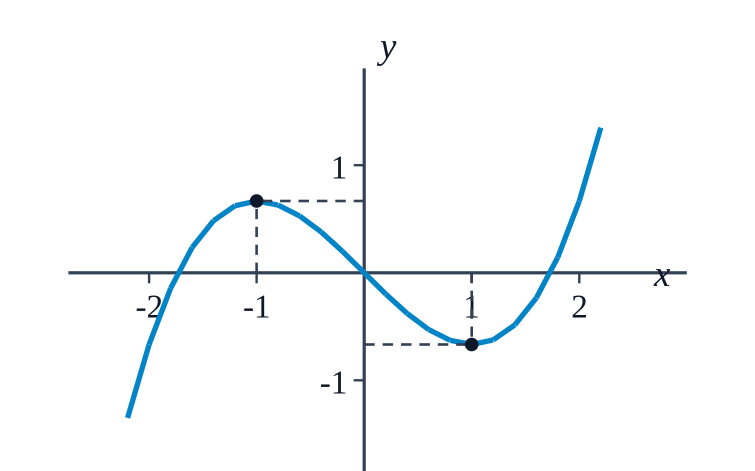
    Which of the following is not the graph of a quadratic polynomial?
    (A)
    (B)
    (C)
    (D)
    NCERT_Question_Class10_Maths_Exemplar_Ch2_Ex2-1_Q11
    NCERT_Question_Class10_Maths_Exemplar_Ch2_Ex2-1_Q11_2
    NCERT_Question_Class10_Maths_Exemplar_Ch2_Ex2-1_Q11_3
    NCERT_Question_Class10_Maths_Exemplar_Ch2_Ex2-1_Q11_4

    Matches the book, not yet reviewed

    This working reaches the answer NCERT prints. It has not yet been read through by hand.

    NCERT’s answer
    (D)
    (D) NCERT_Solution_Class10_Maths_Exemplar_Ch2_Ex2-1_Q11 A quadratic's graph is a parabola with exactly one turning point. This curve turns twice — a maximum then a minimum — the shape of a cubic.