✓ Board-verified
Physics · 2026 · 3 marks
CBSE 2026 · Region 1 · Set 1 · Q22
(a) Using Gauss's law, deduce an experession for electric field at a point due to a uniformly charged infinite plane thin sheet. (b) Two large thin…
(a)
Using Gauss's law, deduce an experession for electric field at a point due to a uniformly charged infinite plane thin sheet.
(b)
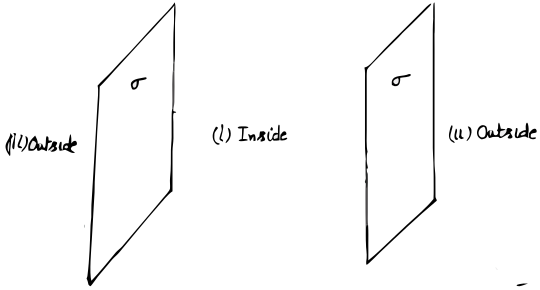
Two large thin plane sheets, each having surface charge density $\displaystyle \sigma$, are held close and parallel to each other in air. What is the net electric field at a point (i) inside and (ii) outside, the sheets ?
(a)
Obtain the condition of balance of a Wheatstone bridge.
(b)
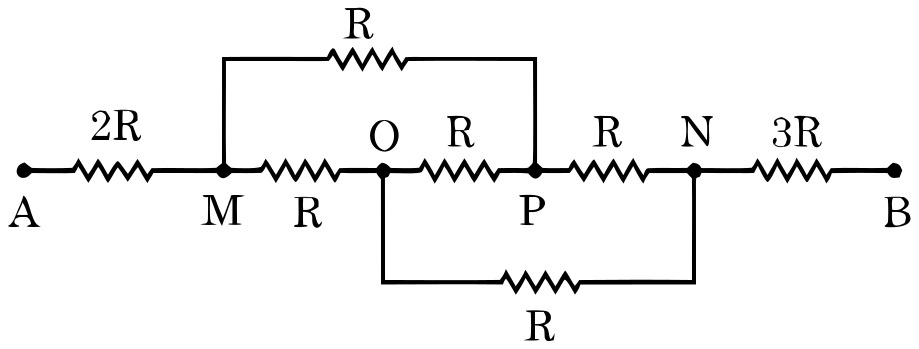
Find net resistance of the network of resistors connected between A and B, as shown in figure.
Marking-scheme solution
(a)
As seen from the figure, only the two faces $\displaystyle 1$ and $\displaystyle 2$ will contribute to the flux. Therefore, flux $\displaystyle \overrightarrow{\mathrm{E}} \cdot \Delta \overrightarrow{\mathrm{S}}$ through both the surfaces are equal and add up.
Therefore, net flux through the Gaussian surface is $\displaystyle 2$ EA. The charge enclosed by the close surface is $\displaystyle \sigma \mathrm{A}$.
$\displaystyle 2 \mathrm{EA}=\dfrac{\sigma \mathrm{A}}{\varepsilon_{0}}$
$\displaystyle \overrightarrow{\mathrm{E}}=\dfrac{\sigma}{2 \varepsilon_{0}} \hat{\mathrm{n}}$
(i)
$\displaystyle \mathrm{E}_{\text {in }}=0$
(ii)
$\displaystyle \mathrm{E}_{\text {out }}=\dfrac{\sigma}{\varepsilon_{0}}$
By using Kirchhoff's rule to closed loops ADBA and CBDC. The first loop gives
$\displaystyle -\mathrm{I}_{1} \mathrm{R}_{1}+0+\mathrm{I}_{2} \mathrm{R}_{2}=0$ ---------- ($\displaystyle 1$) $\displaystyle \because\left[V_{B}=V_{D},\ I_{g}=0\right]$
Second loop gives
$\displaystyle \mathrm{I}_{4} \mathrm{R}_{4}+0-\mathrm{I}_{3} \mathrm{R}_{3}=0$
$\displaystyle \because \mathrm{I}_{\mathrm{g}}=0$, hence
$\displaystyle \mathrm{I}_{1}=\mathrm{I}_{3}$ and $\displaystyle \mathrm{I}_{2}=\mathrm{I}_{4}$
$\displaystyle \mathrm{I}_{2} \mathrm{R}_{4}-\mathrm{I}_{1} \mathrm{R}_{3}=0$ ---------- ($\displaystyle 2$)
From equations ($\displaystyle 1$) and ($\displaystyle 2$)
Hence $\displaystyle \dfrac{\mathrm{R}_{2}}{\mathrm{R}_{1}}=\dfrac{\mathrm{R}_{4}}{\mathrm{R}_{3}}$
(b)
Due to balanced Wheatstone bridge
$\displaystyle \mathrm{R}_{\mathrm{MN}}=\mathrm{R}$
Total resistance across AB
$\displaystyle \mathrm{R}_{\mathrm{AB}}=\mathrm{R}_{\mathrm{AM}}+\mathrm{R}_{\mathrm{MN}}+\mathrm{R}_{\mathrm{NB}}$
$\displaystyle \mathrm{R}_{\mathrm{AB}}=2 \mathrm{R}+\mathrm{R}+3 \mathrm{R}$
$\displaystyle \mathrm{R}_{\mathrm{AB}}=6 \mathrm{R}\ \Omega$
All Electric Charges and Fields questions2026 question paperNCERT solutions: Electric Charges and FieldsPractice Electric Charges and Fields →
More from Electric Charges and Fields
- (i) Two point charges +q and -q are held at (a, 0) and ( -a, 0 ) in x-y plane. Obtain an expression for the net electric field due to the charges at…2025
- An electric dipole of dipole moment 1.0 × 10^-12 Cm lies along x -axis. An electric field of magnitude 2.0 × 10^4 NC^-1 is switched on at an instant…2025
- An electric dipole consists of two point charges q and -q separated by a distance 2a. Derive an expression for the electric field E due to this…2026
- Depict the orientation of an electric dipole in stable and unstable equilibrium in an external uniform electric field. Write the potential energy of…2023
- (i) Define electric flux and write its SI unit. (ii) Use Gauss' law to obtain the expression for the electric field due to a uniformly charged…2023
- Two small solid metal balls A and B of radii R and 2 R having charge densities 2 σ and 3 σ respectively are kept far apart. Find the charge densities…2025
- Define the term 'electric flux' and write its dimensions. A plane surface, in shape of a square of side 1 cm is placed in an electric field E=(100…2024
- Three small charged spheres X, Y and Z carrying charges +q,-q and +q respectively are placed equidistant from each other, as shown in the figure. The…2024
CBSE Class 12 Physics past-paper question from the 2026 board exam, with the answer as CBSE’s own marking scheme gives it. Where our answers come from.