✓ Board-verified
Physics · 2023 · 4 marks
CBSE 2023 · Region 1 · Set 1 · Q35
Strontium titanate is a rare oxide - a natural mineral found in Siberia. It is used as a substitute for diamond because its refractive index and…
Strontium titanate is a rare oxide - a natural mineral found in Siberia. It is used as a substitute for diamond because its refractive index and critical angle are $\displaystyle 2 \cdot 41$ and $\displaystyle 24 \cdot 5^{\circ}$, respectively, which are approximately equal to the refractive index and critical angle of diamond. It has all the properties of diamond. Even an expert jeweller is unable to differentiate between diamond and strontium titanate. A ray of light is incident normally on one face of an equilateral triangular prism ABC made of strontium titanate.
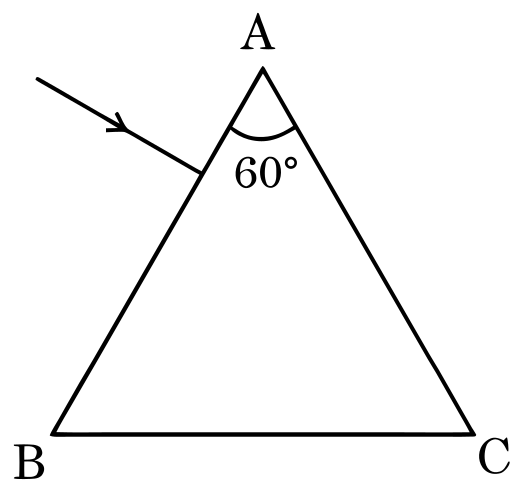
Answer the following questions based on the above :
(a)
Trace the path of the ray showing its passage through the prism.
(b)
Find the velocity of light through the prism.
(c)
Briefly explain two applications of total internal reflection.
OR
(c)
Define total internal reflection of light. Give two conditions for it.
Marking-scheme solution
a) 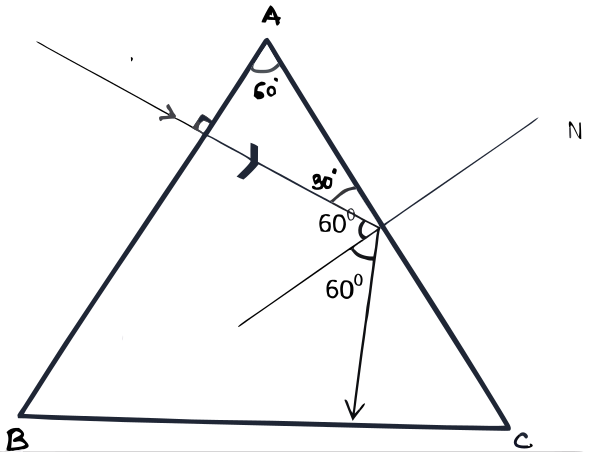
From fig. angle of incidence on second face \(\displaystyle \angle i=60^{0}\) critical angle \(\displaystyle \angle i_{c}=24.5^{\circ}\)
\[(\angle i)>\left(\angle i_{c}\right)
\]
∴ TIR takes place
(b)
\(\displaystyle \mathrm{n}=\frac{c}{\mathrm{v}}\)
\[\mathrm{v}=\frac{c}{\mathrm{n}}=\frac{3 \times 10^{8}}{2.41}=1.24 \times 10^{8} \mathrm{~m} / \mathrm{s}
\]
Optical Fibre / Brilliance of diamond / mirage
When light travels from optically denser medium to rarer medium at an interface and gets reflected back into the same medium the phenomenon is called as total internal reflection.
Conditions for TIR
1. Light must travel from optically denser medium to rarer medium.
2. Angle of incidence at the interface must be greater than the critical angle for the pair of media.
All Ray Optics and Optical Instruments questions2023 question paperNCERT solutions: Ray Optics and Optical InstrumentsPractice Ray Optics and Optical Instruments →
More from Ray Optics and Optical Instruments
- A small bulb is placed at the bottom of a tank, containing a transparent liquid of refractive index √2, to a depth of 1 m. Calculate the area of the…2026
- Assertion: A convex lens, when immersed in a liquid, disappears. Reason ( R ): The refractive indices of material of the lens and the liquid are…2024
- A right angled isosceles glass prism ABC is kept in contact with an equilateral triangular prism DBC as shown in the figure. Both prisms are made of…2025
- A convex lens (n = 1.52) has a focal length of 15.0 cm in air. Find its focal length when it is immersed in liquid of refractive index 1.65. What…2024
- (i) Draw a labelled ray diagram showing the formation of the image at infinity by an astronomical telescope. (ii) A telescope consists of an…2022
- Two convex lenses A and B, each of focal length 10.0 cm, are mounted on an optical bench at 50.0 cm and 70.0 cm respectively. An object is mounted at…2025
- A right-angled prism ABC (refractive index √2 ) is kept on a plane mirror as shown in the figure. A ray of light is incident normally on the face AC.…2025
- A ray of light is incident on a glass prism of refractive index μ and refracting angle A. If it just suffers total internal reflection at the other…2023
CBSE Class 12 Physics past-paper question from the 2023 board exam, with the answer as CBSE’s own marking scheme gives it. Where our answers come from.