✓ Board-verified
Physics · 2023 · 4 marks
Ray Optics and Optical InstrumentsRefraction at Spherical Surfaces and by Lenses4 marksApplycase study
CBSE 2023 · Region 5 · Set 1 · Q34
A lens is a transparent optical medium bounded by two surfaces; at least one of which should be spherical. Considering image formation by a single…
A lens is a transparent optical medium bounded by two surfaces; at least one of which should be spherical. Considering image formation by a single spherical surface successively at the two surfaces of a lens, lens maker's formula is obtained. It is useful to design lenses of desired focal length using surfaces of suitable radii of curvature. This formula helps us obtain a relation between $\displaystyle \mathrm{u}, \mathrm{v}$ and f for a lens. Lenses form images of objects and they are used in a number of optical devices, for example microscopes and telescopes.
(i)
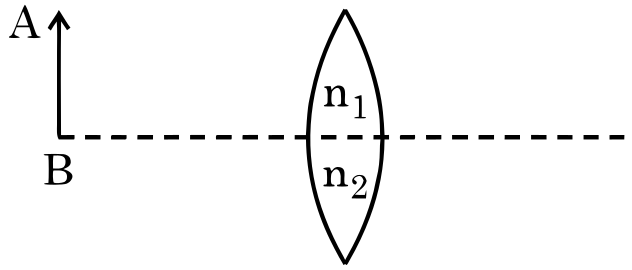
An object AB is kept in front of a composite convex lens, as shown in figure. Will the lens produce one image ? If not, explain.
(ii)
A real image of an object formed by a convex lens is observed on a screen. If the screen is removed, will the image still be formed ? Explain.
(iii)
A double convex lens is made of glass of refractive index $\displaystyle 1.55$ with both faces of the same radius of curvature. Find the radius of curvature required if focal length is $\displaystyle 20$ cm .
OR
(iii)
Two convex lenses A and B of focal lengths $\displaystyle 15$ cm and $\displaystyle 10$ cm respectively are placed coaxially ' $\displaystyle d$ ' distance apart. A point object is kept at a distance of $\displaystyle 30$ cm in front of lens A . Find the value of 'd' so that the rays emerging from lens B are parallel to its principal axis.
Marking-scheme solution
(iii)
For
OR &
(i) No, The lens is made up of two materials of different refractive indices. It has two focal lengths.
(ii)
Yes Rays are still intersecting/ converging at the location of image.
(iii)
\(\displaystyle \frac{1}{f}=(n-1)\left[\frac{1}{R_{1}}-\frac{1}{R_{2}}\right]\)
\[R_{1}=+R, R_{2}=-R
\]
All Ray Optics and Optical Instruments questions2023 question paperNCERT solutions: Ray Optics and Optical InstrumentsPractice Ray Optics and Optical Instruments →
More from Ray Optics and Optical Instruments
- A small bulb is placed at the bottom of a tank, containing a transparent liquid of refractive index √2, to a depth of 1 m. Calculate the area of the…2026
- Assertion: A convex lens, when immersed in a liquid, disappears. Reason ( R ): The refractive indices of material of the lens and the liquid are…2024
- A right angled isosceles glass prism ABC is kept in contact with an equilateral triangular prism DBC as shown in the figure. Both prisms are made of…2025
- A convex lens (n = 1.52) has a focal length of 15.0 cm in air. Find its focal length when it is immersed in liquid of refractive index 1.65. What…2024
- (i) Draw a labelled ray diagram showing the formation of the image at infinity by an astronomical telescope. (ii) A telescope consists of an…2022
- Two convex lenses A and B, each of focal length 10.0 cm, are mounted on an optical bench at 50.0 cm and 70.0 cm respectively. An object is mounted at…2025
- A right-angled prism ABC (refractive index √2 ) is kept on a plane mirror as shown in the figure. A ray of light is incident normally on the face AC.…2025
- A ray of light is incident on a glass prism of refractive index μ and refracting angle A. If it just suffers total internal reflection at the other…2023
CBSE Class 12 Physics past-paper question from the 2023 board exam, with the answer as CBSE’s own marking scheme gives it. Where our answers come from.