✓ Board-verified
Physics · 2024 · 5 marks
CBSE 2024 · Region 3 · Set 1 · Q33
(a) (i) Trace the path of a ray of light showing refraction through a triangular prism and hence obtain an expression for angle of deviation ( δ ) in…
(a)(i)
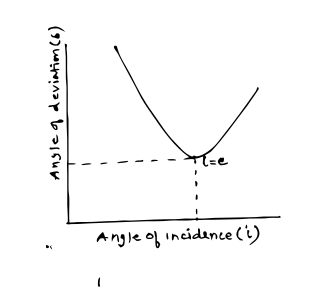
Trace the path of a ray of light showing refraction through a triangular prism and hence obtain an expression for angle of deviation ( $\displaystyle \delta$ ) in terms of A, i and e, where symbols have their usual meanings. Draw a graph showing the variation of angle of deviation with the angle of incidence.
(ii)
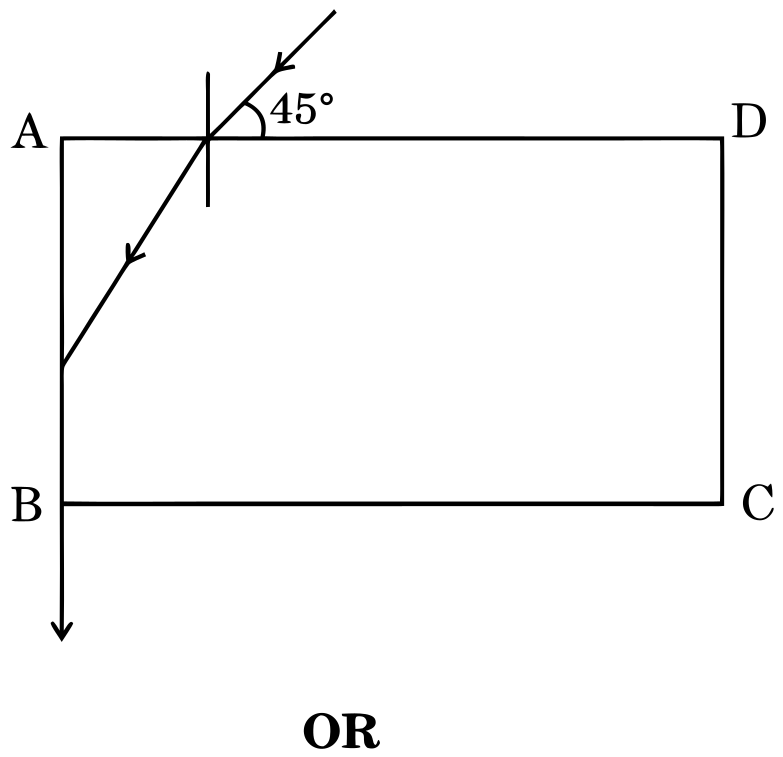
In the figure, a ray of light is incident on a transparent liquid contained in a thin glass box at an angle of $\displaystyle 45^{\circ}$ with its one face. The emergent ray passes along the face AB . Find the refractive index of the liquid.
(b)(i)
The displacement of two light waves, each of amplitude 'a' and frequency $\displaystyle \omega$, emanating from two coherent sources of light, are given by $\displaystyle \mathrm{y}_{1}=\mathrm{a} \cos \omega \mathrm{t}$ and $\displaystyle \mathrm{y}_{2}=\mathrm{a} \cos (\omega \mathrm{t}+\phi) . \phi$ is the phase difference between the two waves. These light waves superpose at a point. Obtain the expression for the resultant intensity at that point.
(ii)
In Young's double slit experiment, find the ratio of intensities at two points on a screen when waves emanating from two slits reaching these points have path differences (i) $\displaystyle \frac{\lambda}{6}$ and
(ii)
$\displaystyle \frac{\lambda}{12}$.
Marking-scheme solution
(i)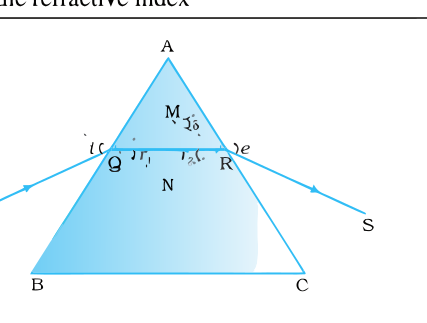
For quadrilateral AQNR,
$\displaystyle \angle A + \angle QNR = 180^\circ$ --- (i)
For triangle QNR
$\displaystyle r_1 + r_2 + \angle QNR = 180^\circ$ ---- (ii)
comparing equation (i) and (ii)
$\displaystyle r_1 + r_2 = A$ ------ (iii)
The angle of deviation
$\displaystyle \delta = (i - r_1) + (e - r_2)$ ------ (iv)
from equation (iii) and (iv)
$\displaystyle \delta = i + e - A$
Graph
(ii)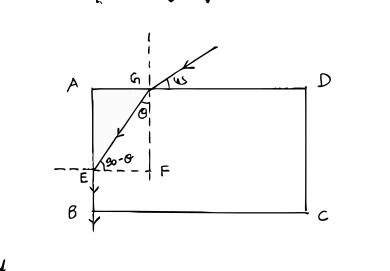
$\displaystyle \dfrac{\sin 45^\circ}{\sin\theta} = \mu$
$\displaystyle \dfrac{1}{\sqrt{2}} = \mu \sin\theta$
For second surface,
$\displaystyle \dfrac{\sin(90^0 - \theta)}{\sin 90^0} = \dfrac{1}{\mu}$
$\displaystyle \dfrac{1}{\sqrt{2}}\dfrac{\cos\theta}{\sin\theta} = 1$
$\displaystyle \tan\theta = \dfrac{1}{\sqrt{2}}$
From the triangle GEF
$\displaystyle \sin\theta = \dfrac{1}{\sqrt{3}}$
$\displaystyle \mu = \sqrt{\dfrac{3}{2}}$
(i)
$\displaystyle y_1 = a\cos\omega t$
$\displaystyle y_2 = a\cos(\omega t + \phi)$
According to the principle of superposition
$\displaystyle y = y_1 + y_2$
$\displaystyle y = a\cos\omega t + a\cos(\omega t + \phi)$
$\displaystyle y = a\cos\omega t + a\cos\omega t\cos\phi - a\sin\omega t\sin\phi$
$\displaystyle y = a\cos\omega t\,(1 + \cos\phi) - a\sin\phi\sin\omega t$
Let,
$\displaystyle a(1 + \cos\phi) = A\cos\theta$ ------- (i)
$\displaystyle a\sin\phi = A\sin\theta$ --------(ii)
Squaring and adding equation (i) and (ii)
$\displaystyle A^2 = a^2(1+\cos\phi)^2 + a^2\sin^2\phi$
$\displaystyle = a^2(1 + \cos^2\phi + 2\cos\phi) + a^2\sin^2\phi$
$\displaystyle = 2a^2(1 + \cos\phi)$
$\displaystyle = 4a^2\cos^2\phi/2$
$\displaystyle I \propto A^2$
$\displaystyle I = kA^2$
where k is constant
$\displaystyle I = 4ka^2\cos^2\phi/2$
(ii)
$\displaystyle \phi_1 = \dfrac{2\pi}{\lambda} \times \dfrac{\lambda}{6} = \pi/3$
$\displaystyle I_1 = 4I_0\cos^2\phi/2$
$\displaystyle = 4I_0\cos^2(\pi/6)$
$\displaystyle I_1 = 3I_0$
$\displaystyle \phi_2 = \dfrac{2\pi}{\lambda} \times \dfrac{\lambda}{12} = \pi/6$
$\displaystyle I_2 = 4I_0\cos^2(\pi/12)$
$\displaystyle I_2 = 4I_0\cos^2 15^0$
$\displaystyle \dfrac{I_1}{I_2} = \dfrac{3}{4\cos^2 15^0}$
All Ray Optics and Optical Instruments questions2024 question paperNCERT solutions: Ray Optics and Optical InstrumentsPractice Ray Optics and Optical Instruments →
More from Ray Optics and Optical Instruments
- A small bulb is placed at the bottom of a tank, containing a transparent liquid of refractive index √2, to a depth of 1 m. Calculate the area of the…2026
- Assertion: A convex lens, when immersed in a liquid, disappears. Reason ( R ): The refractive indices of material of the lens and the liquid are…2024
- A right angled isosceles glass prism ABC is kept in contact with an equilateral triangular prism DBC as shown in the figure. Both prisms are made of…2025
- A convex lens (n = 1.52) has a focal length of 15.0 cm in air. Find its focal length when it is immersed in liquid of refractive index 1.65. What…2024
- (i) Draw a labelled ray diagram showing the formation of the image at infinity by an astronomical telescope. (ii) A telescope consists of an…2022
- Two convex lenses A and B, each of focal length 10.0 cm, are mounted on an optical bench at 50.0 cm and 70.0 cm respectively. An object is mounted at…2025
- A right-angled prism ABC (refractive index √2 ) is kept on a plane mirror as shown in the figure. A ray of light is incident normally on the face AC.…2025
- A ray of light is incident on a glass prism of refractive index μ and refracting angle A. If it just suffers total internal reflection at the other…2023
CBSE Class 12 Physics past-paper question from the 2024 board exam, with the answer as CBSE’s own marking scheme gives it. Where our answers come from.