✓ Board-verified
Physics · 2024 · 5 marks
CBSE 2024 · Region 1 · Set 1 · Q33
(a) (i) A ray of light passes through a triangular prism. Show graphically, how the angle of deviation varies with the angle of incidence? Hence…
(i)
A ray of light passes through a triangular prism. Show graphically, how the angle of deviation varies with the angle of incidence ? Hence define the angle of minimum deviation.
(ii)
A ray of light is incident normally on a refracting face of a prism of prism angle A and suffers a deviation of angle $\displaystyle \delta$. Prove that the refractive index $\displaystyle \mathrm{n}$ of the material of the prism is given by $\displaystyle \mathrm{n}=\frac{\sin (\mathrm{A}+\delta)}{\sin \mathrm{A}}$.
(iii)
The refractive index of the material of a prism is $\displaystyle \sqrt{2}$. If the refracting angle of the prism is $\displaystyle 60^{\circ}$, find the
(1)
Angle of minimum deviation, and
(2)
Angle of incidence.
(i)
State Huygens' principle. A plane wave is incident at an angle i on a reflecting surface. Construct the corresponding reflected wavefront. Using this diagram, prove that the angle of reflection is equal to the angle of incidence.
(ii)
What are the coherent sources of light ? Can two independent sodium lamps act like coherent sources ? Explain.
(iii)
A beam of light consisting of a known wavelength $\displaystyle 520$ nm and an unknown wavelength $\displaystyle \lambda$, used in Young's double slit experiment produces two interference patterns such that the fourth bright fringe of unknown wavelength coincides with the fifth bright fringe of known wavelength. Find the value of $\displaystyle \lambda$.
Marking-scheme solution
(i)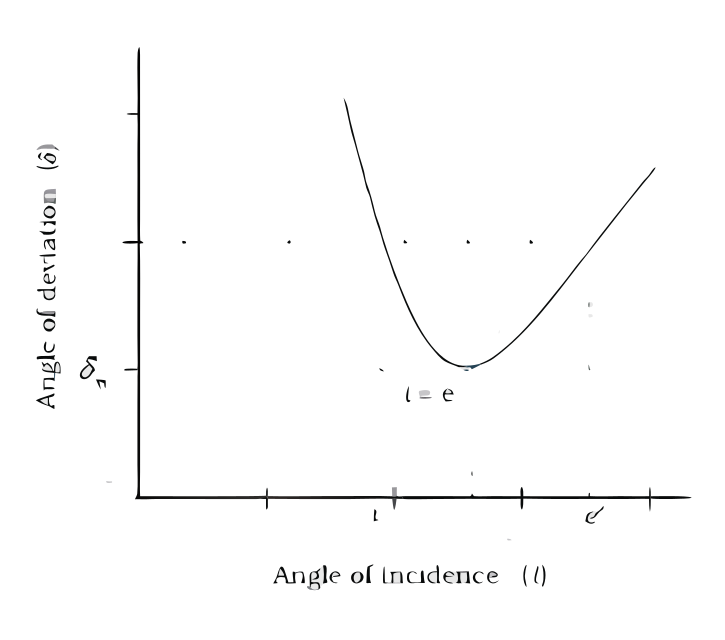
Minimum deviation angle is defined as the angle at which angle of incidence is equal to the angle of emergence.
Alternatively
At minimum deviation refracted ray inside the prism becomes parallel to the base of the prism.
(ii)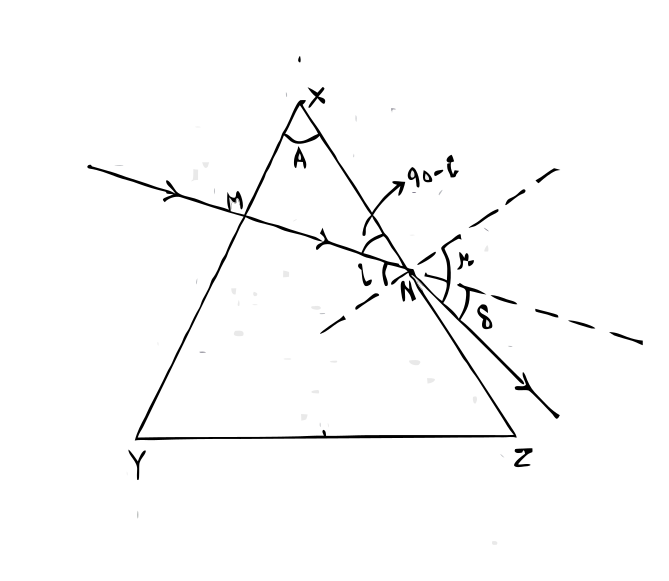
At the face XZ :-
$$\mu \sin i = 1 \times \sin r \qquad \text{-----(1)}$$
$$r = i + \delta \qquad [\text{from diagram}] \qquad \text{-----(2)}$$
In $\displaystyle \Delta XMN$ ; $\displaystyle A + (90 - i) + 90 = 180$
$$\Rightarrow A = i \qquad \text{-----(3)}$$
Putting eq. ($\displaystyle 3$) & ($\displaystyle 2$) in eq. ($\displaystyle 1$)
$$\mu \sin A = \sin (A + \delta)$$
$$\mu = \frac{\sin (A + \delta)}{\sin A}$$
(iii)
(1)
$$\mu = \frac{\sin\left(\dfrac{A + \delta_m}{2}\right)}{\sin \dfrac{A}{2}}$$
$$\sqrt{2} = \frac{\sin\left(\dfrac{60 + \delta_m}{2}\right)}{\sin 30^\circ}$$
$$\Rightarrow \sin\left(\frac{60 + \delta_m}{2}\right) = \frac{1}{\sqrt{2}} = \sin 45^\circ$$
$$\frac{60 + \delta_m}{2} = 45^\circ \Rightarrow \delta_m = 30^\circ$$
(2)
$$i = \frac{A + \delta_m}{2}$$
$$\Rightarrow i = \frac{60 + 30}{2}$$
$$i = 45^\circ$$
(i)
Each point of the wavefront is the source of a secondary disturbance and the wavelets emanating from these points spread out in all directions with the spread of the wave. Each point of the wavefront is the source of a secondary disturbance and the wavelets emanating from these points spread out in all directions with the speed of the wave. These wavelets emanating from the wavefront are usually referred to as secondary wavelets and if we draw a common tangent to all these spheres, we obtain the new position of the wavefront at a later time.
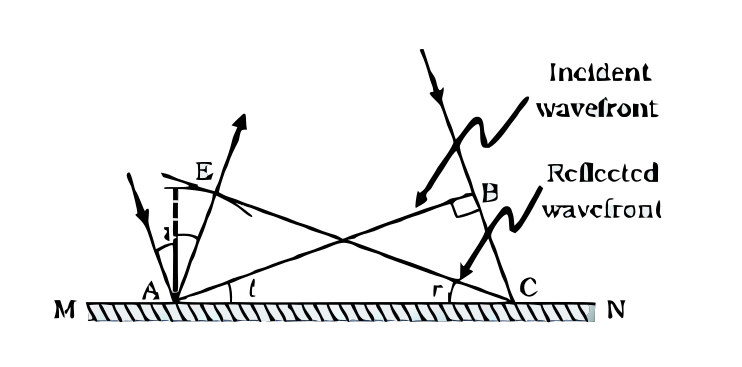
$\displaystyle \Delta EAC$ is congruent to $\displaystyle \Delta BAC$; so $\displaystyle \angle i = \angle r$
(ii)
Two sources are said to be coherent if the phase difference between them does not change with time.
No, two independent sodium lamps cannot be coherent.
Two independent sodium lamps cannot be coherent as the phase between them does not remain constant with time.
(iii)
$$4\beta_2 = 5\beta_1$$
$$4 \times \frac{\lambda D}{d} = 5 \times \frac{\lambda_{known} D}{d}$$
$$\Rightarrow \lambda = \frac{5}{4} \times \lambda_{known}$$
$$= \frac{5}{4} \times 520$$
$$= 650 \text{ nm}$$
All Ray Optics and Optical Instruments questions2024 question paperNCERT solutions: Ray Optics and Optical InstrumentsPractice Ray Optics and Optical Instruments →
More from Ray Optics and Optical Instruments
- A small bulb is placed at the bottom of a tank, containing a transparent liquid of refractive index √2, to a depth of 1 m. Calculate the area of the…2026
- Assertion: A convex lens, when immersed in a liquid, disappears. Reason ( R ): The refractive indices of material of the lens and the liquid are…2024
- A right angled isosceles glass prism ABC is kept in contact with an equilateral triangular prism DBC as shown in the figure. Both prisms are made of…2025
- A convex lens (n = 1.52) has a focal length of 15.0 cm in air. Find its focal length when it is immersed in liquid of refractive index 1.65. What…2024
- (i) Draw a labelled ray diagram showing the formation of the image at infinity by an astronomical telescope. (ii) A telescope consists of an…2022
- Two convex lenses A and B, each of focal length 10.0 cm, are mounted on an optical bench at 50.0 cm and 70.0 cm respectively. An object is mounted at…2025
- A right-angled prism ABC (refractive index √2 ) is kept on a plane mirror as shown in the figure. A ray of light is incident normally on the face AC.…2025
- A ray of light is incident on a glass prism of refractive index μ and refracting angle A. If it just suffers total internal reflection at the other…2023
CBSE Class 12 Physics past-paper question from the 2024 board exam, with the answer as CBSE’s own marking scheme gives it. Where our answers come from.