✓ Board-verified
Physics · 2023 · 5 marks
CBSE 2023 · Region 4 · Set 1 · Q32
(a) (i) Draw a ray diagram to show how the final image is formed at infinity in an astronomical refracting telescope. Obtain an expression for its…
(i)
Draw a ray diagram to show how the final image is formed at infinity in an astronomical refracting telescope. Obtain an expression for its magnifying power.
(ii)
Two thin lenses $\displaystyle \mathrm{L}_{1}$ and $\displaystyle \mathrm{L}_{2}, \mathrm{~L}_{1}$ being a convex lens of focal length $\displaystyle 24$ cm and $\displaystyle \mathrm{L}_{2}$ a concave lens of focal length $\displaystyle 18$ cm are placed coaxially at a separation of $\displaystyle 45$ cm . A $\displaystyle 1$ cm tall object is placed in front of the lens $\displaystyle \mathrm{L}_{1}$ at a distance of $\displaystyle 36$ cm . Find the location and height of the image formed by the combination.
(i)
Explain the working principle of an optical fibre with the help of a diagram. Mention one use of a light pipe.
(ii)
A ray of light is incident at an angle of $\displaystyle 60^{\circ}$ on one face of a prism with the prism angle $\displaystyle \mathrm{A}=60^{\circ}$. The ray passes symmetrically through the prism. Find the angle of minimum deviation ( $\displaystyle \delta_{\mathrm{m}}$ ) and refractive index of the material of the prism. If the prism is immersed in water, how will $\displaystyle \delta_{\mathrm{m}}$ be affected? Justify your answer.
Marking-scheme solution
(i)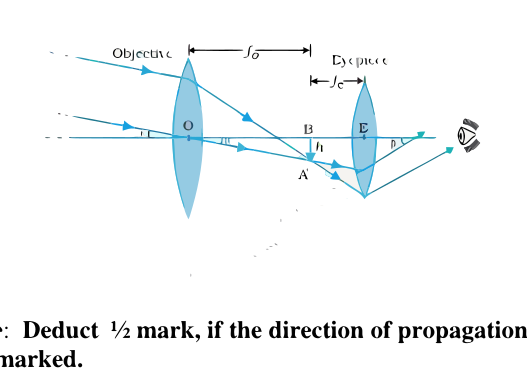
From the diagram $\displaystyle \beta = \dfrac{h}{f_e}$
and $\displaystyle \alpha = \dfrac{h}{f_o}$
Magnifying Power $\displaystyle = \dfrac{f_o}{f_e}$
(ii)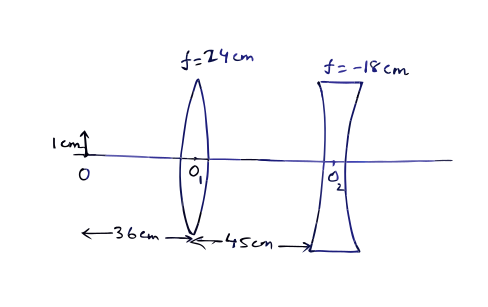
For lens $\displaystyle \mathrm{L}_1$,
$\displaystyle \dfrac{1}{v} - \dfrac{1}{u} = \dfrac{1}{f}$
$\displaystyle \dfrac{1}{v} - \dfrac{1}{-36} = \dfrac{1}{24}$
$\displaystyle \dfrac{1}{v} = \dfrac{1}{24} - \dfrac{1}{36}$
$\displaystyle \dfrac{1}{v} = \dfrac{3-2}{72} = \dfrac{1}{72}$
$\displaystyle v = 72\,cm$
For lens $\displaystyle \mathrm{L}_2$ :
$\displaystyle \dfrac{1}{v'} - \dfrac{1}{u'} = \dfrac{1}{f'}$
$\displaystyle \dfrac{1}{v'} - \dfrac{1}{(72-45)} = \dfrac{1}{-18}$
$\displaystyle \dfrac{1}{v'} = \dfrac{1}{-18} + \dfrac{1}{27}$
$\displaystyle \dfrac{1}{v'} = \dfrac{-3+2}{54} = \dfrac{-1}{54}$
$\displaystyle v' = -54\,cm$
Final distance $\displaystyle v_1' = -54 - (-45)$
$\displaystyle v_1' = -9\,cm$ (to the left of convex lens)
Magnification $\displaystyle \dfrac{h_i}{h_o} = \dfrac{v_1'}{u}$
$\displaystyle \dfrac{h_i}{1} = \dfrac{-9}{-36} \Rightarrow h_i = +\dfrac{1}{4}\,cm$
(i)
Working Principle:
Optical fibre uses the optical principle of total internal reflection to capture the light transmitted in an optical fibre and confine the light to the core of the fibre.
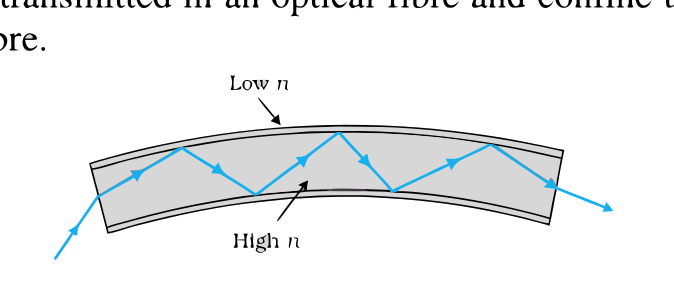
Uses : Transmission of audio and video signal / Examination of internal organs / Endoscopy
(ii)
$\displaystyle \delta_m = i + e - A$
$\displaystyle \delta_m = 2i - A$
$\displaystyle \delta_m = 60°$
Refractive Index
$\displaystyle \mu = \dfrac{\sin\left(\dfrac{A+\delta_m}{2}\right)}{\sin A/2}$
$\displaystyle \mu = \dfrac{\sin\dfrac{120^o}{2}}{\sin\dfrac{60^0}{2}}$
$\displaystyle \mu = \dfrac{\sin 60^0}{\sin 30^0} = \dfrac{\sqrt3/2}{1/2}$
$\displaystyle \mu = \sqrt3$
If the prism is immersed in water $\displaystyle \mu$ decreases and consequently angle of minimum deviation decreases. Since $\displaystyle \delta_m$ depends on $\displaystyle \mu$ through equation given above.
All Ray Optics and Optical Instruments questions2023 question paperNCERT solutions: Ray Optics and Optical InstrumentsPractice Ray Optics and Optical Instruments →
More from Ray Optics and Optical Instruments
- A small bulb is placed at the bottom of a tank, containing a transparent liquid of refractive index √2, to a depth of 1 m. Calculate the area of the…2026
- Assertion: A convex lens, when immersed in a liquid, disappears. Reason ( R ): The refractive indices of material of the lens and the liquid are…2024
- A right angled isosceles glass prism ABC is kept in contact with an equilateral triangular prism DBC as shown in the figure. Both prisms are made of…2025
- A convex lens (n = 1.52) has a focal length of 15.0 cm in air. Find its focal length when it is immersed in liquid of refractive index 1.65. What…2024
- (i) Draw a labelled ray diagram showing the formation of the image at infinity by an astronomical telescope. (ii) A telescope consists of an…2022
- Two convex lenses A and B, each of focal length 10.0 cm, are mounted on an optical bench at 50.0 cm and 70.0 cm respectively. An object is mounted at…2025
- A right-angled prism ABC (refractive index √2 ) is kept on a plane mirror as shown in the figure. A ray of light is incident normally on the face AC.…2025
- A ray of light is incident on a glass prism of refractive index μ and refracting angle A. If it just suffers total internal reflection at the other…2023
CBSE Class 12 Physics past-paper question from the 2023 board exam, with the answer as CBSE’s own marking scheme gives it. Where our answers come from.