✓ Board-verified
Physics · 2023 · 5 marks
Ray Optics and Optical InstrumentsRefraction at Spherical Surfaces and by Lenses5 marksApplylong answer
CBSE 2023 · Region 1 · Set 2 · Q32
(a) (i) (1) Write two points of difference between an interference pattern and a diffraction pattern. (2) Name any two factors on which the fringe…
(i)
(1)
Write two points of difference between an interference pattern and a diffraction pattern.
(2)
Name any two factors on which the fringe width in a Young's double-slit experiment depends.
(ii)
In Young's double-slit experiment, the two slits are separated by a distance equal to $\displaystyle 100$ times the wavelength of light that passes through the slits. Calculate :
(1)
the angular separation in radians between the central maximum and the adjacent maximum.
(2)
the distance between these two maxima on a screen $\displaystyle 50$ cm from the slits.
(i)
A spherical surface of radius of curvature R separates two media of refractive indices $\displaystyle \mathrm{n}_{1}$ and $\displaystyle \mathrm{n}_{2}$. A point object is placed in front of the surface at distance $\displaystyle u$ in medium of refractive index $\displaystyle \mathrm{n}_{1}$ and its image is formed by the surface at distance v , in the medium of refractive index $\displaystyle \mathrm{n}_{2}$. Derive a relation between $\displaystyle u$ and $\displaystyle v$.
(ii)
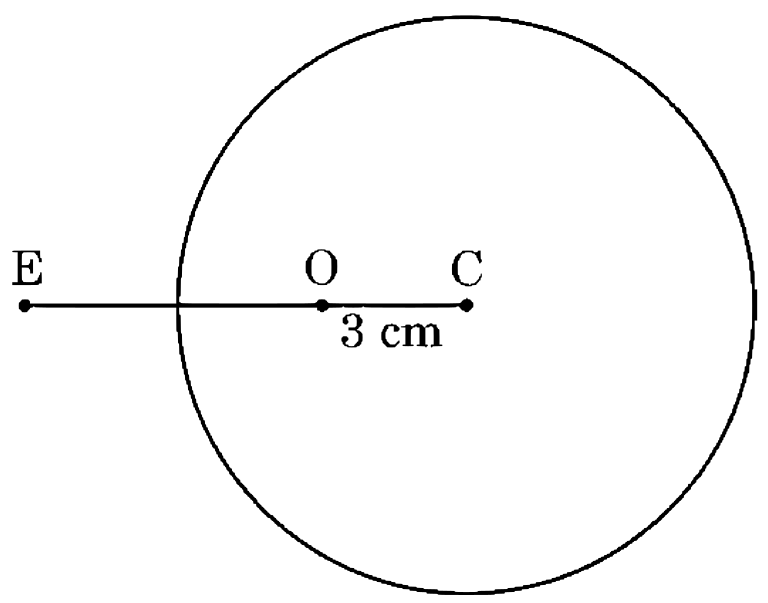
A solid glass sphere of radius $\displaystyle 6.0$ cm has a small air bubble trapped at a distance $\displaystyle 3.0$ cm from its centre C as shown in the figure. The refractive index of the material of the sphere is $\displaystyle 1 \cdot 5$. Find the apparent position of this bubble when seen through the surface of the sphere from an outside point E in air.
Marking-scheme solution
(i)
(1)
(a)
The interference pattern has a number of equally spaced bright and dark bands while diffraction pattern has a central bright maximum which is twice as wide as the other maxima.
(b)
Interference pattern is obtained by superposing two waves originating from two narrow slits, while diffraction pattern is a superposition of a continuous family of waves originating from each point on a single slit.
(c)
The maxima in interference pattern is obtained at angle $\displaystyle \lambda/a$, while the first minima is obtained at same angle $\displaystyle \lambda/a$ for diffraction pattern.
(d)
in interference pattern the intensity of bright fringes remain same while in diffraction the intensity falls as we go to successive maxima away from the center on either side.
(2)
Factors affecting fringes width
Wave length ($\displaystyle \lambda$) / distance of screen from slits (D) / separation between slits (d).
(ii)
(1)
$\displaystyle d\sin\theta = n\lambda$
$\displaystyle n = 1$
$\displaystyle \sin\theta = \dfrac{\lambda}{d}$
For small angle $\displaystyle \sin\theta \approx \theta = \dfrac{\lambda}{100\lambda} = \dfrac{1}{100}$ radian.
(2)
$\displaystyle \beta = \dfrac{\lambda D}{d} = \theta D$
$\displaystyle = \dfrac{1}{100} \times 50 \times 10^{-2}$
$\displaystyle = 50 \times 10^{-4}\,m$
$\displaystyle = 5\ \text{mm}$
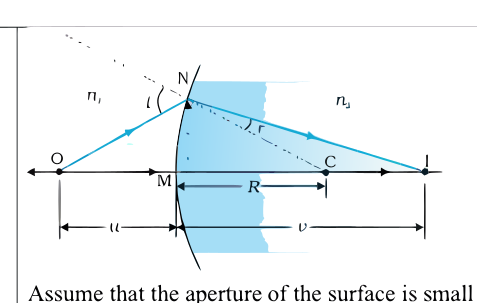
Assume that the aperture of the surface is small as compared to other distance involved, so that small angle approximation can be made.
For small angles
for $\displaystyle \triangle NOC$, i is the exterior angle
$\displaystyle \therefore\ i = \angle NOM + \angle NCM$
$\displaystyle i = \dfrac{MN}{OM} + \dfrac{MN}{MC}$ … (i)
Similarly $\displaystyle r = \angle NCM - \angle NIM$
$\displaystyle = \dfrac{MN}{MC} - \dfrac{MN}{MI}$ … (ii)
By Snell's law
$\displaystyle n_1 \sin i = n_2 \sin r$
for small angles
$\displaystyle n_1 i = n_2 r$
substituting i and r from (i) and (ii) we get
$\displaystyle \dfrac{n_1}{OM} + \dfrac{n_2}{MI} = \dfrac{n_2 - n_1}{MC}$
Applying Cartesian coordinates
$\displaystyle OM = -u,\ MI = +v,\ MC = +R$
$\displaystyle \dfrac{n_2}{v} - \dfrac{n_1}{u} = \dfrac{n_2 - n_1}{R}$
(ii)
$\displaystyle \dfrac{n_2}{v} - \dfrac{n_1}{u} = \dfrac{n_2 - n_1}{R}$
$\displaystyle R = -6\ \text{cm},\ u = -3\ \text{cm},\ n_1 = 1.5,\ n_2 = 1$
$\displaystyle \dfrac{1}{v} + \dfrac{1.5}{3} = \dfrac{1 - 1.5}{-6}$
$\displaystyle \dfrac{1}{v} = \dfrac{0.5}{6} - \dfrac{1.5}{3}$
$\displaystyle \dfrac{1}{v} = \dfrac{0.5 - 3}{6}$
$\displaystyle \dfrac{1}{v} = \dfrac{-2.5}{6}$
$\displaystyle v = -2.4\ \text{cm}$
from the left surface inside the sphere
All Ray Optics and Optical Instruments questions2023 question paperNCERT solutions: Ray Optics and Optical InstrumentsPractice Ray Optics and Optical Instruments →
More from Ray Optics and Optical Instruments
- A small bulb is placed at the bottom of a tank, containing a transparent liquid of refractive index √2, to a depth of 1 m. Calculate the area of the…2026
- Assertion: A convex lens, when immersed in a liquid, disappears. Reason ( R ): The refractive indices of material of the lens and the liquid are…2024
- A right angled isosceles glass prism ABC is kept in contact with an equilateral triangular prism DBC as shown in the figure. Both prisms are made of…2025
- A convex lens (n = 1.52) has a focal length of 15.0 cm in air. Find its focal length when it is immersed in liquid of refractive index 1.65. What…2024
- (i) Draw a labelled ray diagram showing the formation of the image at infinity by an astronomical telescope. (ii) A telescope consists of an…2022
- Two convex lenses A and B, each of focal length 10.0 cm, are mounted on an optical bench at 50.0 cm and 70.0 cm respectively. An object is mounted at…2025
- A right-angled prism ABC (refractive index √2 ) is kept on a plane mirror as shown in the figure. A ray of light is incident normally on the face AC.…2025
- A ray of light is incident on a glass prism of refractive index μ and refracting angle A. If it just suffers total internal reflection at the other…2023
CBSE Class 12 Physics past-paper question from the 2023 board exam, with the answer as CBSE’s own marking scheme gives it. Where our answers come from.