✓ Board-verified
Physics · 2023 · 5 marks
CBSE 2023 · Region 2 · Set 1 · Q32
(a) (i) Define coefficient of self-induction. Obtain an expression for self-inductance of a long solenoid of length l, area of cross- section A…
(i)
Define coefficient of self-induction. Obtain an expression for self-inductance of a long solenoid of length $\displaystyle l$, area of cross- section A having N turns.
(ii)
Calculate the self-inductance of a coil using the following data obtained when an AC source of frequency $\displaystyle \left(\frac{200}{\pi}\right) \mathrm{Hz}$ and a DC source is applied across the coil.
| AC Source | ||
| S.No. | V (Volts) | I (A) |
| $\displaystyle 1$ | $\displaystyle 3.0$ | $\displaystyle 0.5$ |
| $\displaystyle 2$ | $\displaystyle 6.0$ | $\displaystyle 1.0$ |
| $\displaystyle 3$ | $\displaystyle 9.0$ | $\displaystyle 1.5$ |
| DC Source | ||
| S.No. | V (Volts) | I (A) |
| $\displaystyle 1$ | $\displaystyle 4.0$ | $\displaystyle 1.0$ |
| $\displaystyle 2$ | $\displaystyle 6.0$ | $\displaystyle 1.5$ |
| $\displaystyle 3$ | $\displaystyle 8.0$ | $\displaystyle 2.0$ |
(i)
With the help of a labelled diagram, describe the principle and working of an ac generator. Hence, obtain an expression for the instantaneous value of the emf generated.
(ii)
The coil of an ac generator consists of $\displaystyle 100$ turns of wire, each of area $\displaystyle 0.5 \mathrm{~m}^{2}$. The resistance of the wire is $\displaystyle 100 \Omega$. The coil is rotating in a magnetic field of $\displaystyle 0.8$ T perpendicular to its axis of rotation, at a constant angular speed of $\displaystyle 60$ radian per second. Calculate the maximum emf generated and power dissipated in the coil.
Marking-scheme solution
(a)(i)
Coefficient of self induction is defined as the amount of magnetic flux associated with a coil when unit current flows through it.
Alternatively
It is defined as the magnitude of emf induced in a coil when current changes at the rate of $\displaystyle 1$ A/s through it.
(ii)
The magnetic field due to a current $\displaystyle I$ flowing in solenoid is
\[B = \frac{\mu_0 N I}{l} \]
The total magnetic flux linked with solenoid
\[N\phi_B = (N)\left(\frac{\mu_0 N I}{l}\right)(A) \]
\[= \frac{\mu_0 N^2 I A}{l} \]
The self inductance is
\[L = \frac{N\phi_B}{I} \]
\[L = \frac{\mu_0 N^2 A}{l} \]
(iii)
From the table, $\displaystyle Z = 6\ \Omega$, $\displaystyle R = 4\ \Omega$
\[Z^2 = R^2 + X_L^2 \]
\[X_L^2 = Z^2 - R^2 = 36 - 16 = 20 \]
\[X_L = 2\sqrt{5} \approx 4.5\ \Omega \]
\[2\pi \nu L = 4.5 \]
\[L = \frac{4.5}{2 \times \pi \times \dfrac{200}{\pi}} \]
\[L = 1.1 \times 10^{-2}\, H = 11\, mH \]
OR(b) (i) Diagram
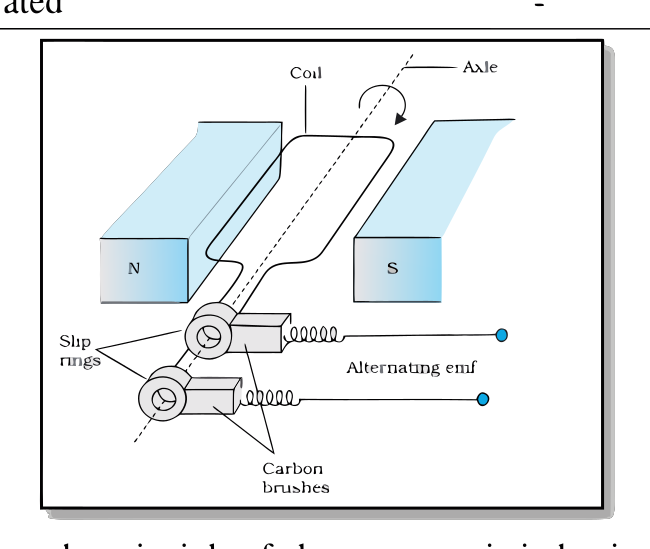
Principle – It is based on the principle of electromagnetic induction. Whenever there is a change in magnetic flux linked with a coil, an emf is induced in the coil.
Working - When a rectangular coil is rotated in a magnetic field, the magnetic flux changes continuously which induces an emf and the direction of current changes periodically.
\[\varepsilon = \frac{-N\, d\phi}{dt} \]
\[= -NBA\frac{d}{dt}\left(\cos \omega t\right) \]
\[\varepsilon = NBA\omega \sin \omega t \]
(ii)
\[\varepsilon_0 = NBA\omega \]
\[= 100 \times 0.8 \times 0.5 \times 60 \]
\[= 2400\ \text{V} \]
Power dissipated, $\displaystyle P = \dfrac{\varepsilon_{rms}^2}{R}$
\[= \frac{\left(\dfrac{2400}{\sqrt{2}}\right)^2}{100} \]
\[= 28.8\ \text{kW} \]
All Electromagnetic Induction questions2023 question paperNCERT solutions: Electromagnetic InductionPractice Electromagnetic Induction →
More from Electromagnetic Induction
- The emf induced in a coil rotating in a magnetic field does not depend upon the following:2024
- Two coplanar concentric circular loops of radii R and r(≪ R) are arranged coaxially. Obtain the expression for their mutual inductance. A square loop…2023
- A square loop of side 50 cm is placed in a uniform magnetic field of 3‧0 T acting perpendicular to the plane of the loop. If the loop is rotated…2026
- A closely wound long solenoid of self-inductance L is cut into two identical solenoids. The value of self-inductance of each small solenoid will be:2026
- Assertion: The mutual inductance between two coils is maximum when the coils are wound on each other. Reason (R): The flux linkage between two coils…2024
- A long solenoid of radius r consists of n turns per unit length. A current I=I_0 sin ω t flows in the solenoid. A coil of N turns is wound tightly…2023
- In the process of charging of a capacitor, the current produced between the plates of the capacitor is:2023
- The magnetic flux linked with a closed coil (in Wb ) varies with time t (in s ) as φ=5 t^2+4 t-2. If the resistance of the circuit is 14 Ω, the…2025
CBSE Class 12 Physics past-paper question from the 2023 board exam, with the answer as CBSE’s own marking scheme gives it. Where our answers come from.