✓ Board-verified
Physics · 2024 · 5 marks
CBSE 2024 · Region 1 · Set 1 · Q32
(a) (i) A resistor and a capacitor are connected in series to an ac source v = v_m sin ω t. Derive an expression for the impedance of the circuit.…
(i)
A resistor and a capacitor are connected in series to an ac source $\displaystyle \mathrm{v}=\mathrm{v}_{\mathrm{m}} \sin \omega \mathrm{t}$. Derive an expression for the impedance of the circuit.
(ii)
When does an inductor act as a conductor in a circuit ? Give reason for it.
(iii)
An electric lamp is designed to operate at $\displaystyle 110$ V dc and $\displaystyle 11$ A current. If the lamp is operated on $\displaystyle 220 \mathrm{~V}, 50 \mathrm{~Hz}$ ac source with a coil in series, then find the inductance of the coil.
(i)
Draw a labelled diagram of a step-up transformer and describe its working principle. Explain any three causes for energy losses in a real transformer.
(ii)
A step-up transformer converts a low voltage into high voltage. Does it violate the principle of conservation of energy? Explain.
(iii)
A step-up transformer has $\displaystyle 200$ and $\displaystyle 3000$ turns in its primary and secondary coils respectively. The input voltage given to the primary coil is $\displaystyle 90$ V . Calculate :
(1)
The output voltage across the secondary coil
(2)
The current in the primary coil if the current in the secondary coil is $\displaystyle 2 \cdot 0 \mathrm{~A}$.
Marking-scheme solution
(a)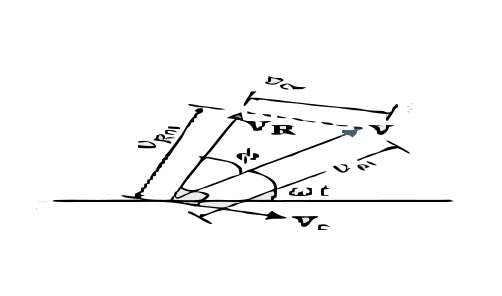
$$V_C + V_R = V$$
$$v_m^2 = v_{rm}^2 + v_{cm}^2$$
$$v_{rm} = i_m R$$
$$v_{cm} = i_m X_c$$
$$v_m^2 = (i_m R)^2 + (i_m X_c)^2$$
$$= i_m^2\left[R^2 + X_c^2\right]$$
$$\Rightarrow i_m = \frac{v_m}{\sqrt{R^2 + X_c^2}}$$
$$\Rightarrow \text{Impedance } Z = \sqrt{R^2 + X_c^2}$$
(ii)
For direct current (dc), an inductor behaves as a conductor.
As $\displaystyle X_L = \omega L = 2\pi \nu L$
For dc $\displaystyle \nu = 0 \Rightarrow X_L = 0$
Alternatively:-
Induced emf $\displaystyle (\varepsilon) = -\dfrac{L\,dI}{dt}$
For dc; $\displaystyle dI = 0 \Rightarrow \varepsilon = 0$
(iii)
$\displaystyle R = \dfrac{110}{11} = 10\,\Omega$
$$i_{rms} = \frac{v_{rms}}{\sqrt{R^2 + X_L^2}} = \frac{220}{\sqrt{100 + X_L^2}}$$
$$11 = \frac{220}{\sqrt{100 + X_L^2}}$$
$$\sqrt{100 + X_L^2} = \frac{220}{11} = 20\,\Omega$$
Squaring both sides:
$$\Rightarrow 100 + X_L^2 = 400$$
$$\Rightarrow X_L^2 = 300 \Rightarrow X_L = 10\sqrt{3}\,\Omega$$
$$X_L = 2\pi f L \Rightarrow 10\sqrt{3} = 2\pi \times 50 \times L$$
$$L = \frac{\sqrt{3}}{10\pi}\,H$$
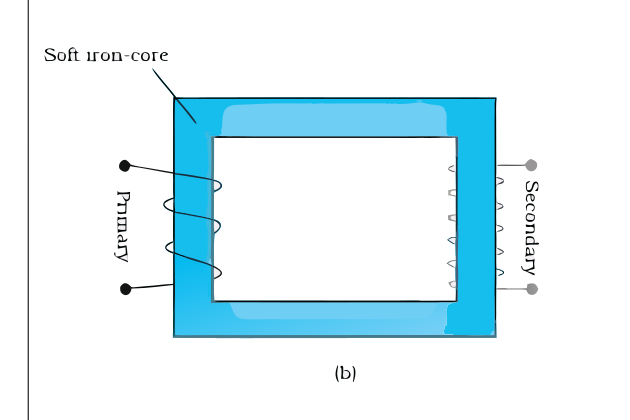
(b)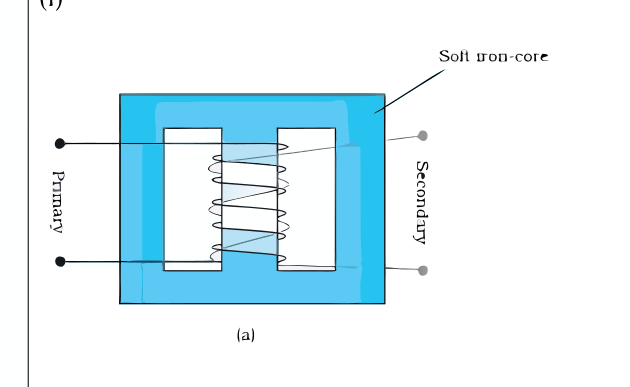
The working principle of transformer is mutual induction.
When an alternating voltage is applied to the primary, the resulting current produces an alternating magnetic flux which links the secondary and induces an emf in it.
Causes of energy losses
(a)
Flux leakage
(b)
Resistance of the windings
Eddy currents
(d)
Hysteresis
(ii)
No
Current changes correspondingly. So, the input power is equal to the output power.
(iii)
(1)
$$\frac{V_s}{V_P} = \frac{N_s}{N_P}$$
$$V_s = \frac{N_s}{N_P} \times V_P = \frac{3000}{200} \times 90$$
$$V_s = 1350\,V$$
(2)
$$\frac{I_P}{I_s} = \frac{N_s}{N_P}$$
$$I_P = \frac{3000}{200} \times 2 = 30\ \text{A}$$
All Alternating Current questions2024 question paperNCERT solutions: Alternating CurrentPractice Alternating Current →
More from Alternating Current
- Distinguish between reactance and impedance of an ac circuit. Show that an ideal inductor in an ac circuit does not dissipate any power.2024
- An alternating current is given by I=I_0 cos (100 π) t. The least time the current takes to decrease from its maximum value to zero will be:2025
- A resistor of 30 Ω and a capacitor of 250/(π) μ F are connected in series to a 200 V, 50 Hz ac source. Calculate (i) the current in the circuit, and…2023
- A resistor and an ideal inductor are connected in series to a 100 √2 V, 50 Hz ac source. When a voltmeter is connected across the resistor or the…2024
- A transformer is connected to a 200 V ac source. The transformer supplies 3000 V to a device. If the number of turns in the primary coil is 450, then…2025
- An alternating current I=14 sin (100 π t) A passes through a series combination of a resistor of 30 Ω and an inductor of (2/(5 π)) H. Taking √2=1.4,…2023
- Which of the following statements about a series LCR circuit connected to an ac source is correct?2023
- An inductor, a capacitor and a resistor are connected in series across an ac source of voltage. If the frequency of the source is decreased…2023
CBSE Class 12 Physics past-paper question from the 2024 board exam, with the answer as CBSE’s own marking scheme gives it. Where our answers come from.