✓ Board-verified
Physics · 2026 · 5 marks
Ray Optics and Optical InstrumentsRefraction at Spherical Surfaces and by Lenses5 marksApplylong answer
CBSE 2026 · Region 3 · Set 1 · Q33
(a) (i) A point object is kept in front of a convex spherical surface of radius of curvature R. Draw the ray diagram to show the formation of image…
(i)
A point object is kept in front of a convex spherical surface of radius of curvature R. Draw the ray diagram to show the formation of image and derive the relation between the object and image distance (u and v) in terms of refractive index n of the medium and R.
(ii)
A convex lens of focal length of $\displaystyle 20$ cm is used to form the image of an object placed $\displaystyle 30$ cm away from the lens. Find the position and nature of the image formed.
(i)
Two thin converging lenses of focal length $\displaystyle \mathrm{f}_{1}$ and $\displaystyle \mathrm{f}_{2}$ are placed coaxially in contact. Derive expression for the focal length of the combination.
(ii)
A beam of coherent light of wavelength $\displaystyle 550$ nm is incident normal to the plane of a pair of two slits $\displaystyle \mathrm{S}_{1}$ and $\displaystyle \mathrm{S}_{2}$ each of width $\displaystyle 1 \cdot 2 \times 10^{-6} \mathrm{~m}$ separated by $\displaystyle 1 \cdot 1 \mathrm{~mm}$. Dark and bright fringes are observed on a screen $\displaystyle 2 \cdot 2 \mathrm{~m}$ away from the plane of the slits. Calculate :
(I)
fringe width.
(II)
distance of the second dark fringe from the central maximum.
(III)
what will happen when the entire apparatus is immersed in water.
Marking-scheme solution
(i)
For small angles: $\displaystyle \tan \angle N O M=\dfrac{M N}{M O}$, $\displaystyle \tan \angle N C M=\dfrac{M N}{M C}$, $\displaystyle \tan \angle N I M=\dfrac{M N}{M I}$
$\displaystyle \mathrm{i}=\angle N O M+\angle N C M=\dfrac{M N}{M O}+\dfrac{M N}{O C}\quad \ldots(1)$
Similarly $\displaystyle r=\angle N C M-\angle N I M=\dfrac{M N}{M C}-\dfrac{M N}{M I}\quad \ldots(2)$
By Snell's law for small angles: $\displaystyle 1 \times \mathrm{i}=n \times \mathrm{r}$
Substituting i and r from ($\displaystyle 1$) and ($\displaystyle 2$): $\displaystyle \dfrac{1}{M O}+\dfrac{n}{M I}=\dfrac{n-1}{M C} \quad \ldots(3)$
Using Cartesian sign conventions $\displaystyle MO=-u$, $\displaystyle MI=+v$, $\displaystyle MC=+R$, substituting in ($\displaystyle 3$): $\displaystyle \dfrac{n}{v}-\dfrac{1}{u}=\dfrac{n-1}{R}$
(ii)
$\displaystyle \dfrac{1}{f}=\dfrac{1}{v}-\dfrac{1}{u}$
$\displaystyle \dfrac{1}{20}=\dfrac{1}{v}-\dfrac{1}{-30}$
$\displaystyle v=60 \mathrm{~cm}$
Nature of image: real and inverted.
(i)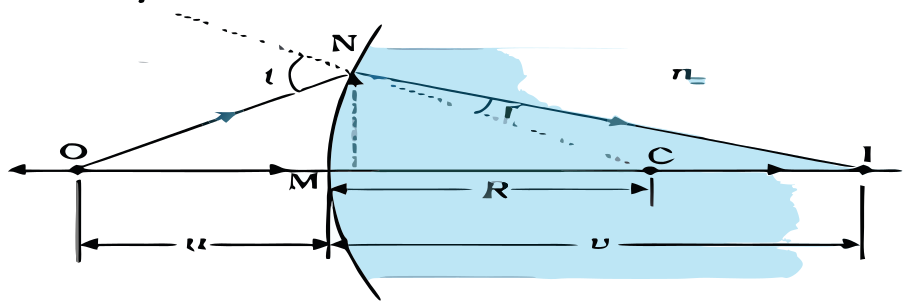
For the image formed by the first lens A: $\displaystyle \dfrac{1}{v_{1}}-\dfrac{1}{u}=\dfrac{1}{f_{1}}$
For the image formed by the second lens B: $\displaystyle \dfrac{1}{v}-\dfrac{1}{v_{1}}=\dfrac{1}{f_{2}}$
Adding and comparing with the lens formula: $\displaystyle \dfrac{1}{f}=\dfrac{1}{f_{1}}+\dfrac{1}{f_{2}}$
(ii)
(I)
$\displaystyle \beta=\dfrac{\lambda \mathrm{D}}{\mathrm{d}}=\dfrac{550 \times 10^{-9} \times 2.2}{1.1 \times 10^{-3}}=1.1 \mathrm{~mm}$
(II)
$\displaystyle \mathrm{x}=\dfrac{(2 n-1) \lambda \mathrm{D}}{2 \mathrm{~d}}$, with $\displaystyle n=2$: $\displaystyle x=1.65 \mathrm{~mm}$
(III)
Fringe width decreases. (Alternatively: $\displaystyle \beta^{\prime}=\dfrac{\beta}{n}$)
All Ray Optics and Optical Instruments questions2026 question paperNCERT solutions: Ray Optics and Optical InstrumentsPractice Ray Optics and Optical Instruments →
More from Ray Optics and Optical Instruments
- A small bulb is placed at the bottom of a tank, containing a transparent liquid of refractive index √2, to a depth of 1 m. Calculate the area of the…2026
- Assertion: A convex lens, when immersed in a liquid, disappears. Reason ( R ): The refractive indices of material of the lens and the liquid are…2024
- A right angled isosceles glass prism ABC is kept in contact with an equilateral triangular prism DBC as shown in the figure. Both prisms are made of…2025
- A convex lens (n = 1.52) has a focal length of 15.0 cm in air. Find its focal length when it is immersed in liquid of refractive index 1.65. What…2024
- (i) Draw a labelled ray diagram showing the formation of the image at infinity by an astronomical telescope. (ii) A telescope consists of an…2022
- Two convex lenses A and B, each of focal length 10.0 cm, are mounted on an optical bench at 50.0 cm and 70.0 cm respectively. An object is mounted at…2025
- A right-angled prism ABC (refractive index √2 ) is kept on a plane mirror as shown in the figure. A ray of light is incident normally on the face AC.…2025
- A ray of light is incident on a glass prism of refractive index μ and refracting angle A. If it just suffers total internal reflection at the other…2023
CBSE Class 12 Physics past-paper question from the 2026 board exam, with the answer as CBSE’s own marking scheme gives it. Where our answers come from.