✓ Board-verified
Physics · 2026 · 5 marks
CBSE 2026 · Region 5 · Set 1 · Q33
(a) (i) A parallel beam of monochromatic light falls normally on a single slit of width 'a' and a diffraction pattern is observed on a screen placed…
(i)
A parallel beam of monochromatic light falls normally on a single slit of width 'a' and a diffraction pattern is observed on a screen placed at distance D from the slits. Explain :
(I)
the formation of maxima and minima in the diffraction pattern, and
(II)
why the maxima go on becoming weaker and weaker with its increasing number (n).
(ii)
Write any two points of difference between interference pattern due to double-slit and diffraction pattern due to single-slit.
(i)
With the help of a ray diagram, describe the construction and working of a compound microscope.
(ii)
(I)
The real image of an object placed between f and 2f from a convex lens can be seen on a screen placed at the image location. If the screen is removed, is the image still there ? Explain.
(II)
Plane and convex mirrors produce virtual images of objects. Can they produce real images under some circumstances ? Explain.
Marking-scheme solution
(i)
(I)
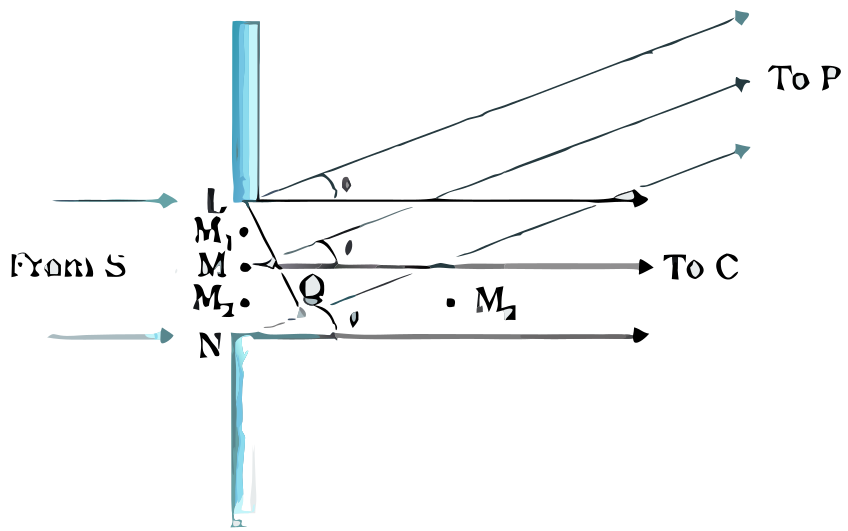
Path difference between the waves originating from points L and N superimposed at P on the screen is $\displaystyle \mathrm{NQ}=a \sin \theta$
Secondary minima: $\displaystyle a \sin \theta=n \lambda, \quad n= \pm 1, \pm 2, \ldots$
Secondary maxima: $\displaystyle a \sin \theta=(2 n+1) \lambda / 2, \quad n= \pm 1, \pm 2, \ldots$
Alternatively: The light coming from the slit superimposes at the centre of the screen and forms the central maximum with maximum intensity. For secondary maxima on the screen, light coming from a part (one-third, one-fifth, one-seventh …) of the whole slit contributes to the intensity on the screen. For secondary minima, contributions from two halves of the whole slit cancel each other, so the intensity falls to zero.
(II)
As n increases, maxima go on becoming weaker, since the light coming from a fraction of the slit (one-third, one-fifth, one-seventh, …) contributes to the intensity at a point.
(ii)
Interference vs diffraction (any two): the width of bright and dark bands is equal, whereas the width of the central maximum is twice the width of the secondary maxima or minima.
Intensity of all bright fringes is the same, whereas the intensity of bright fringes decreases with distance from the central maximum.
There is good contrast between bright and dark fringes, whereas there is poor contrast between bright and dark fringes.
(i)
Construction: It consists of two convex lenses — an objective lens with small aperture placed near the object, and an eyepiece with large aperture placed near the eye. Both lenses have small focal length. These lenses are placed coaxially in a narrow tube with a rack and pinion arrangement.
Working: The lens near the object, called the objective, forms a real, inverted and magnified image of the object. This serves as the object for the eyepiece, which produces the final image, enlarged and virtual.
(ii)
(I)
Yes — a real image is formed by actual intersection of rays.
(II)
Yes — if the object is virtual.
All Ray Optics and Optical Instruments questions2026 question paperNCERT solutions: Ray Optics and Optical InstrumentsPractice Ray Optics and Optical Instruments →
More from Ray Optics and Optical Instruments
- A small bulb is placed at the bottom of a tank, containing a transparent liquid of refractive index √2, to a depth of 1 m. Calculate the area of the…2026
- Assertion: A convex lens, when immersed in a liquid, disappears. Reason ( R ): The refractive indices of material of the lens and the liquid are…2024
- A right angled isosceles glass prism ABC is kept in contact with an equilateral triangular prism DBC as shown in the figure. Both prisms are made of…2025
- A convex lens (n = 1.52) has a focal length of 15.0 cm in air. Find its focal length when it is immersed in liquid of refractive index 1.65. What…2024
- (i) Draw a labelled ray diagram showing the formation of the image at infinity by an astronomical telescope. (ii) A telescope consists of an…2022
- Two convex lenses A and B, each of focal length 10.0 cm, are mounted on an optical bench at 50.0 cm and 70.0 cm respectively. An object is mounted at…2025
- A right-angled prism ABC (refractive index √2 ) is kept on a plane mirror as shown in the figure. A ray of light is incident normally on the face AC.…2025
- A ray of light is incident on a glass prism of refractive index μ and refracting angle A. If it just suffers total internal reflection at the other…2023
CBSE Class 12 Physics past-paper question from the 2026 board exam, with the answer as CBSE’s own marking scheme gives it. Where our answers come from.