✓ Board-verified
Physics · 2025 · 5 marks
CBSE 2025 · Region 1 · Set 1 · Q33
(a) (i) (1) What are coherent sources? Why are they necessary for observing a sustained interference pattern? (2) Lights from two independent sources…
(i)
(1)
What are coherent sources? Why are they necessary for observing a sustained interference pattern?
(2)
Lights from two independent sources are not coherent. Explain.
(ii)
Two slits $\displaystyle 0.1$ mm apart are arranged $\displaystyle 1.20$ m from a screen. Light of wavelength $\displaystyle 600$ nm from a distant source is incident on the slits.
(1)
How far apart will adjacent bright interference fringes be on the screen?
(2)
Find the angular width (in degree) of the first bright fringe.
(i)
Define a wavefront. An incident plane wave falls on a convex lens and gets refracted through it. Draw a diagram to show the incident and refracted wavefront.
(ii)
A beam of light coming from a distant source is refracted by a spherical glass ball (refractive index $\displaystyle 1.5$) of radius $\displaystyle 15$ cm. Draw the ray diagram and obtain the position of the final image formed.
Marking-scheme solution
a)
i) $\displaystyle 1$) Definition of coherent sources. $\displaystyle 1$ Necessity of coherent sources for sustained interference pattern $\displaystyle 1$
2) Explanation $\displaystyle 1$
ii) $\displaystyle 1$) Finding distance between adjacent bright fringes. $\displaystyle 1$
i) $\displaystyle 1$) If the phase difference between the displacement produced by each of the wave from two sources does not change with time then two sources are said to be coherent.
Alternatively
Two sources are said to be coherent if they emit light continuously of same frequency / wavelength and having zero or constant phase difference.
Coherent sources are required to get constant phase difference.
$\displaystyle 2$) Two independent sources will never be coherent because phase difference between them will not be constant.
ii) $\displaystyle 1$) Distance between adjacent bright fringe = fringe width
\[\beta=\frac{\lambda D}{d}
\]
\[=\frac{600 \times 10^{-9} \times 1.2}{0.1 \times 10^{-3}}=7.2 \mathrm{~mm}
\]
2) \[\begin{aligned}
\theta & =\frac{\lambda}{d} \\
& =\frac{600 \times 10^{-9}}{0.1 \times 10^{-3}}=6 \times 10^{-3} \mathrm{rad}=0.34^{\circ}
\end{aligned}
\]
Give full marks if the student writes the answer in radians only.
b)
i) A wavefront is a locus of all the points which oscillate in phase.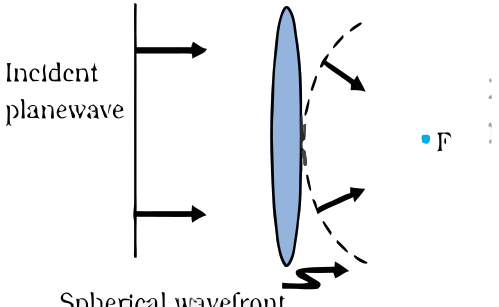 of radius \(\displaystyle f\)
of radius \(\displaystyle f\)More from Wave Optics
- Define 'wavefront' of a light wave. A plane wavefront is refracted from a convex lens. Draw the shape of the refracted wavefront. A plane wave…2025
- A double slit set-up was initially placed in a tank filled with water and the interference pattern was obtained using a laser light. When water is…2025
- The phenomenon of interference is shown by2026
- Assertion: In interference and diffraction of light, light energy reduces in one region producing a dark fringe. It increases in another region and…2024
- Using the Huygens' principle, briefly describe reflection of a plane wavefront from a reflecting surface. Hence, prove the laws of reflection.2025
- Assertion: In a Young's double-slit experiment, interference pattern is not observed when two coherent sources are infinitely close to each other.…2024
- (i) Give any two differences between the interference pattern obtained in Young's double-slit experiment and a diffraction pattern due to a single…2024
- A plane wave-front propagating in a medium of refractive index ' μ_1 ' is incident on a plane surface making an angle of incidence (i). It enters…2023
CBSE Class 12 Physics past-paper question from the 2025 board exam, with the answer as CBSE’s own marking scheme gives it. Where our answers come from.