✓ Board-verified
Mathematics · 2024 · 4 marks
CBSE 2024 · Region 5 · Set 1 · Q36
(a) Students of a school are taken to a railway museum to learn about railways heritage and its history. An exhibit in the museum depicted many rail…
Students of a school are taken to a railway museum to learn about railways heritage and its history.
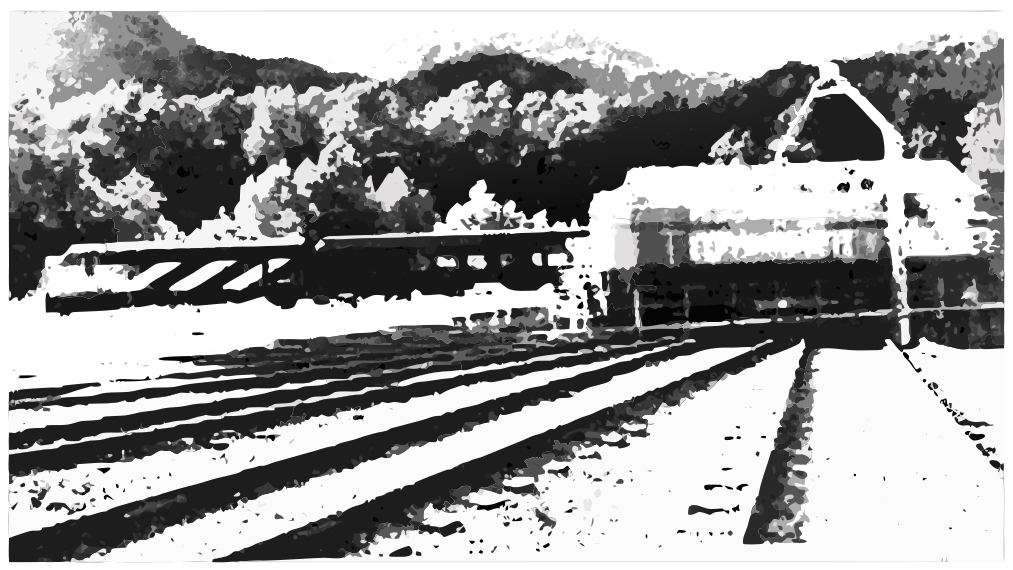
An exhibit in the museum depicted many rail lines on the track near the railway station. Let L be the set of all rail lines on the railway track and R be the relation on L defined by $\displaystyle \mathrm{R}=\left\{\left(l_{1}, l_{2}\right): l_{1}\right.$ is parallel to $\displaystyle \left.l_{2}\right\}$ On the basis of the above information, answer the following questions :
(i)
Find whether the relation R is symmetric or not.
(ii)
Find whether the relation R is transitive or not.
(iii)
If one of the rail lines on the railway track is represented by the equation $\displaystyle \mathrm{y}=3 x+2$, then find the set of rail lines in R related to it.
Let S be the relation defined by $\displaystyle \mathrm{S}=\left\{\left(l_{1}, l_{2}\right): l_{1}\right.$ is perpendicular to $\displaystyle \left.l_{2}\right\}$ check whether the relation S is symmetric and transitive.
Marking-scheme solution
(a)(i)
Let $\displaystyle \left(l_{1}, l_{2}\right) \in \mathrm{R} \Rightarrow l_{1}\left\|l_{2} \Rightarrow l_{2}\right\| l_{1} \Rightarrow\left(l_{2}, l_{1}\right) \in \mathrm{R}, \therefore \mathrm{R}$ is a symmetric relation
(ii)
Let $\displaystyle \left(l_{1}, l_{2}\right),\left(l_{2}, l_{3}\right) \in \mathrm{R} \Rightarrow l_{1}\left\|l_{2}, l_{2}\right\| l_{3} \Rightarrow l_{1} \| l_{3} \Rightarrow\left(l_{1}, l_{3}\right) \in \mathrm{R}, \therefore \mathrm{R}$ is a transitive relation
(iii)
The set is $\displaystyle \{1: 1$ is a line of type $\displaystyle \mathrm{y}=3 x+c, c \in \mathrm{R}\}$
Or
(b) Let $\displaystyle \left(l_{1}, l_{2}\right) \in \mathrm{R} \Rightarrow l_{1} \perp l_{2} \Rightarrow l_{2} \perp l_{1} \Rightarrow\left(l_{2}, l_{1}\right) \in \mathrm{R}, \therefore \mathrm{R}$ is a symmetric relation
Let $\displaystyle \left(l_{1}, l_{2}\right),\left(l_{2}, l_{3}\right) \in \mathrm{R} \Rightarrow l_{1} \perp l_{2}, l_{2} \perp l_{3} \Rightarrow l_{1} \| l_{3} \Rightarrow\left(l_{1}, l_{3}\right) \notin \mathrm{R}, \therefore \mathrm{R}$ is not a transitive relation
** Due to printing error Part (a) or Part(b), both parts be taken as independent questions of $\displaystyle 4$ marks each
All Relations and Functions questions2024 question paperNCERT solutions: Relations and FunctionsPractice Relations and Functions →
More from Relations and Functions
- A function f: R_+ → R (where R_+ is the set of all non-negative real numbers) defined by f(x)=4 x+3 is:2024
- Let f: A → B be defined by f(x)=(x-2)/(x-3), where A=R-{3} and B=R-{1}. Discuss the bijectivity of the function.2025
- If f(x)=|x|+|x-1|, then which of the following is correct?2025
- A class-room teacher is keen to assess the learning of her students the concept of "relations" taught to them. She writes the following five…2025
- If f: N → W is defined as f(n)= {n/2, if n is even; 0, if n is odd}, then f is:2025
- A function f:[-4,4] →[0,4] is given by f(x)=√(16-x^2). Show that f is an onto function but not a one-one function. Further, find all possible values…2023
- If f(x)=-2 x^8, then the correct statement is:2025
- Prove that a function f:[0, ∞) →[-5, ∞) defined as f(x)=4 x^2+4 x-5 is both one-one and onto.2023
CBSE Class 12 Mathematics past-paper question from the 2024 board exam, with the answer as CBSE’s own marking scheme gives it. Where our answers come from.