✓ Board-verified
Mathematics · 2025 · 4 marks
CBSE 2025 · Region 4 · Set 1 · Q36
Some students are having a misconception while comparing decimals. For example, a student may mention that 78 · 56>78 · 9 as 7856>789. In order to…
Some students are having a misconception while comparing decimals. For example, a student may mention that $\displaystyle 78 \cdot 56>78 \cdot 9$ as $\displaystyle 7856>789$. In order to assess this concept, a decimal comparison test was administered to the students of class VI through the following question : In the recently held Sports Day in the school, $\displaystyle 5$ students participated in a javelin throw competition. The distances to which they have thrown the javelin are shown below in the table :
The students were asked to identify who has thrown the javelin the farthest. Based on the test attempted by the students, the teacher concludes that $\displaystyle 40 \%$ of the students have the misconception in the concept of decimal comparison and the rest do not have the misconception. $\displaystyle 80 \%$ of the students having misconception answered Bijoy as the correct answer in the paper. $\displaystyle 90 \%$ of the students who are identified with not having misconception, did not answer Bijoy as their answer. On the basis of the above information, answer the following questions :
| Name of student | Distance of javelin (in meters) |
| Ajay | $\displaystyle 47 \cdot 7$ |
| Bijoy | $\displaystyle 47 \cdot 07$ |
| Kartik | $\displaystyle 43 \cdot 09$ |
| Dinesh | $\displaystyle 43 \cdot 9$ |
| Devesh | $\displaystyle 45 \cdot 2$ |
(i)
What is the probability of a student not having misconception but still answers Bijoy in the test?
(ii)
What is the probability that a randomly selected student answers Bijoy as his answer in the test?
(iii)
(a)
What is the probability that a student who answered as Bijoy is having misconception?
OR
(b)
What is the probability that a student who answered as Bijoy is amongst students who do not have the misconception? Case Study - $\displaystyle 2$
Marking-scheme solution
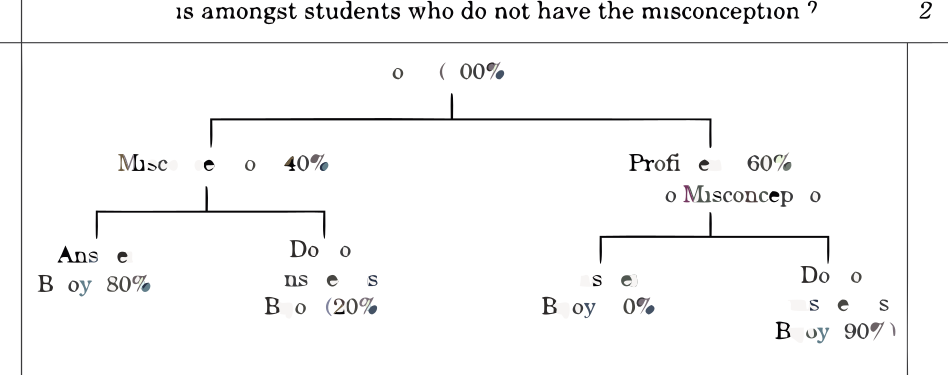
Let $\displaystyle E_1$ : Student has a misconception
$\displaystyle E_2$ : Student does not have misconception
A : Student answered Bijoy as correct
$\displaystyle \therefore P(E_1)=\dfrac{40}{100},\ P(E_2)=\dfrac{60}{100}$
$\displaystyle P(A\mid E_1)=\dfrac{80}{100},\ P(A\mid E_2)=\dfrac{10}{100}$
$\displaystyle P(\bar A\mid E_1)=\dfrac{20}{100},\ P(\bar A\mid E_2)=\dfrac{90}{100}$
(i)
$\displaystyle P(A\mid E_2)=\dfrac{10}{100}$ or $\displaystyle \dfrac{1}{10}$
(ii)
$\displaystyle P(A)=P(E_1)P(A\mid E_1)+P(E_2)P(A\mid E_2)$
$\displaystyle =\dfrac{40}{100}\times\dfrac{80}{100}+\dfrac{60}{100}\times\dfrac{10}{100}$
$\displaystyle =\dfrac{38}{100}$ or $\displaystyle \dfrac{19}{50}$
(iii)
(a)
$\displaystyle P(E_1\mid A)=\dfrac{P(E_1)P(A\mid E_1)}{P(A)}$
$\displaystyle =\dfrac{\dfrac{40}{100}\times\dfrac{80}{100}}{\dfrac{38}{100}}=\dfrac{16}{19}$
OR
(b)
$\displaystyle P(E_2\mid A)=\dfrac{P(E_2)P(A\mid E_2)}{P(A)}$
$\displaystyle =\dfrac{\dfrac{60}{100}\times\dfrac{10}{100}}{\dfrac{38}{100}}=\dfrac{3}{19}$
More from Probability
- Assertion: Two coins are tossed simultaneously. The probability of getting two heads, if it is known that at least one head comes up, is 1/3. Reason…2023
- If A and B are two events such that P(B)=1/5, P(A ∣ B)=2/3 and P(A ∪ B)=3/5, then P(A) is:2025
- A shop selling electronic items sells smartphones of only three reputed companies A, B and C because chances of their manufacturing a defective…2025
- Three friends A, B and C got their photograph clicked. Find the probability that B is standing at the central position, given that A is standing at…2022
- A box has 4 green, 8 blue and 3 red pens. A student picks up a pen at random, checks its colour and replaces it in the box. He repeats this process 3…2025
- Smoking increases the risk of lung problems. A study revealed that 170 in 1000 males who smoke develop lung complications, while 120 out of 1000…2026
- Let M and N be two events such that P(M)=0.6, P(N)=0.2 and P(M ∩ N)=0.5, then P(M^′ / N^′) is2025
- The probability distribution of a random variable X is: where k is some unknown constant. The probability that the random variable X takes the value…2024
CBSE Class 12 Mathematics past-paper question from the 2025 board exam, with the answer as CBSE’s own marking scheme gives it. Where our answers come from.