✓ Board-verified
Mathematics · 2025 · 4 marks
Differential EquationsMethods of Solving First Order, First Degree Differential Equations4 marksApplycase study
CBSE 2025 · Region 4 · Set 1 · Q38
During a heavy gaming session, the temperature of a student's laptop processor increases significantly. After the session, the processor begins to…
During a heavy gaming session, the temperature of a student's laptop processor increases significantly. After the session, the processor begins to cool down, and the rate of cooling is proportional to the difference between the processor's temperature and the room temperature $\displaystyle \left(25^{\circ} \mathrm{C}\right)$. Initially the processor's temperature is $\displaystyle 85^{\circ} \mathrm{C}$. The rate of cooling is defined by the equation $\displaystyle \frac{\mathrm{d}}{\mathrm{dt}}(\mathrm{T}(\mathrm{t}))=-\mathrm{k}(\mathrm{T}(\mathrm{t})-25)$, where $\displaystyle \mathrm{T}(\mathrm{t})$ represents the temperature of the processor at time t (in minutes) and k is a constant.
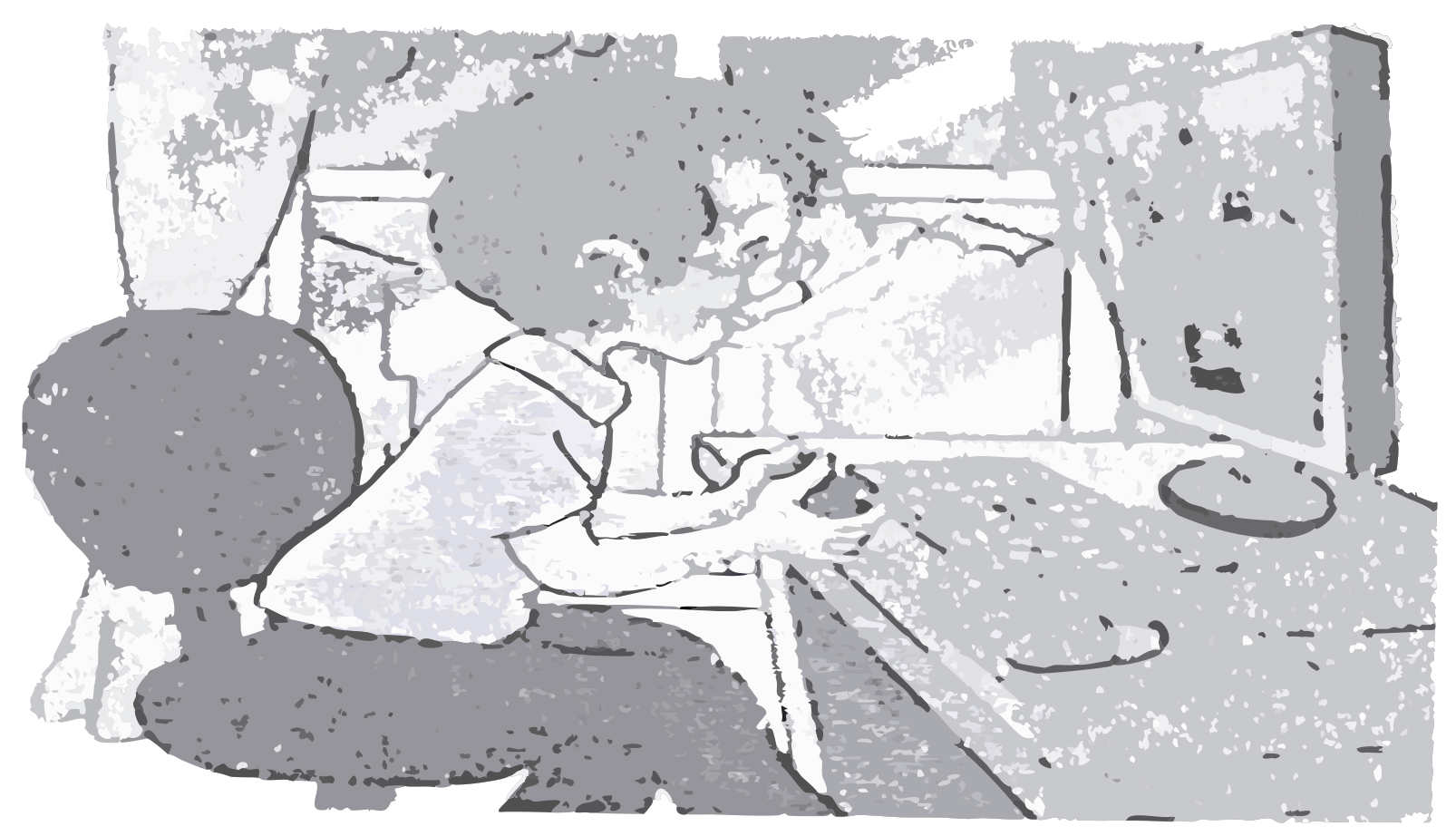
Based on the above information, answer the following questions :
(i)
Find the expression for temperature of processor, $\displaystyle \mathrm{T}(\mathrm{t})$ given that $\displaystyle \mathrm{T}(0)=85^{\circ} \mathrm{C}$.
(ii)
How long will it take for the processor's temperature to reach $\displaystyle 40^{\circ} \mathrm{C}$ ? Given that $\displaystyle \mathrm{k}=0 \cdot 03, \log _{\mathrm{e}} 4=1 \cdot 3863$.
Marking-scheme solution
(i)
$\displaystyle \frac{\mathrm{d} \mathrm{T}}{\mathrm{d} \mathrm{t}}=-\mathrm{k}(\mathrm{T}-25)$
\[\begin{aligned}
& \Rightarrow \frac{\mathrm{d} \mathrm{T}}{\mathrm{T}-25}=-\mathrm{k} \mathrm{d} \mathrm{t} \\
& \Rightarrow \int \frac{\mathrm{d} \mathrm{T}}{\mathrm{T}-25}=-\mathrm{k} \int \mathrm{d} \mathrm{t}
\end{aligned}
\]
Using in equation $\displaystyle (a), \log |\mathrm{T}-25|=-\mathrm{k} \mathrm{t}+\log 60$
(ii)
When $\displaystyle \mathrm{k}=0.03, \log |\mathrm{T}-25|=-0.03 \mathrm{t}+\log 60$
\[\Rightarrow \log \left|\frac{\mathrm{T}-25}{60}\right|=-0.03 \mathrm{t}
\]
When $\displaystyle \mathrm{T}=40, \mathrm{t}=\mathrm{t}_{1}$
\[\Rightarrow \frac{15}{60}=\mathrm{e}^{-0.03 \mathrm{t}_{1}}
\]
All Differential Equations questions2025 question paperNCERT solutions: Differential EquationsPractice Differential Equations →
More from Differential Equations
- The integrating factor of the differential equation (1-y^2) (d x)/dy+y x=ay,(-1<y<1) is2023
- The integrating factor for solving the differential equation x dy/dx-y=2 x^2 is:2023
- Product of the order and degree of differential equation 1+(dy/dx)^3=λ((d^3 y)/(dx^3))^2 is:2026
- Solve the differential equation (d y)/(d x)= cos x-2 y.2025
- The solution of the differential equation (d x)/x+(d y)/y=0 is:2023
- Find the general solution of the differential equation (y^2-x^2) d x=2 x y dy OR Find the particular solution of the differential equation (1+e^2 x)…2026
- The integrating factor of the differential equation (x+2 y^2) (d y)/(d x)=y(y>0) is:2024
- Find the particular solution of the differential equation dy/dx-y/x+cosec(y/x)=0; given that y=0, when x=1.2025
CBSE Class 12 Mathematics past-paper question from the 2025 board exam, with the answer as CBSE’s own marking scheme gives it. Where our answers come from.