✓ Board-verified
Chemistry · 2025 · 5 marks
CBSE 2025 · Region 4 · Set 1 · Q32
(a) (i) Give reasons: (I) [ Ni ( CO )_4] is diamagnetic whereas [ NiCl_4]^2- is paramagnetic. [Atomic number: Ni = 28] (II) CO is a stronger…
(i)
Give reasons :
(I)
$\displaystyle \left[\mathrm{Ni}(\mathrm{CO})_{4}\right]$ is diamagnetic whereas $\displaystyle \left[\mathrm{NiCl}_{4}\right]^{2-}$ is paramagnetic. [Atomic number : Ni = $\displaystyle 28$]
(II)
CO is a stronger complexing agent than $\displaystyle \mathrm{NH}_{3}$.
(III)
The trans isomer of complex $\displaystyle \left[\mathrm{Co}(\mathrm{en})_{2} \mathrm{Cl}_{2}\right]^{+}$is optically inactive.
(ii)
Using Crystal Field theory, write the number of unpaired electrons in octahedral complexes of $\displaystyle \mathrm{Fe}^{3+}$ in the presence of :
(I)
Strong field ligand
(II)
Weak field ligand [Atomic number : $\displaystyle \mathrm{Fe}=26$ ]
(i)
Name the type of isomerism exhibited by the following compounds. Also draw their corresponding isomers.
(I)
$\displaystyle \left[\mathrm{Co}\left(\mathrm{NH}_{3}\right)_{6}\right]\left[\mathrm{Cr}(\mathrm{CN})_{6}\right]$
(II)
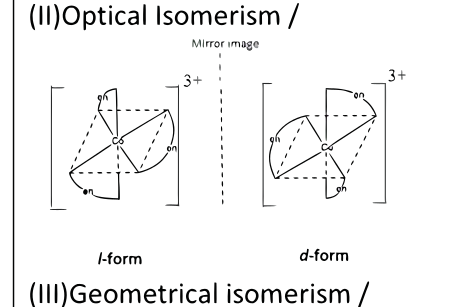
$\displaystyle \left[\mathrm{Co}(\mathrm{en})_{3}\right]^{3+}$
(III)
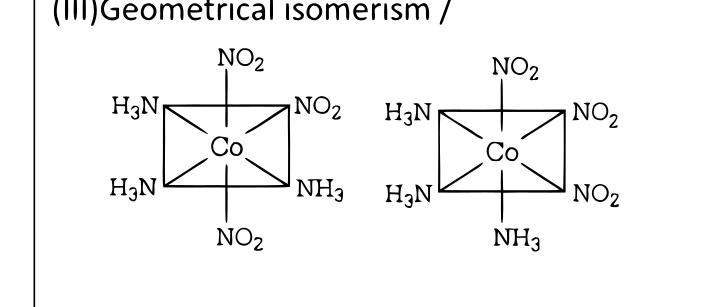
$\displaystyle \left[\mathrm{Co}\left(\mathrm{NH}_{3}\right)_{3}\left(\mathrm{NO}_{2}\right)_{3}\right]$
(ii)
Differentiate between weak field and strong field ligands. How does the strength of the ligand influence the spin of the complex ?
Marking-scheme solution
(i)
(I)
CO being a strong field ligand, causes pairing of electrons therefore, there is no unpaired electron.
(II)
… creates synergic effect between CO and the Metal.
(III)
Mirror images are superimposable/ Presence of plane of symmetry.
(ii)
(I)
Δ_O > P, causes pairing of electrons, therefore $\displaystyle 1$ unpaired electron
(II)
Δ_O < P, No pairing of electrons therefore $\displaystyle 5$ unpaired electrons
(i)
(I)
Coordination Isomerism / [Cr(NH₃)₆] [Co(CN)₆]
(II)
Optical Isomerism /
(III)
Geometrical isomerism /
(ii)
Weak field ligands produce weak field and leads to small splitting of d-orbitals whereas strong field ligands produce strong field leading to large splitting of d-orbitals.
Strong field ligands cause pairing of electrons/a smaller number of unpaired electrons hence produces low spin complexes and weak field ligands causes no pairing of electrons/ a greater number of unpaired electrons hence produces high spin complexes.
All Coordination Compounds questions2025 question paperNCERT solutions: Coordination CompoundsPractice Coordination Compounds →
More from Coordination Compounds
- [Co(NH_3)_6]^3+ is diamagnetic whereas [CoF_6]^3- is paramagnetic. Justify the statement. [Atomic number of Co=27 ] Write the electronic…2026
- Draw the geometrical isomers of the given complex: [Pt(en)_2 Cl_2]^2+ Write the electronic configuration for d^4 ion if Δ_0<P on the basis of crystal…2024
- On the basis of crystal field theory, write the electronic configuration for d^4 with a strong field ligand for which Δ_0>P. A solution of [Ni(H_2…2023
- Out of the following statements, the incorrect statement is:2025
- The secondary valency of Co in [Co(en)_3]^3+ is2026
- The Valence Bond Theory (VBT) explains the formation, magnetic behaviour and geometrical shapes of coordination compounds whereas 'The Crystal Field…2024
- The formula of the complex Iron (III) hexacyanidoferrate (II) is:2023
- [Fe(H_2 O)_6]^2+ is paramagnetic whereas [Fe(CO)_5] is diamagnetic. Justify the statement. [Atomic number of Fe=26 ] 2+1 On the basis of crystal…2026
CBSE Class 12 Chemistry past-paper question from the 2025 board exam, with the answer as CBSE’s own marking scheme gives it. Where our answers come from.