✓ Board-verified
Chemistry · 2023 · 5 marks
CBSE 2023 · Region 4 · Set 1 · Q33
(a) (i) Calculate the emf of the following cell at 298 K: Al ( s )| Al^3+(0.001 M ) ∥ Ni^2+(0.1 M )| Ni ( s ); [ Given: E_Al^°^3+ / Al =-1.66 V,…
(i)
Calculate the emf of the following cell at $\displaystyle 298$ K : \[\begin{aligned} & \mathrm{Al}(\mathrm{~s})\left|\mathrm{Al}^{3+}(0.001 \mathrm{M}) \| \mathrm{Ni}^{2+}(0.1 \mathrm{M})\right| \mathrm{Ni}(\mathrm{~s}) \\ & {\left[\text { Given }: \mathrm{E}_{\mathrm{Al}^{\circ}}{ }^{3+} / \mathrm{Al}=-1.66 \mathrm{~V}, \mathrm{E}_{\mathrm{Ni}^{2+} / \mathrm{Ni}}^{\circ}=-0.25 \mathrm{~V}, \log 10=1\right]} \end{aligned} \]
(ii)
With the help of a graph explain why it is not possible to determine $\displaystyle \mathbf{\Lambda}_{\mathrm{m}}^{\circ}$ for a weak electrolyte by extrapolating the molar conductivity $\displaystyle \left(\mathbf{\Lambda}_{\mathrm{m}}\right)$ versus $\displaystyle \mathrm{C}^{1 / 2}$ curve as for strong electrolyte.
(i)
The molar conductivities of $\displaystyle \mathrm{NH}_{4}^{+}$and $\displaystyle \mathrm{Cl}^{-}$ion are $\displaystyle 73.8 \mathrm{~S} \mathrm{~cm}^{2} \mathrm{~mol}^{-1}$ and $\displaystyle 76.2 \mathrm{~S} \mathrm{~cm}^{2} \mathrm{~mol}^{-1}$ respectively. The conductivity of $\displaystyle 0.1 \mathrm{M} \mathrm{NH}_{4} \mathrm{Cl}$ is $\displaystyle 1.29 \times 10^{-2} \mathrm{~S} \mathrm{~cm}^{-1}$. Calculate its molar conductivity and degree of dissociation.
(ii)
Calculate the half-cell potential at $\displaystyle 298$ K for the reaction \[\mathrm{Zn}^{2+}+2 \mathrm{e}^{-} \longrightarrow \mathrm{Zn} \] if $\displaystyle \left[\mathrm{Zn}^{2+}\right]=0.1 \mathrm{M}$ and $\displaystyle \mathrm{E}_{\mathrm{Zn}^{2+} / \mathrm{Zn}}^{\circ}=-0.76 \mathrm{~V}$.
Marking-scheme solution
(a) (i)
\[\begin{aligned}
\mathrm{E}_{\text {cell }}= & \mathrm{E}_{\text {cell }}^{\circ}-\frac{0.059}{6} \log \frac{\left[\mathrm{Al}^{3+}\right]^{2}}{\left[\mathrm{Ni}^{2+}\right]^{3}} \\
\mathrm{E}_{\text {cell }}= & {[-0.25+1.66]-\frac{0.059}{6} \log \frac{[0.001]^{2}}{[0.1]^{3}} } \\
& =1.41-\frac{0.059}{6} \log 10^{-6+3} \\
& =1.41+\frac{0.059}{6} \times 3 \\
& =1.41+0.0295 \\
& =1.4395 \mathrm{~V}
\end{aligned}
\]
(b) (i)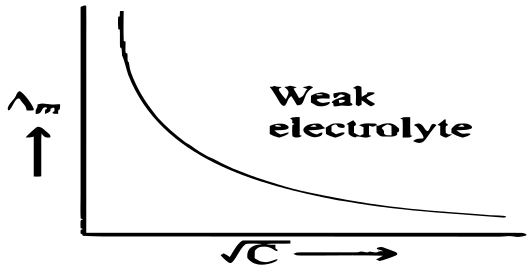
(ii) As seen from the curve, it runs parallel to the y-axis. So, even on extrapolation, it will not intercept, hence \(\displaystyle \mathbf{\Lambda}^{\circ}{ }_{\mathrm{m}}\) cannot be obtained.
All Electrochemistry questions2023 question paperNCERT solutions: ElectrochemistryPractice Electrochemistry →
More from Electrochemistry
- Kohlrausch gave the following relation for strong electrolytes: Λ_m=Λ_m^°-A √C Which of the following equality holds true?2025 · asked 2×
- Assertion: E_Cu^° 2+/ Cu is positive (+0.34 V). Reason (R): Copper has high Δ_a H^° and low Δ_hyd H^°.2023 · asked 2×
- During the electrolysis of aqueous NaCl, the cathodic reaction is:2024
- Calculate the standard Gibbs energy (Δ_r G^°) of the following reaction at 25 °C: 3 + 2 Au( s)+Ca^2+(1 M) → Au^3+(1 M)+Ca( s); E_Au^3+ / Au^°=+1.5 V,…2025
- (i) What should be the signs (positive/negative) for E^°_Cell and Δ G^° for a spontaneous redox reaction occurring under standard conditions? (ii)…2023
- Batteries and fuel cells are very useful forms of galvanic cell. Any battery or cell that we use as a source of electrical energy is basically a…2024
- (i) Why on dilution the Λ_m of CH_3 COOH increases very fast, while that of CH_3 COONa increases gradually? (ii) What happens if external potential…2022
- During electrolysis of dilute H_2 SO_4, using platinum electrodes, the gas evolved at the anode is:2025
CBSE Class 12 Chemistry past-paper question from the 2023 board exam, with the answer as CBSE’s own marking scheme gives it. Where our answers come from.