✓ Board-verified
Chemistry · 2025 · 5 marks
CBSE 2025 · Region 6 · Set 2 · Q32
(a) (i) Calculate E_cell of a galvanic cell in which the following reaction takes place at 25^° C: Zn ( s )+ Pb^2+(0 · 02 M ) → Zn^2+(0 · 1 M )+ Pb (…
(i)
Calculate $\displaystyle \mathrm{E}_{\text {cell }}$ of a galvanic cell in which the following reaction takes place at $\displaystyle 25^{\circ} \mathrm{C}$ : 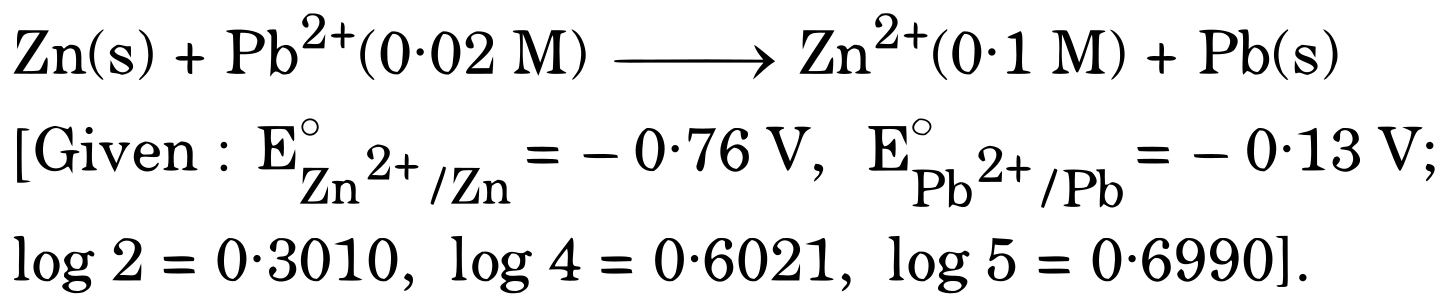 \[\mathrm{Zn}(\mathrm{~s})+\mathrm{Pb}^{2+}(0 \cdot 02 \mathrm{M}) \longrightarrow \mathrm{Zn}^{2+}(0 \cdot 1 \mathrm{M})+\mathrm{Pb}(\mathrm{~s}) \] [Given : $\displaystyle \mathrm{E}_{\mathrm{Zn}^{2+} / \mathrm{Zn}}^{\circ}=-0.76 \mathrm{~V}, \mathrm{E}_{\mathrm{Pb}^{2+} / \mathrm{Pb}}^{\circ}=-0.13 \mathrm{~V}$; $\displaystyle \log 2=0 \cdot 3010, \log 4=0 \cdot 6021, \log 5=0 \cdot 6990]$.
\[\mathrm{Zn}(\mathrm{~s})+\mathrm{Pb}^{2+}(0 \cdot 02 \mathrm{M}) \longrightarrow \mathrm{Zn}^{2+}(0 \cdot 1 \mathrm{M})+\mathrm{Pb}(\mathrm{~s}) \] [Given : $\displaystyle \mathrm{E}_{\mathrm{Zn}^{2+} / \mathrm{Zn}}^{\circ}=-0.76 \mathrm{~V}, \mathrm{E}_{\mathrm{Pb}^{2+} / \mathrm{Pb}}^{\circ}=-0.13 \mathrm{~V}$; $\displaystyle \log 2=0 \cdot 3010, \log 4=0 \cdot 6021, \log 5=0 \cdot 6990]$.(ii)
State Faraday's first law of electrolysis. How much electricity, in terms of Faraday, is required to reduce one mol of $\displaystyle \mathrm{MnO}_{4}^{-}$to $\displaystyle \mathrm{Mn}^{2+}$ ion ?
(i)
The resistance of a conductivity cell containing $\displaystyle 0.001$ M KCl solution at $\displaystyle 298$ K is $\displaystyle 1000$ ohm. What is the cell constant if conductivity of $\displaystyle 0.001$ M KCl solution at $\displaystyle 298$ K is $\displaystyle 0 \cdot 125 \times 10^{-3} \mathrm{~S} \mathrm{~cm}^{-1}$ ?
(ii)
Calculate the $\displaystyle \mathrm{E}_{\mathrm{Mg}^{2+} / \mathrm{Mg}}$ potential for the following half cell at $\displaystyle 25$°C : $\displaystyle \mathrm{Mg} / \mathrm{Mg}^{2+}\left(1 \times 10^{-4} \mathrm{M}\right) ; \mathrm{E}_{\mathrm{Mg}^{2+} / \mathrm{Mg}}^{\circ}=+2 \cdot 36 \mathrm{~V}$ [Given : $\displaystyle \log 10=1$ ]
(iii)
What is the effect of temperature on the electrical conductance of metallic conductor ?
Marking-scheme solution
(a)(i)
ECell = (𝐸𝑜𝑐– 𝐸𝑜𝑎) -
$\displaystyle 0$⋅$\displaystyle 059$
𝑙𝑜𝑔[
𝑍𝑛$\displaystyle 2$+
𝑃𝑏$\displaystyle 2$+]
= [(– $\displaystyle 0$ ⋅$\displaystyle 13$) −(−$\displaystyle 0$ ⋅$\displaystyle 76$)]–
$\displaystyle 0$⋅$\displaystyle 059$
𝑙𝑜𝑔
$\displaystyle 0$⋅$\displaystyle 1$
$\displaystyle 0$⋅$\displaystyle 02$
= $\displaystyle 0.63$ – $\displaystyle 0.0295$ log $\displaystyle 5$
=$\displaystyle 0.63$-$\displaystyle 0.0295$ X $\displaystyle 0.699$
= 0.61V
(ii)
The amount of chemical reaction which occurs at any electrode during electrolysis by a
current is proportional to the quantity of electricity passed through the electrolyte.
5F
(b) (i)
k= G*/R
G* = k X R =$\displaystyle 0.125$ X $\displaystyle 10$-$\displaystyle 3$ X $\displaystyle 1000$
=$\displaystyle 0.125$ cm-$\displaystyle 1$
(ii)
E Mg2+/Mg = E0 Mg2+/Mg –
$\displaystyle 0$⋅$\displaystyle 059$
$\displaystyle 2$ log
[𝑀𝑔$\displaystyle 2$+ ]
= $\displaystyle 2.36$ V –
$\displaystyle 0$⋅$\displaystyle 059$
$\displaystyle 2$ log
$\displaystyle 10$−$\displaystyle 4$
= $\displaystyle 2.36$– $\displaystyle 0$·$\displaystyle 0295$ X $\displaystyle 4$ log $\displaystyle 10$
= $\displaystyle 2.242$ V
(iii)
It decreases with increase in temperature
All Electrochemistry questions2025 question paperNCERT solutions: ElectrochemistryPractice Electrochemistry →
More from Electrochemistry
- Kohlrausch gave the following relation for strong electrolytes: Λ_m=Λ_m^°-A √C Which of the following equality holds true?2025 · asked 2×
- Assertion: E_Cu^° 2+/ Cu is positive (+0.34 V). Reason (R): Copper has high Δ_a H^° and low Δ_hyd H^°.2023 · asked 2×
- During the electrolysis of aqueous NaCl, the cathodic reaction is:2024
- Calculate the standard Gibbs energy (Δ_r G^°) of the following reaction at 25 °C: 3 + 2 Au( s)+Ca^2+(1 M) → Au^3+(1 M)+Ca( s); E_Au^3+ / Au^°=+1.5 V,…2025
- (i) What should be the signs (positive/negative) for E^°_Cell and Δ G^° for a spontaneous redox reaction occurring under standard conditions? (ii)…2023
- Batteries and fuel cells are very useful forms of galvanic cell. Any battery or cell that we use as a source of electrical energy is basically a…2024
- (i) Why on dilution the Λ_m of CH_3 COOH increases very fast, while that of CH_3 COONa increases gradually? (ii) What happens if external potential…2022
- During electrolysis of dilute H_2 SO_4, using platinum electrodes, the gas evolved at the anode is:2025
CBSE Class 12 Chemistry past-paper question from the 2025 board exam, with the answer as CBSE’s own marking scheme gives it. Where our answers come from.