✓ Board-verified
Chemistry · 2024 · 5 marks
CBSE 2024 · Region 4 · Set 1 · Q33
(a) An amide 'A' with molecular formula C_7 H_7 ON undergoes Hoffmann Bromamide degradation reaction to give amine 'B'. B' on treatment with nitrous…
(a)
An amide 'A' with molecular formula $\displaystyle \mathrm{C}_{7} \mathrm{H}_{7} \mathrm{ON}$ undergoes Hoffmann Bromamide degradation reaction to give amine 'B'. B' on treatment with nitrous acid at $\displaystyle 273$-$\displaystyle 278$ K form 'C' and on treatment with chloroform and ethanolic potassium hydroxide forms 'D'. 'C' on treatment, with ethanol gives 'E'. Identify 'A', 'B', 'C' 'D' and 'E.' and write the sequence of chemical equations. $\displaystyle 5$
(b)(i)
(1)
What is Hinsberg's reagent ?
(2)
Arrange the following compounds in the increasing order of their basic strength in gaseous phase : $\displaystyle \mathrm{C}_{2} \mathrm{H}_{5} \mathrm{NH}_{2},\left(\mathrm{C}_{2} \mathrm{H}_{5}\right)_{3} \mathrm{~N},\left(\mathrm{C}_{2} \mathrm{H}_{5}\right)_{2} \mathrm{NH}$
(ii)
Give reasons for the following :
(1)
Methyl amine is more basic than aniline.
(2)
Aniline readily reacts with bromine water to give $\displaystyle 2$, $\displaystyle 4$, $\displaystyle 6$- tribromoaniline.
(3)
Primary amines have higher boiling points than tertiary amines. $\displaystyle 2+3$
Marking-scheme solution
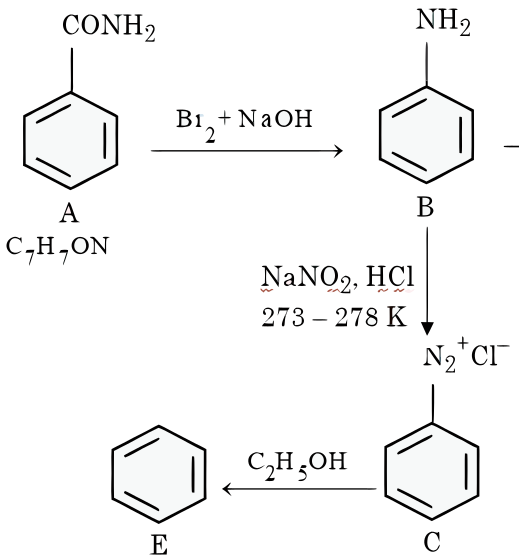 ( \(\displaystyle \mathbf{1}\) mark for identification of \(\displaystyle \mathbf{A}, \frac{\mathbf{1}}{\mathbf{2}}+\frac{\mathbf{1}}{\mathbf{2}}\) each for identification and reaction of formation of \(\displaystyle \mathbf{B}, \mathbf{C}\), D, E).
More from Amines
- Assertion: Acetanilide ( -NHCOCH_3 ) is less basic than aniline. Reason (R): Acetylation of aniline results in decrease of electron density on…2024 · asked 2×
- Among the following, which is the strongest base?2023 · asked 2×
- Which of the following is least basic?2023
- Assertion: Aliphatic primary amines can be prepared by Gabriel phthalimide synthesis. Reason (R): Alkyl halides undergo nucleophilic substitution…2024
- How will you obtain the following from benzene diazonium chloride? Write chemical equations involved: 3 []2026
- A compound 'A' on reduction with iron scrap and hydrochloric acid gives compound 'B' with molecular formula C_6 H_7 N. Compound 'B' on reaction with…2022
- Assertion: Aniline is a stronger base than ammonia. Reason (R): The unshared electron pair on nitrogen atom in aniline becomes less available for…2024
- Identify the primary amine from the given options:2024
CBSE Class 12 Chemistry past-paper question from the 2024 board exam, with the answer as CBSE’s own marking scheme gives it. Where our answers come from.