✓ Board-verified
Biology · 2026 · 5 marks
CBSE 2026 · Region 2 · Set 1 · Q32
(a) Observe the segment of mRNA given below and answers the questions given below: (i) Explain and illustrate the steps involved to make fully…
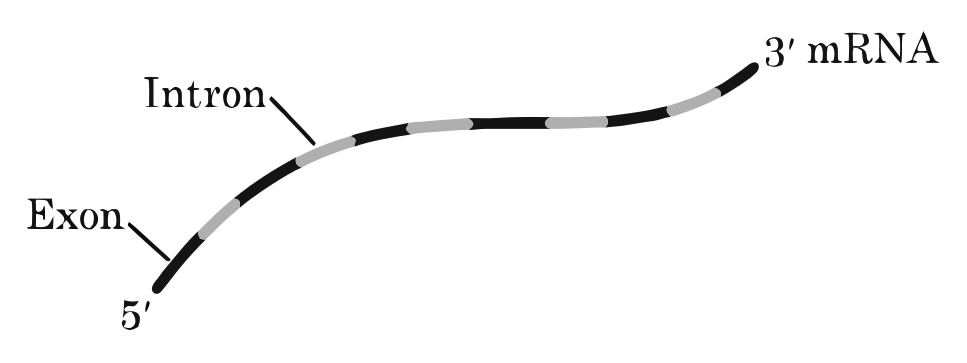
Observe the segment of mRNA given below and answers the questions given below:
(i)
Explain and illustrate the steps involved to make fully processed hn RNA.
(ii)
Gene encoding RNA polymerase I and RNA polymerase III have been affected by mutation. Explain its impact on the synthesis of polypeptide giving reasons.
In a particular cattle, the coat colour red and white are controlled by single pair of alleles. A calf that receives allele for red coat from mother and allele for white coat from father shows equal number of red and white hairs on its coat.
(i)
Is this an example of Co-dominance or incomplete dominance. Give a reason for your answer.
(ii)
With the help of a genetic cross upto $\displaystyle \mathrm{F}_{2}$ generation, explain what will be the consequent phenotype of calf when
(1)
Red is dominant over white,
(2)
Red is incompletely dominant.
Marking-scheme solution
(i)
Splicing - Introns or non-coding sequences are removed and axon or coding sequences are joined.
Capping - An unusual nucleotide Methyl guanosine triphosphate is added at
$\displaystyle 5$' end of hn RNA
Tailing - About $\displaystyle 200$ – $\displaystyle 300$ adenylate residues are added at $\displaystyle 3$' end of hnRNA in a template independent manner
(ii)
Polypeptide will not be synthesized as translation will not take place because
RNA I transcribes r RNAs which plays catalytic and structural role in protein synthesis, RNA polymerase III helps in transcription of tRNA which is the adaptor molecule and transfers amino acids to the site of protein synthesis.
(i)
Co-dominance, as two different alleles for a genetic trait are able to express / both characters are expressed equally.
(1)
Red is dominant over white
If pure breeding red coat cattle are represented as 'RR' and pure breeding white coat cattle as 'rr'. Then
RR (Red coat) X rr (White coat)
Gametes : R, R and r, r
F1 generation : Rr (All with red coat)
Rr X Rr
F2 generation :
F2 phenotypic ratio: $\displaystyle 3$ Red Coat : $\displaystyle 1$ White Coat
(2)
Red is incompletely dominant
RR (Red coat) X rr (White coat)
Gametes : R, R and r, r
F1 generation : Rr (All with Pink coat)
Rr X Rr
F2 generation :
F2 phenotypic ratio: $\displaystyle 1$ Red : $\displaystyle 2$ Pink : $\displaystyle 1$ White
All Molecular Basis of Inheritance questions2026 question paperNCERT solutions: Molecular Basis of InheritancePractice Molecular Basis of Inheritance →
More from Molecular Basis of Inheritance
- A bacterium having radioactive thymidine in its DNA is allowed to multiply in a medium having non-radioactive thymidine for two generations. What…2026
- Assertion: Repetitive sequences are stretches of DNA sequences that are thought to have no direct coding functions. Reason (R): They shed light on…2026
- Explain how the addition of lactose in the medium regulates the switching on of the lac operon in bacteria.2025
- In a human, the average gene consists of (i) bases and the largest known human gene contains (ii) bases. Select the correct option to fill in the…2026
- In a translational unit UTRs are present at:2025
- The simplest definition of a gene in eukaryotes is - A unit of DNA that has information to mainly specify the synthesis of:2025
- Explain the processing of heterogeneous nuclear RNA (hnRNA) into a fully functional mRNA in eukaryotes. Where does this processing occur in the cell?2024
- The type of bond represented by the dotted line '-----' in a schematic polynucleotide chain is:2024
CBSE Class 12 Biology past-paper question from the 2026 board exam, with the answer as CBSE’s own marking scheme gives it. Where our answers come from.