✓ Board-verified
Mathematics · 2025 · 5 marks
CBSE 2025 · Region 3 · Set 1 · Q34
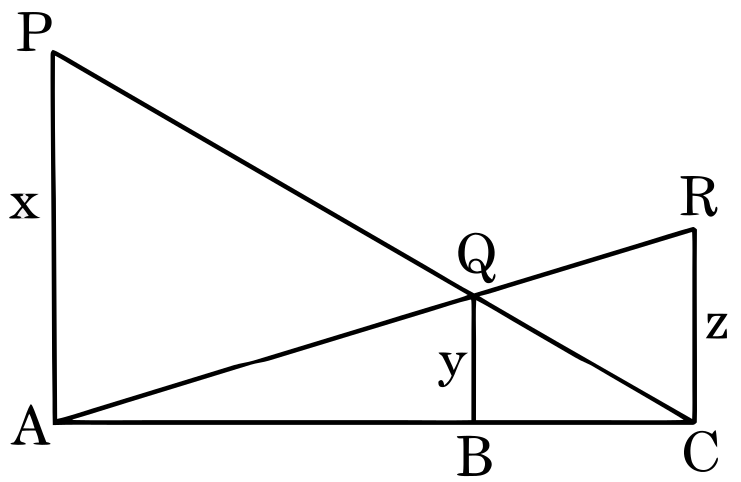
(a) In the given figure, PA, QB and RC are perpendicular to AC. If PA = x units, QB = y units and RC = z units, prove that 1/x+1/z=1/y.
In the given figure, $\displaystyle \mathrm{PA}, \mathrm{QB}$ and RC are perpendicular to AC. If $\displaystyle \mathrm{PA}=\mathrm{x}$ units, $\displaystyle \mathrm{QB}=\mathrm{y}$ units and $\displaystyle \mathrm{RC}=\mathrm{z}$ units, prove that $\displaystyle \frac{1}{\mathrm{x}}+\frac{1}{\mathrm{z}}=\frac{1}{\mathrm{y}}$.
Sides AB and BC and median AD of triangle ABC are respectively proportional to sides PQ and QR and median PM of $\displaystyle \triangle \mathrm{PQR}$. Show that $\displaystyle \triangle \mathrm{ABC} \sim \triangle \mathrm{PQR}$.
Marking-scheme solution
\(\displaystyle \Delta \mathrm{ABQ} \sim \Delta \mathrm{ACR}\)
\(\displaystyle \frac{\mathrm{AB}}{\mathrm{AC}}=\frac{\mathrm{QB}}{\mathrm{RC}}=\frac{\mathrm{y}}{\mathrm{z}}\)
Similarly, \(\displaystyle \Delta \mathrm{CBQ} \sim \Delta \mathrm{CAP}\)
\(\displaystyle \frac{\mathrm{BC}}{\mathrm{AC}}=\frac{\mathrm{QB}}{\mathrm{PA}}=\frac{\mathrm{y}}{\mathrm{x}}\)
On adding (i) & (ii), we get
\[\begin{aligned}
& \frac{A B}{A C}+\frac{B C}{A C}=\frac{y}{z}+\frac{y}{x} \\
& \frac{A B+B C}{A C}=y\left(\frac{1}{z}+\frac{1}{x}\right) \\
& \frac{A C}{A C}=y\left(\frac{1}{z}+\frac{1}{x}\right) \\
& \therefore \frac{1}{x}+\frac{1}{z}=\frac{1}{y}
\end{aligned}
\]
(b)

In \(\displaystyle \triangle \mathrm{ABD}\) and \(\displaystyle \triangle \mathrm{PQM}\)
\[\begin{aligned}
& \frac{\mathrm{AB}}{\mathrm{PQ}}=\frac{\mathrm{BC}}{\mathrm{QR}}=\frac{\mathrm{AD}}{\mathrm{PM}} \text { (given) } \\
& \frac{\mathrm{AB}}{\mathrm{PQ}}=\frac{2 \mathrm{BD}}{2 \mathrm{QM}}=\frac{\mathrm{AD}}{\mathrm{PM}} \\
& \frac{\mathrm{AB}}{\mathrm{PQ}}=\frac{\mathrm{BD}}{\mathrm{QM}}=\frac{\mathrm{AD}}{\mathrm{PM}} \\
& \therefore \triangle \mathrm{ABD} \sim \triangle \mathrm{PQM} \\
& \therefore \angle \mathrm{~B}=\angle \mathrm{Q} \\
& \mathrm{In} \triangle \mathrm{ABC} \text { and } \triangle \mathrm{PQR} \\
& \frac{\mathrm{AB}}{\mathrm{PQ}}=\frac{\mathrm{BC}}{\mathrm{QR}} \text { and } \angle \mathrm{B}=\angle \mathrm{Q} \\
& \triangle \mathrm{ABC} \sim \triangle \mathrm{PQR}
\end{aligned}
\]
More from Triangles
- Sides AB and AC and median AM of a ABC are proportional to sides DE and DF and Median DN of another DEF. Show that ABC ∼ DEF. ABCD is a…2023
- In the given figure, DE ∥ BC. If AD=2 units, DB=AE=3 units and EC=x units, then the value of x is:2023
- Which of the following statements is incorrect?2025
- E is a point on the side AD produced of a parallelogram ABCD and BE intersects CD at F. Show that Δ ABE ∼ Δ CFB. OR Sides AB, BC and the median AD of…2024
- If PQR ∼ ABC; PQ=6 cm, AB=8 cm and the perimeter of ABC is 36 cm, then the perimeter of PQR is2023
- In the given figure, ABCD is a quadrilateral. Diagonal BD bisects ∠ B and ∠ D both. Prove that:2024
- E and F are points on the sides AB and AC respectively of a ABC such that AE/EB=AF/FC=1/2. Which of the following relation is true?2025
- If Δ ABC ∼ Δ PQR with ∠ A=32^° and ∠ R=65^°, then the measure of ∠ B is:2023
CBSE Class 10 Mathematics past-paper question from the 2025 board exam, with the answer as CBSE’s own marking scheme gives it. Where our answers come from.