✓ Board-verified
Physics · 2022 · 3 marks
CBSE 2022 · Region 1 · Set 1 · Q11
(a) (i) Monochromatic light is incident on a surface separating two media. The frequency of the light after refraction remains unaffected but its…
(i)
Monochromatic light is incident on a surface separating two media. The frequency of the light after refraction remains unaffected but its wavelength changes. Why ?
(ii)
The frequency of an electromagnetic radiation is $\displaystyle 1.0 \times 10^{11} \mathrm{~Hz}$. Identify the radiation and mention its two uses.
(i)
Trace the path of a ray of light PQ which is incident at an angle i on one face of a glass prism of angle A. It then emerges out from the other face at an angle e. Use the ray diagram to prove that the angle through which the ray is deviated is given by $\displaystyle \angle \delta$ $\displaystyle =\angle \mathrm{i}+\angle \mathrm{e}-\angle \mathrm{A}$.
(ii)
What will be the minimum value of $\displaystyle \delta$ if the ray passes symmetrically through the prism ?
Marking-scheme solution
(i)
Refraction arises through interaction of incident light with the atomic constituents of matter. Atoms may be viewed as oscillators which take up the frequency of the external agency causing forced oscillations. Thus the frequency of refracted light equals the frequency of incident light.
Alternatively
Frequency is the characteristic of the source of light. So it remains unaffected. But $\displaystyle \lambda$ depends on refractive index ( $\displaystyle \mu$ ) of the medium as -
$$\lambda_{m}=\frac{\lambda_{o}}{\mu}
$$ii) Infrared/ Microwaves/ Radio waves
Uses of Infrared rays
Remote control
Green house effect
Photography in foggy condition
To reveal secret writings
Infrared lamps
Uses of Microwaves
Radar System
Geostationary satellite
Microwave ovens
Uses of Radiowaves
TV transmission
Radio broadcast
Mobile transmission
Diagram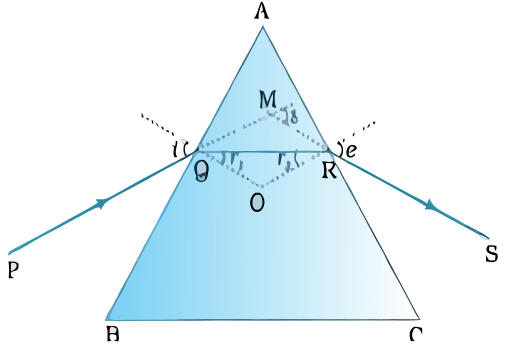
$\displaystyle \delta=\left(i-r_{1}\right)+\left(e-r_{2}\right)$
$\displaystyle \angle \mathrm{Q}=\angle \mathrm{R}=90^{\circ} \quad \therefore \angle \mathrm{A}+\angle \mathrm{O}=180^{\circ}$
In $\displaystyle \triangle \mathrm{QOR}$
$$\begin{equation*}
O+r_{$\displaystyle 1$}+r_{$\displaystyle 2$}=$\displaystyle 180$^{\circ} \tag{2}
\end{equation*}
$$Comparing ($\displaystyle 1$) and
$$\therefore A=r_{$\displaystyle 1$}+r_{$\displaystyle 2$}
$$$\therefore \delta=(i+e)-A$
All Ray Optics and Optical Instruments questions2022 question paperNCERT solutions: Ray Optics and Optical InstrumentsPractice Ray Optics and Optical Instruments →
More from Ray Optics and Optical Instruments
- A small bulb is placed at the bottom of a tank, containing a transparent liquid of refractive index √2, to a depth of 1 m. Calculate the area of the…2026
- Assertion: A convex lens, when immersed in a liquid, disappears. Reason ( R ): The refractive indices of material of the lens and the liquid are…2024
- A right angled isosceles glass prism ABC is kept in contact with an equilateral triangular prism DBC as shown in the figure. Both prisms are made of…2025
- A convex lens (n = 1.52) has a focal length of 15.0 cm in air. Find its focal length when it is immersed in liquid of refractive index 1.65. What…2024
- (i) Draw a labelled ray diagram showing the formation of the image at infinity by an astronomical telescope. (ii) A telescope consists of an…2022
- Two convex lenses A and B, each of focal length 10.0 cm, are mounted on an optical bench at 50.0 cm and 70.0 cm respectively. An object is mounted at…2025
- A right-angled prism ABC (refractive index √2 ) is kept on a plane mirror as shown in the figure. A ray of light is incident normally on the face AC.…2025
- A ray of light is incident on a glass prism of refractive index μ and refracting angle A. If it just suffers total internal reflection at the other…2023
CBSE Class 12 Physics past-paper question from the 2022 board exam, with the answer as CBSE’s own marking scheme gives it. Where our answers come from.