✓ Board-verified
Physics · 2025 · 5 marks
CBSE 2025 · Region 6 · Set 1 · Q32
(a) (i) Draw a ray diagram to show the image formation by a compound microscope. Obtain the expression for the total magnification of the microscope…
(i)
Draw a ray diagram to show the image formation by a compound microscope. Obtain the expression for the total magnification of the microscope when the final image is formed at infinity.
(ii)
In a compound microscope, an object is placed at a distance of $\displaystyle 1.5$ cm from the objective of focal length $\displaystyle 1.25$ cm. The eyepiece has a focal length of $\displaystyle 5$ cm. The final image is formed at infinity. Calculate the distance between the objective and the eyepiece.
(i)
Using Huygens'principle, explain the refraction of a plane wavefront, propagating in air, at a plane interface between air and glass. Hence verify Snell's law.
(ii)
Use mirror formula to deduce that a convex mirror always produces a virtual image of an object kept in front of it.
Marking-scheme solution
(a)(i)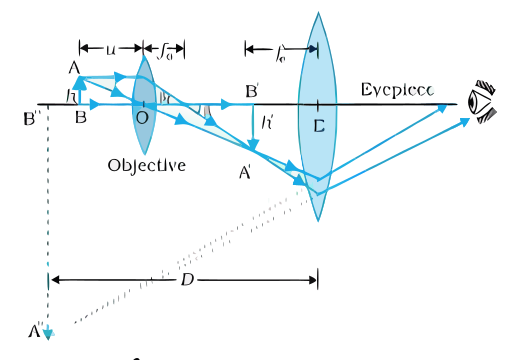
Magnification produced by objective
$$m_0 = \frac{h'}{h} = \frac{L}{f_o}$$
Magnification produced by eye-piece
$$m_e = 1 + \frac{D}{f_e}$$
If the final image is formed at infinity
$$m_e = \frac{D}{f_e}$$
Total magnification
$$m = m_0 \times m_e$$
$$= \left(\frac{L}{f_o}\right)\left(\frac{D}{f_e}\right)$$
$$\frac{1}{v_o} - \frac{1}{u_o} = \frac{1}{f_0}$$
$$\frac{1}{v_o} - \frac{1}{(-1.5)} = \frac{1}{1.25}$$
$$v_o = 7.5\ \text{cm}$$
$$L = |v_o| + |f_e| \quad \text{as final image is formed at infinity } (v_e = \infty,\ u_e = f_e)$$
$$L = 7.5 + 5$$
$$L = 12.5\ \text{cm}$$
(i)
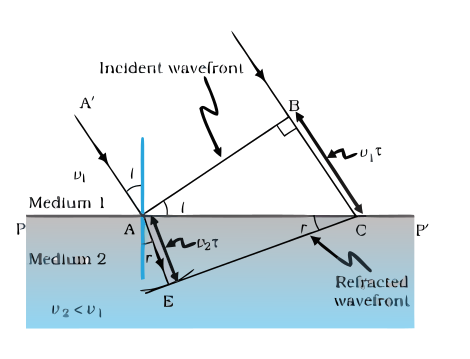
$$\sin i = \frac{BC}{AC} = \frac{v_1 \tau}{AC}$$
$$\sin r = \frac{AE}{AC} = \frac{v_2 \tau}{AC}$$
$$\frac{\sin i}{\sin r} = \frac{v_1}{v_2}$$
$$\frac{\sin i}{\sin r} = \frac{c/n_1}{c/n_2}$$
$$\frac{\sin i}{\sin r} = \frac{n_2}{n_1} \quad \text{or} \quad n_1 \sin i = n_2 \sin r$$
(ii)
$$\frac{1}{v} + \frac{1}{u} = \frac{1}{f}$$
$$u < 0,\ f > 0$$
$$\frac{1}{v} + \frac{1}{(-u)} = \frac{1}{f}$$
$$\frac{1}{v} = \frac{1}{f} + \frac{1}{u}$$
$\displaystyle \frac{1}{v}$ is positive
$\displaystyle \therefore$ v is positive $\displaystyle \Rightarrow$ virtual image
All Ray Optics and Optical Instruments questions2025 question paperNCERT solutions: Ray Optics and Optical InstrumentsPractice Ray Optics and Optical Instruments →
More from Ray Optics and Optical Instruments
- A small bulb is placed at the bottom of a tank, containing a transparent liquid of refractive index √2, to a depth of 1 m. Calculate the area of the…2026
- Assertion: A convex lens, when immersed in a liquid, disappears. Reason ( R ): The refractive indices of material of the lens and the liquid are…2024
- A right angled isosceles glass prism ABC is kept in contact with an equilateral triangular prism DBC as shown in the figure. Both prisms are made of…2025
- A convex lens (n = 1.52) has a focal length of 15.0 cm in air. Find its focal length when it is immersed in liquid of refractive index 1.65. What…2024
- (i) Draw a labelled ray diagram showing the formation of the image at infinity by an astronomical telescope. (ii) A telescope consists of an…2022
- Two convex lenses A and B, each of focal length 10.0 cm, are mounted on an optical bench at 50.0 cm and 70.0 cm respectively. An object is mounted at…2025
- A right-angled prism ABC (refractive index √2 ) is kept on a plane mirror as shown in the figure. A ray of light is incident normally on the face AC.…2025
- A ray of light is incident on a glass prism of refractive index μ and refracting angle A. If it just suffers total internal reflection at the other…2023
CBSE Class 12 Physics past-paper question from the 2025 board exam, with the answer as CBSE’s own marking scheme gives it. Where our answers come from.