✓ Board-verified
Physics · 2023 · 5 marks
Ray Optics and Optical InstrumentsRefraction at Spherical Surfaces and by Lenses5 marksApplylong answer
CBSE 2023 · Region 3 · Set 1 · Q33
(a) (i) Draw a ray diagram showing the formation of a real image of an object placed at a distance ' u ' in front of a concave mirror of radius of…
(i)
Draw a ray diagram showing the formation of a real image of an object placed at a distance ' $\displaystyle u$ ' in front of a concave mirror of radius of curvature ' $\displaystyle R$ '. Hence, obtain the relation for the image distance ' $\displaystyle v$ ' in terms of $\displaystyle u$ and $\displaystyle R$.
(ii)
A $\displaystyle 1.8$ m tall person stands in front of a convex lens of focal length $\displaystyle 1$ m , at a distance of $\displaystyle 5$ m . Find the position and height of the image formed.
(i)
Draw a ray diagram showing refraction of a ray of light through a triangular glass prism. Hence, obtain the relation for the refractive index ( $\displaystyle \mu$ ) in terms of angle of prism (A) and angle of minimum deviation ( $\displaystyle \delta_{\mathrm{m}}$ ).
(ii)
The radii of curvature of the two surfaces of a concave lens are $\displaystyle 20$ cm each. Find the refractive index of the material of the lens if its power is $\displaystyle -5 \cdot 0 \mathrm{D}$.
Marking-scheme solution
(i)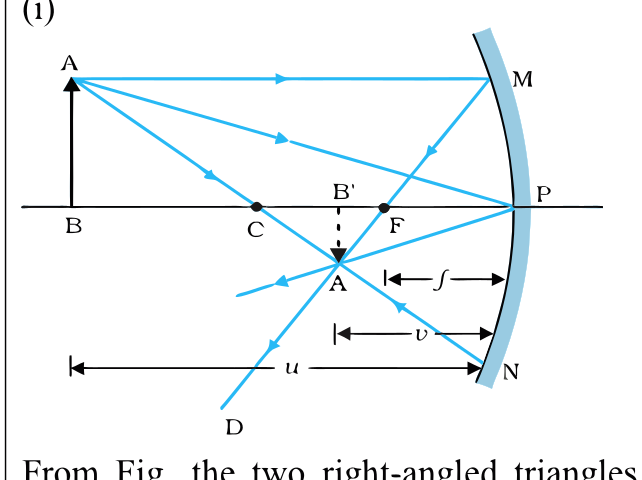
From Fig. the two right-angled triangles A′B′F and MPF are similar. (For paraxial rays, MP can be considered to be a straight line perpendicular to CP.) Therefore,
\[\frac{\mathrm{B'A'}}{\mathrm{PM}}=\frac{\mathrm{B'F}}{\mathrm{FP}}\]
or \[\frac{\mathrm{B'A'}}{\mathrm{BA}}=\frac{\mathrm{B'F}}{\mathrm{FP}} \qquad (\because \mathrm{PM}=\mathrm{AB})\] -----(i)
Since $\displaystyle \angle \mathrm{APB} = \angle \mathrm{A'PB'}$, the right angled triangles A′B′P and ABP are also similar. Therefore,
\[\frac{\mathrm{B'A'}}{\mathrm{BA}}=\frac{\mathrm{B'P}}{\mathrm{BP}}\] -----(ii)
Comparing equations (i) and (ii)
\[\frac{\mathrm{B'F}}{\mathrm{FP}}=\frac{\mathrm{B'P}-\mathrm{FP}}{\mathrm{FP}}=\frac{\mathrm{B'P}}{\mathrm{BP}}\] -----(iii)
B′P = – v, FP = – f, BP = – u;
Using these in Eq.(iii) we get $\displaystyle \dfrac{1}{v}+\dfrac{1}{u}=\dfrac{1}{f}=\dfrac{2}{R}$
(ii)
For lens: $\displaystyle \dfrac{1}{v}-\dfrac{1}{u}=\dfrac{1}{f}$
$\displaystyle u = -5m; \quad f = +1m$
\[\frac{1}{v}-\frac{1}{-5}=\frac{1}{(+1)}\]
\[\Rightarrow v = \frac{5}{4}m = 1.25m\]
\[m=\frac{I}{O}=\frac{v}{u}=\frac{\left(+\dfrac{5}{4}\right)}{(-5)}\]
I = (- $\displaystyle 0.25$) × ($\displaystyle 1.8$)
I = - $\displaystyle 0.45$ m
(i)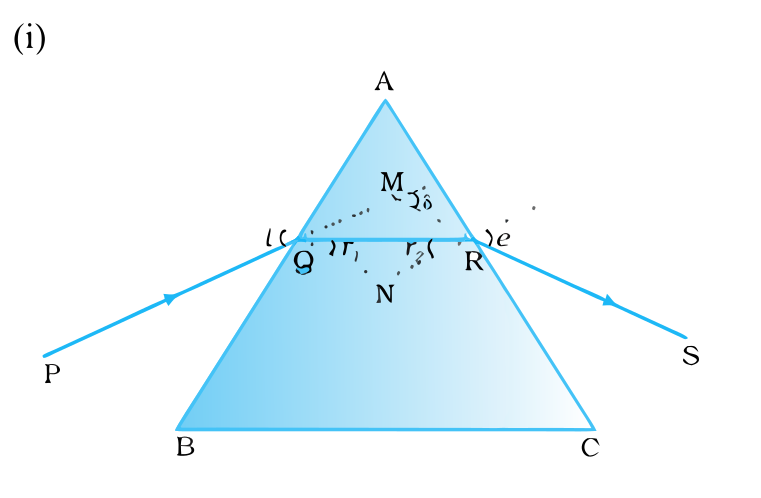
In the quadrilateral AQNR, two of the angles (at the vertices Q and R) are right angles. Therefore, the sum of the other angles of the quadrilateral is $\displaystyle 180$º.
$\displaystyle \angle$A + $\displaystyle \angle$QNR = $\displaystyle 180$º
From the triangle QNR, r$\displaystyle _1$ + r$\displaystyle _2$ + $\displaystyle \angle$QNR = $\displaystyle 180$º
Comparing these two equations, we get
r$\displaystyle _1$ + r$\displaystyle _2$ = A -------(i)
The total deviation $\displaystyle \delta$ is the sum of deviations at the two faces,
$\displaystyle \delta = (i - r_1) + (e - r_2)$ that is, $\displaystyle \delta = i + e - A$ -------(ii)
When $\displaystyle \delta = \delta_m$; i = e & r$\displaystyle _1$ = r$\displaystyle _2$
From (i); 2r = A or r = A/$\displaystyle 2$
From (ii); $\displaystyle \delta_m$ = 2i - A or $\displaystyle i=\dfrac{A+\delta_m}{2}$
\[\mu=\frac{\sin i}{\sin r}=\frac{\sin\left(\dfrac{A+\delta_m}{2}\right)}{\sin \dfrac{A}{2}}\]
(ii)
Given; P = - 5D
$\displaystyle f\ (\text{in cm}) = \dfrac{100}{(-5)} = -20$ cm
Using Lens Maker's formula ; $\displaystyle \dfrac{1}{f}=(\mu-1)\left[\dfrac{1}{R_1}-\dfrac{1}{R_2}\right]$
\[\frac{1}{(-20)}=(\mu-1)\left[\frac{1}{(-20)}-\frac{1}{(+20)}\right]\]
\[\frac{1}{(-20)}=(\mu-1)\left[-\frac{1}{10}\right]; \qquad \mu-1=\frac{1}{2}\]
\[\Rightarrow \mu=\frac{3}{2}=1.5\]
All Ray Optics and Optical Instruments questions2023 question paperNCERT solutions: Ray Optics and Optical InstrumentsPractice Ray Optics and Optical Instruments →
More from Ray Optics and Optical Instruments
- A small bulb is placed at the bottom of a tank, containing a transparent liquid of refractive index √2, to a depth of 1 m. Calculate the area of the…2026
- Assertion: A convex lens, when immersed in a liquid, disappears. Reason ( R ): The refractive indices of material of the lens and the liquid are…2024
- A right angled isosceles glass prism ABC is kept in contact with an equilateral triangular prism DBC as shown in the figure. Both prisms are made of…2025
- A convex lens (n = 1.52) has a focal length of 15.0 cm in air. Find its focal length when it is immersed in liquid of refractive index 1.65. What…2024
- (i) Draw a labelled ray diagram showing the formation of the image at infinity by an astronomical telescope. (ii) A telescope consists of an…2022
- Two convex lenses A and B, each of focal length 10.0 cm, are mounted on an optical bench at 50.0 cm and 70.0 cm respectively. An object is mounted at…2025
- A right-angled prism ABC (refractive index √2 ) is kept on a plane mirror as shown in the figure. A ray of light is incident normally on the face AC.…2025
- A ray of light is incident on a glass prism of refractive index μ and refracting angle A. If it just suffers total internal reflection at the other…2023
CBSE Class 12 Physics past-paper question from the 2023 board exam, with the answer as CBSE’s own marking scheme gives it. Where our answers come from.