✓ Board-verified
Physics · 2022 · 5 marks
CBSE 2022 · Region 5 · Set 2 · Q12
A ray of light travels from a denser to a rarer medium. After refraction, it bends away from the normal. When we keep increasing the angle of…
A ray of light travels from a denser to a rarer medium. After refraction, it bends away from the normal. When we keep increasing the angle of incidence, the angle of refraction also increases till the refracted ray grazes along the interface of two media. The angle of incidence for which it happens is called critical angle. If the angle of incidence is increased further the ray will not emerge and it will be reflected back in the denser medium. This phenomenon is called total internal reflection of light.
(i)
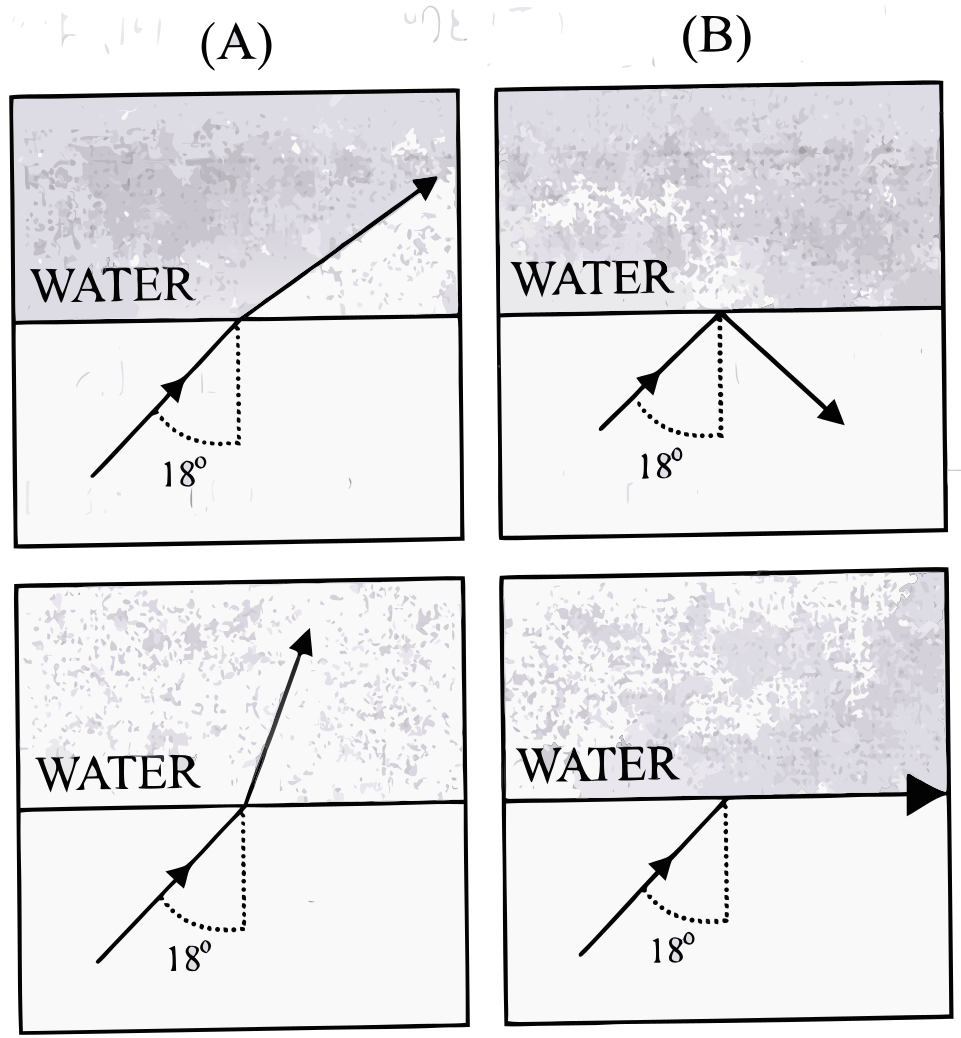
A ray of light travels from a medium into water at an angle of incidence of $\displaystyle 18^{\circ}$. The refractive index of the medium is more than that of water and the critical angle for the interface between the two media is $\displaystyle 20^{\circ}$. Which one of the following figures best represents the correct path of the ray of light ?
(C)
(D)
(ii)
A point source of light is placed at the bottom of a tank filled with water, of refractive index $\displaystyle \mu$, to a depth d. The area of the surface of water through which light from the source can emerge, is :
(a)
$\displaystyle \frac{\pi \mathrm{d}^{2}}{2\left(\mu^{2}-1\right)}$
(b)
$\displaystyle \frac{\pi \mathrm{d}^{2}}{\left(\mu^{2}-1\right)}$ c) $\displaystyle \frac{\pi \mathrm{d}^{2}}{\sqrt{2} \sqrt{\mu^{2}-1}}$
(d)
$\displaystyle \frac{2 \pi \mathrm{~d}^{2}}{\left(\mu^{2}-1\right)}$
(iii)
For which of the following media, with respect to air, the value of critical angle is maximum ?
(a)
Crown glass
(b)
Flint glass
(c)
Water
(d)
Diamond
(iv)
The critical angle for a pair of two media A and B of refractive indices $\displaystyle 2.0$ and $\displaystyle 1.0$ respectively is :
(a)
$\displaystyle 0$°
(b) $\displaystyle 30$°
(c)
$\displaystyle 45$°
(d)
$\displaystyle 60$°
(v)
The critical angle of pair of a medium and air is $\displaystyle 30$°. The speed of light in the medium is :
(a)
$\displaystyle 1 \times 10^{8} \mathrm{~m} \mathrm{~s}^{-1}$
(b)
$\displaystyle 1.5 \times 10^{8} \mathrm{~m} \mathrm{~s}^{-1}$
(c)
$\displaystyle 2.2 \times 10^{8} \mathrm{~m} \mathrm{~s}^{-1}$
(d)
$\displaystyle 2.8 \times 10^{8} \mathrm{~m} \mathrm{~s}^{-1}$
Marking-scheme solution
(i) -a
(ii) -b
(iii) -c
(iv) -b
(v) -b
All Ray Optics and Optical Instruments questions2022 question paperNCERT solutions: Ray Optics and Optical InstrumentsPractice Ray Optics and Optical Instruments →
More from Ray Optics and Optical Instruments
- A small bulb is placed at the bottom of a tank, containing a transparent liquid of refractive index √2, to a depth of 1 m. Calculate the area of the…2026
- Assertion: A convex lens, when immersed in a liquid, disappears. Reason ( R ): The refractive indices of material of the lens and the liquid are…2024
- A right angled isosceles glass prism ABC is kept in contact with an equilateral triangular prism DBC as shown in the figure. Both prisms are made of…2025
- A convex lens (n = 1.52) has a focal length of 15.0 cm in air. Find its focal length when it is immersed in liquid of refractive index 1.65. What…2024
- (i) Draw a labelled ray diagram showing the formation of the image at infinity by an astronomical telescope. (ii) A telescope consists of an…2022
- Two convex lenses A and B, each of focal length 10.0 cm, are mounted on an optical bench at 50.0 cm and 70.0 cm respectively. An object is mounted at…2025
- A right-angled prism ABC (refractive index √2 ) is kept on a plane mirror as shown in the figure. A ray of light is incident normally on the face AC.…2025
- A ray of light is incident on a glass prism of refractive index μ and refracting angle A. If it just suffers total internal reflection at the other…2023
CBSE Class 12 Physics past-paper question from the 2022 board exam, with the answer as CBSE’s own marking scheme gives it. Where our answers come from.