✓ Board-verified
Physics · 2024 · 4 marks
CBSE 2024 · Region 5 · Set 1 · Q30
A prism is an optical medium bounded by three refracting plane surfaces. A ray of light suffers successive refractions on passing through its two…
A prism is an optical medium bounded by three refracting plane surfaces. A ray of light suffers successive refractions on passing through its two surfaces and deviates by a certain angle from its original path. The refractive index of the material of the prism is given by $\displaystyle \mu=\sin \left(\frac{\mathrm{A}+\delta \mathrm{m}}{2}\right) / \sin \frac{\mathrm{A}}{2}$. If the angle of incidence on the second surface is greater than an angle called critical angle, the ray will not be refracted from the second surface and is totally internally reflected.
(i)
The critical angle for glass is $\displaystyle \theta_{1}$ and that for water is $\displaystyle \theta_{2}$. The critical angle for glass-water surface would be (given $\displaystyle { }_{\mathrm{a}} \mu_{\mathrm{g}}=1.5$, $\displaystyle { }_{\mathrm{a}} \mu_{\mathrm{w}}=1.33$ )
(A)
less than $\displaystyle \theta_{2}$
(B)
between $\displaystyle \theta_{1}$ and $\displaystyle \theta_{2}$
(C)
greater than $\displaystyle \theta_{2}$
(D)
less than $\displaystyle \theta_{1}$
(ii)
When a ray of light of wavelength $\displaystyle \lambda$ and frequency $\displaystyle v$ is refracted into a denser medium
(A)
$\displaystyle \lambda$ and $\displaystyle v$ both increase.
(B)
$\displaystyle \lambda$ increases but $\displaystyle v$ is unchanged.
(C)
$\displaystyle \lambda$ decreases but $\displaystyle v$ is unchanged.
(D)
$\displaystyle \lambda$ and $\displaystyle v$ both decrease.
(iii)
The critical angle for a ray of light passing from glass to water is minimum for
(A)
red colour
(B)
blue colour
(C)
yellow colour
(D)
violet colour
Three beams of red, yellow and violet colours are passed through a prism, one by one under the same condition. When the prism is in the position of minimum deviation, the angles of refraction from the second surface are $\displaystyle \mathrm{r}_{\mathrm{R}}, \mathrm{r}_{\mathrm{Y}}$ and $\displaystyle \mathrm{r}_{\mathrm{V}}$ respectively. Then
(A)
$\displaystyle \mathrm{r}_{\mathrm{V}}<\mathrm{r}_{\mathrm{Y}}<\mathrm{r}_{\mathrm{R}}$
(B)
$\displaystyle \mathrm{r}_{\mathrm{Y}}<\mathrm{r}_{\mathrm{R}}<\mathrm{r}_{\mathrm{V}}$
(C)
$\displaystyle \mathrm{r}_{\mathrm{R}}<\mathrm{r}_{\mathrm{Y}}<\mathrm{r}_{\mathrm{V}}$
(D)
$\displaystyle \mathrm{r}_{\mathrm{R}}=\mathrm{r}_{\mathrm{Y}}=\mathrm{r}_{\mathrm{V}}$
(iv)
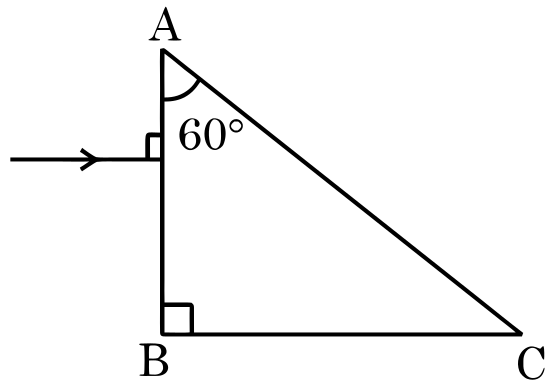
A ray of light is incident normally on a prism ABC of refractive index $\displaystyle \sqrt{2}$, as shown in figure. After it strikes face AC, it will
(A)
go straight undeviated
(B)
just graze along the face AC
(C)
refract and go out of the prism
(D)
undergo total internal reflection
Marking-scheme solution
(i)(C)
greater than $\displaystyle \theta_{2}$
(ii)(C)
$\displaystyle \lambda$ decreases but $\displaystyle \nu$ is unchanged
(iii)(a)
(D) violet colour
OR
(b)(C)
$\displaystyle r_{R}<r_{Y}<r_{V}$
(iv)(D)
undergo total internal reflection
All Ray Optics and Optical Instruments questions2024 question paperNCERT solutions: Ray Optics and Optical InstrumentsPractice Ray Optics and Optical Instruments →
More from Ray Optics and Optical Instruments
- A small bulb is placed at the bottom of a tank, containing a transparent liquid of refractive index √2, to a depth of 1 m. Calculate the area of the…2026
- Assertion: A convex lens, when immersed in a liquid, disappears. Reason ( R ): The refractive indices of material of the lens and the liquid are…2024
- A right angled isosceles glass prism ABC is kept in contact with an equilateral triangular prism DBC as shown in the figure. Both prisms are made of…2025
- A convex lens (n = 1.52) has a focal length of 15.0 cm in air. Find its focal length when it is immersed in liquid of refractive index 1.65. What…2024
- (i) Draw a labelled ray diagram showing the formation of the image at infinity by an astronomical telescope. (ii) A telescope consists of an…2022
- Two convex lenses A and B, each of focal length 10.0 cm, are mounted on an optical bench at 50.0 cm and 70.0 cm respectively. An object is mounted at…2025
- A right-angled prism ABC (refractive index √2 ) is kept on a plane mirror as shown in the figure. A ray of light is incident normally on the face AC.…2025
- A ray of light is incident on a glass prism of refractive index μ and refracting angle A. If it just suffers total internal reflection at the other…2023
CBSE Class 12 Physics past-paper question from the 2024 board exam, with the answer as CBSE’s own marking scheme gives it. Where our answers come from.