✓ Board-verified
Mathematics · 2026 · 4 marks
CBSE 2026 · Region 3 · Set 2 · Q38
Two vertical light poles of height 22 m and 16 m stand on the opposite sides of a 20 m wide road as shown below in the figure. Two ladders of length…
Two vertical light poles of height $\displaystyle 22$ m and $\displaystyle 16$ m stand on the opposite sides of a $\displaystyle 20$ m wide road as shown below in the figure.
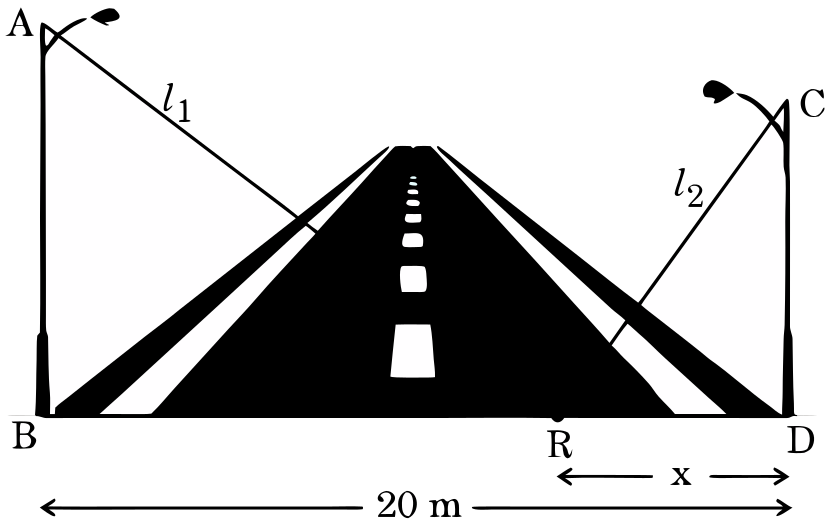
Two ladders of length $\displaystyle \mathrm{l}_{1}$ and $\displaystyle \mathrm{l}_{2}$ are placed from a common point R on the road at a distance of x m from the smaller pole. Based on the above information, answer the following questions :
(i)
$\displaystyle \operatorname{Express} \mathrm{p}(\mathrm{x})=\mathrm{l}_{1}+\mathrm{l}_{2}$ in terms of x.
(ii)
Find $\displaystyle \mathrm{p}^{\prime}(\mathrm{x})$.
(iii)(a)
Find the value of x for which $\displaystyle \mathrm{l}_{1}^{2}+\mathrm{l}_{2}^{2}$ is minimum.
(iii)(b)
If the $\displaystyle 22$ m long pole is also replaced by a $\displaystyle 16$ m long pole, at what distance from either pole should the ladders be kept so that the sum of squares of lengths of ladders needed to reach the top of the pole is minimum ?
Marking-scheme solution
(i)
$\displaystyle p(x)=\sqrt{22^{2}+(20-x)^{2}}+\sqrt{16^{2}+x^{2}}$ or $\displaystyle p(x)=\sqrt{x^{2}-40 x+884}+\sqrt{x^{2}+256}$
(ii)
$\displaystyle p^{\prime}(x)=\dfrac{x-20}{\sqrt{x^{2}-40 x+884}}+\dfrac{x}{\sqrt{x^{2}+256}}$
(iii)
Let $\displaystyle q(x)=l_{1}{}^{2}+l_{2}{}^{2}=2 x^{2}-40 x+1140$
$\displaystyle q^{\prime}(x)=4 x-40$
Put $\displaystyle q^{\prime}(x)=0 \Rightarrow x=10$
$\displaystyle q^{\prime \prime}(x=10)=4>0 \Rightarrow q(x)$ is minimum at $\displaystyle x=10$.
Let, ladder is kept at y m distance from one pole.
Suppose, $\displaystyle r(y)=$ sum of squares of lengths of ladders
$\displaystyle \Rightarrow r(y)=\left(16^{2}+y^{2}\right)+\left[16^{2}+(20-y)^{2}\right]$
$\displaystyle \Rightarrow r(y)=2 y^{2}-40 y+912$
On diff. wrt y, we get $\displaystyle r^{\prime}(y)=4 y-40$
Put $\displaystyle r^{\prime}(y)=0 \Rightarrow y=10$
$\displaystyle r^{\prime \prime}(y)=4>0 \Rightarrow r(y)$ is minimum at $\displaystyle y=10$.
Hence, the required distance of the ladder from each pole $\displaystyle =10$ m
All Application of Derivatives questions2026 question paperNCERT solutions: Application of DerivativesPractice Application of Derivatives →
More from Application of Derivatives
- Overspeeding increases fuel consumption and decreases fuel economy as a result of tyre rolling friction and air resistance. While vehicles reach…2024
- Find the local maxima and local minima of the function f(x)=8/3 x^3-12 x^2+18 x+5.2025
- The least value of f(x)=x^3-12 x, x ∈[0,3] is2026
- Let f(x) be a continuous function on [a, b] and differentiable on (a, b). Then, this function f(x) is strictly increasing in (a, b) if2024
- Show that the function f given by f(x)= sin x+ cos x, is strictly decreasing in the interval ((π)/4, (5 π)/4).2024
- A cylindrical tank is being filled with sand at a rate of 314 m^3 / h. If the radius of the tank is 10 m, then the height of sand in the tank…2026
- Find the sub-interval of (0, ∞) in which f(x)=x^2 e^-x is increasing.2026
- A carpenter needs to make a wooden cuboidal box, closed from all sides, which has a square base and fixed volume. Since he is short of the paint…2025
CBSE Class 12 Mathematics past-paper question from the 2026 board exam, with the answer as CBSE’s own marking scheme gives it. Where our answers come from.