✓ Board-verified
Mathematics · 2026 · 4 marks
CBSE 2026 · Region 1 · Set 1 · Q37
In an online jackpot, there is one first prize of ₹ 3,00,000, two second prizes of ₹ 2,00,000 each and three third prizes of ₹ 50,000 each. A total…
In an online jackpot, there is one first prize of ₹ $\displaystyle 3,00,000$, two second prizes of ₹ $\displaystyle 2,00,000$ each and three third prizes of ₹ $\displaystyle 50,000$ each.
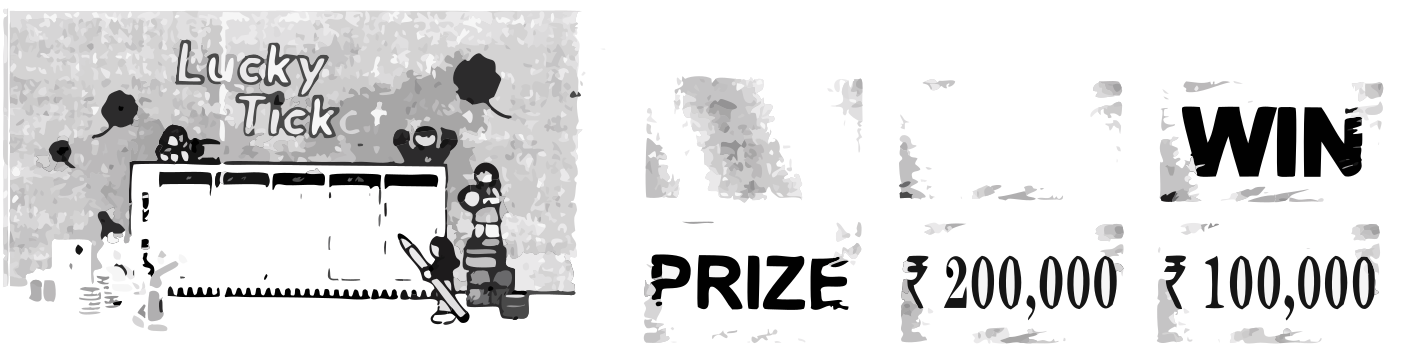
A total of $\displaystyle 1,00,000$ jackpot tickets each costing ₹ $\displaystyle 100$ were sold there by raising a fund of ₹ $\displaystyle 1,00,00,000$. Rohan bought one ticket.
Based on given information, answer the following questions :
(i)
What are the possible amounts, the person can win?
(ii)
(a)
What is the probability that the person wins atleast ₹ $\displaystyle 2,00,000$ ?
OR
(b)
What is the probability that the person does not win any amount?
(iii)
In another jackpot, Rohan also bought a ticket having a prize money of ₹ $\displaystyle 5,00,000$. The chances of winning the jackpot are $\displaystyle 1$ in $\displaystyle 1,00,000$. Find the probability that on exactly one of tickets he wins the jackpot.
Official answer
(i)
The possible amounts are: ₹$\displaystyle 3,00,000$, ₹$\displaystyle 2,00,000$, ₹$\displaystyle 50,000$, or ₹$\displaystyle 0$ (no prize). (ii)(a) P(win at least ₹$\displaystyle 2,00,000$) = ($\displaystyle 1$+$\displaystyle 2$)/$\displaystyle 100,000$ = $\displaystyle 3$/$\displaystyle 100,000$ = $\displaystyle 3$/$\displaystyle 10$^5. (ii)(b) P(does not win any amount) = ($\displaystyle 100,000$ - $\displaystyle 1$ - $\displaystyle 2$ - $\displaystyle 3$)/$\displaystyle 100,000$ = $\displaystyle 99,994$/$\displaystyle 100,000$ = $\displaystyle 49,997$/$\displaystyle 50$,000.
Marking-scheme solution
(i)
₹ $\displaystyle 300000$, ₹ $\displaystyle 200000$, ₹ $\displaystyle 50000$
(ii)
(a)
Required probability $\displaystyle =\dfrac{3}{100000}$
OR
(b)
Required probability $\displaystyle =1-\dfrac{6}{100000}=\dfrac{99994}{100000}$ or $\displaystyle \dfrac{49997}{50000}$
(iii)
P (Exactly on one of the tickets Rohan wins the jackpot) $\displaystyle =$ P [(He wins first and he loses second) or (He loses first and wins second)]
$\displaystyle =\dfrac{6}{100000} \times \dfrac{99999}{100000}+\dfrac{99994}{100000} \times \dfrac{1}{100000}=\dfrac{699988}{10^{10}}$ or $\displaystyle \dfrac{174997}{2500000000}$
More from Probability
- Assertion: Two coins are tossed simultaneously. The probability of getting two heads, if it is known that at least one head comes up, is 1/3. Reason…2023
- If A and B are two events such that P(B)=1/5, P(A ∣ B)=2/3 and P(A ∪ B)=3/5, then P(A) is:2025
- A shop selling electronic items sells smartphones of only three reputed companies A, B and C because chances of their manufacturing a defective…2025
- Three friends A, B and C got their photograph clicked. Find the probability that B is standing at the central position, given that A is standing at…2022
- A box has 4 green, 8 blue and 3 red pens. A student picks up a pen at random, checks its colour and replaces it in the box. He repeats this process 3…2025
- Smoking increases the risk of lung problems. A study revealed that 170 in 1000 males who smoke develop lung complications, while 120 out of 1000…2026
- Let M and N be two events such that P(M)=0.6, P(N)=0.2 and P(M ∩ N)=0.5, then P(M^′ / N^′) is2025
- The probability distribution of a random variable X is: where k is some unknown constant. The probability that the random variable X takes the value…2024
CBSE Class 12 Mathematics past-paper question from the 2026 board exam, with the answer as CBSE’s own marking scheme gives it. Where our answers come from.