✓ Board-verified
Mathematics · 2026 · 5 marks
CBSE 2026 · Region 2 · Set 3 · Q32
(a) Find the sub-interval of (0, (π)/2) in which f (x)= log ( sin x+ cos x) is increasing and decreasing.
Find the sub-interval of $\displaystyle \left(0, \frac{\pi}{2}\right)$ in which $\displaystyle \mathrm{f}(x)=\log (\sin x+\cos x)$ is increasing and decreasing.
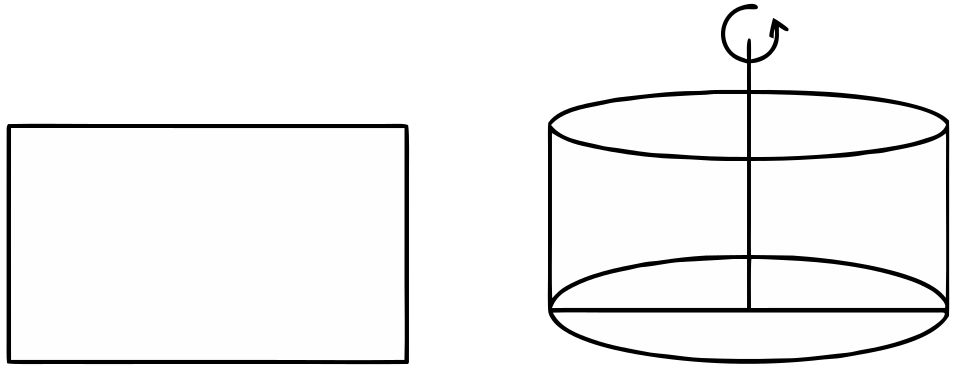
A rectangle of perimeter $\displaystyle 30$ cm is revolved along one of its sides to sweep out a cylinder of maximum volume. Find the dimensions of the rectangle.
Marking-scheme solution
$\displaystyle \mathrm{f}(x)=\log(\sin x+\cos x), x \in\left(0, \dfrac{\pi}{2}\right)$
$\displaystyle \Rightarrow \mathrm{f}^{\prime}(x)=\dfrac{\cos x-\sin x}{\sin x+\cos x}$
For critical points of $\displaystyle \mathrm{f}(x)$, put $\displaystyle \mathrm{f}^{\prime}(x)=0$
$\displaystyle \Rightarrow \dfrac{\cos x-\sin x}{\sin x+\cos x}=0 \Rightarrow \cos x=\sin x$
$\displaystyle \Rightarrow \tan x=1$
$\displaystyle \Rightarrow x=\dfrac{\pi}{4} \in\left(0, \dfrac{\pi}{2}\right)$
$\displaystyle \mathrm{f}^{\prime}(x)>0$ when $\displaystyle x \in\left(0, \dfrac{\pi}{4}\right) \Rightarrow \mathrm{f}(x)$ is increasing in $\displaystyle \left(0, \dfrac{\pi}{4}\right)$.
$\displaystyle \mathrm{f}^{\prime}(x)<0$ when $\displaystyle x \in\left(\dfrac{\pi}{4}, \dfrac{\pi}{2}\right) \Rightarrow \mathrm{f}(x)$ is decreasing in $\displaystyle \left(\dfrac{\pi}{4}, \dfrac{\pi}{2}\right)$.
Let the lengths of the sides of the rectangle be $\displaystyle x$ and $\displaystyle (15-x)$.
Let it be revolved around the side of length $\displaystyle (15-x)$, so that $\displaystyle x$ becomes the radius of the cylinder.
Volume of cylinder, $\displaystyle V=\pi x^{2}(15-x)=\pi\left(15 x^{2}-x^{3}\right)$
$\displaystyle \dfrac{dV}{dx}=\pi\left(30 x-3 x^{2}\right)$
For critical points, put $\displaystyle \dfrac{dV}{dx}=0$
$\displaystyle \Rightarrow x=10$ cm $\displaystyle (\because x \neq 0)$
Now $\displaystyle \dfrac{d^{2} V}{dx^{2}}=\pi(30-6 x)$ ; $\displaystyle \left.\dfrac{d^{2} V}{dx^{2}}\right]_{x=10\ \text{cm}}=-30\pi<0$
So, volume is maximum when $\displaystyle x=10$ cm.
Hence the dimensions of rectangle are $\displaystyle 10$ cm and $\displaystyle 5$ cm.
All Application of Derivatives questions2026 question paperNCERT solutions: Application of DerivativesPractice Application of Derivatives →
More from Application of Derivatives
- Overspeeding increases fuel consumption and decreases fuel economy as a result of tyre rolling friction and air resistance. While vehicles reach…2024
- Find the local maxima and local minima of the function f(x)=8/3 x^3-12 x^2+18 x+5.2025
- The least value of f(x)=x^3-12 x, x ∈[0,3] is2026
- Let f(x) be a continuous function on [a, b] and differentiable on (a, b). Then, this function f(x) is strictly increasing in (a, b) if2024
- Show that the function f given by f(x)= sin x+ cos x, is strictly decreasing in the interval ((π)/4, (5 π)/4).2024
- A cylindrical tank is being filled with sand at a rate of 314 m^3 / h. If the radius of the tank is 10 m, then the height of sand in the tank…2026
- Find the sub-interval of (0, ∞) in which f(x)=x^2 e^-x is increasing.2026
- A carpenter needs to make a wooden cuboidal box, closed from all sides, which has a square base and fixed volume. Since he is short of the paint…2025
CBSE Class 12 Mathematics past-paper question from the 2026 board exam, with the answer as CBSE’s own marking scheme gives it. Where our answers come from.