✓ Board-verified
Mathematics · 2025 · 5 marks
CBSE 2025 · Region 5 · Set 1 · Q35
(a) Find the foot of the perpendicular drawn from the point ( 1,1,4 ) on the line (x +2)/5=(y +1)/2=(- z +4)/-3.
(a)
Find the foot of the perpendicular drawn from the point ( $\displaystyle 1,1,4$ ) on the line $\displaystyle \frac{\mathrm{x}+2}{5}=\frac{\mathrm{y}+1}{2}=\frac{-\mathrm{z}+4}{-3}$.
OR
(b)
Find the point on the line $\displaystyle \frac{\mathrm{x}-1}{3}=\frac{\mathrm{y}+1}{2}=\frac{\mathrm{z}-4}{3}$ at a distance of $\displaystyle 2 \sqrt{2}$ units from the point $\displaystyle (-1,-1,2)$.
Marking-scheme solution
Let $\displaystyle \frac{\mathrm{x}+2}{5}=\frac{\mathrm{y}+1}{2}=\frac{\mathrm{z}-4}{3}=\lambda$
Coordinate of general point on the given line are $\displaystyle \mathbf{M}(\mathbf{5} \boldsymbol{\lambda}-\mathbf{2}, \mathbf{2} \boldsymbol{\lambda}-\mathbf{1}, \mathbf{3} \boldsymbol{\lambda}+\mathbf{4})$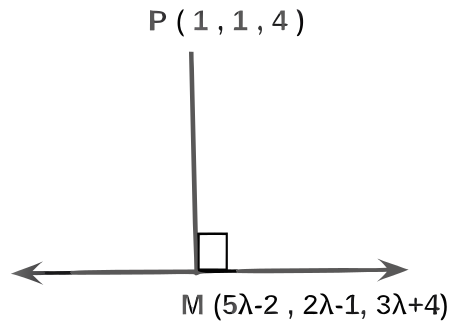
Direction Ratios of $\displaystyle \mathbf{P M}$ vector are $\displaystyle <\mathbf{5} \boldsymbol{\lambda}-\mathbf{3} \boldsymbol{,} \mathbf{2} \boldsymbol{\lambda} \boldsymbol{-} \mathbf{2} \boldsymbol{,} \mathbf{3} \boldsymbol{\lambda} \boldsymbol{>}$
Since, $\displaystyle \mathbf{P M} \perp \boldsymbol{l}$
$\displaystyle \Rightarrow 5(5 \lambda-3)+2(2 \lambda-2)+3(3 \lambda)=0$
$\displaystyle \Rightarrow \lambda=\frac{1}{2}$
Hence, coordinates of $\displaystyle M$ are $\displaystyle \left(\frac{\mathbf{1}}{\mathbf{2}}, \mathbf{0}, \frac{\mathbf{1 1}}{\mathbf{2}}\right)$
Equation of given line be $\displaystyle \frac{\mathrm{x}-1}{3}=\frac{\mathrm{y}+1}{2}=\frac{\mathrm{z}-4}{3}=\boldsymbol{\lambda}$ (say)
Coordinate of any general point on the line are $\displaystyle \mathbf{P}(\mathbf{3} \boldsymbol{\lambda}+\mathbf{1}, \mathbf{2} \boldsymbol{\lambda}-\mathbf{1}, \mathbf{3} \boldsymbol{\lambda}+\mathbf{4})$.
Let distance of point $\displaystyle P$ from ( $\displaystyle -1,-1,2$ ) is $\displaystyle 2 \sqrt{ } 2$.
$\displaystyle \Rightarrow \sqrt{(\mathbf{3} \boldsymbol{\lambda}+\mathbf{2})^{\mathbf{2}}+(\mathbf{2} \boldsymbol{\lambda})^{\mathbf{2}}+(\mathbf{3} \boldsymbol{\lambda}+\mathbf{2})^{\mathbf{2}}}=\mathbf{2} \sqrt{\mathbf{2}}$
$\displaystyle \Rightarrow \mathbf{2 2 \boldsymbol { \lambda } ^ { 2 }}+\mathbf{2 4} \boldsymbol{\lambda}=\mathbf{0}$
$\displaystyle \boldsymbol{\Rightarrow} \boldsymbol{\lambda}=\mathbf{0}$ or $\displaystyle \boldsymbol{\lambda}=-\frac{\mathbf{1 2}}{\mathbf{1 1}}$
All Three Dimensional Geometry questions2025 question paperNCERT solutions: Three Dimensional GeometryPractice Three Dimensional Geometry →
More from Three Dimensional Geometry
- Find the image A^′ of the point A(1,6,3) in the line x/1=(y-1)/2=(z-2)/3. Also, find the equation of the line joining A and A^′. OR Find a point P on…2025
- Find the values of λ, for which the distance of point (2,1, λ) from plane 3 x+5 y+ 4 z=11 is 2 √2 units.2022
- Find the value of λ if the following lines are perpendicular to each other: l_1: (1-x)/-3=(3 y-2)/(2 λ)=(z-3)/3; l_2: (x-1)/(3 λ)=(1-y)/1=(2 z-5)/32025
- The value of λ for which the angle between the lines r= i+ j+ k+p(2 i+ j+2 k) and r=(1+q) i+(1+q λ) j+(1+q) k is (π)/2 is:2023
- If a line makes an angle of (π)/4 with the positive directions of both x -axis and z -axis, then the angle which it makes with the positive direction…2024
- Assertion: If a line makes angles α, β, γ with positive direction of the coordinate axes, then sin^2 α+ sin^2 β+ sin^2 γ=2. Reason (R): The sum of…2023
- If the lines (x-3)/1=(1-y)/1=(z+2)/p and (2-x)/3=(y+1)/5=(z+56)/(2 p) are perpendicular to each other, then find the value(s) of p. OR Find the…2026
- Find the equation of the plane passing through points (2, 1, 0), (3, -2, -2) and (1, 1, -7). Also, obtain its distance from the origin. OR Find the…2022
CBSE Class 12 Mathematics past-paper question from the 2025 board exam, with the answer as CBSE’s own marking scheme gives it. Where our answers come from.