✓ Board-verified
Chemistry · 2023 · 4 marks
CBSE 2023 · Region 3 · Set 1 · Q31
The polarity of C - X bond of alkyl halides is responsible for their nucleophilic substitution, elimination and their reaction with metal atoms to…
The polarity of C - X bond of alkyl halides is responsible for their nucleophilic substitution, elimination and their reaction with metal atoms to form organometallic compounds. Alkyl halides are prepared by the free radical halogenation of alkanes, addition of halogen acids to alkenes, replacement of - OH group of alcohols with halogens using phosphorus halides, thionyl chloride or halogen acids. Aryl halides are prepared by electrophilic substitution of arenes. Nucleophilic substitution reactions are categorised into $\displaystyle \mathrm{S}_{\mathrm{N}}{ }^{1}$ and $\displaystyle \mathrm{S}_{\mathrm{N}}{ }^{2}$ on the basis of their kinetic properties. Chirality has a profound role in understanding the $\displaystyle \mathrm{S}_{\mathrm{N}}{ }^{1}$ and $\displaystyle \mathrm{S}_{\mathrm{N}}{ }^{2}$ mechanism. Answer the following questions:
(i)
What happens when bromobenzene is treated with Mg in the presence of dry ether?
(ii)
Which compound in each of the following pairs will react faster in $\displaystyle \mathrm{S}_{\mathrm{N}}{ }^{1}$ reaction with $\displaystyle \mathrm{OH}^{-}$?
(1)
$\displaystyle \mathrm{CH}_{2}=\mathrm{CH}-\mathrm{CH}_{2}-\mathrm{Cl}$ or $\displaystyle \mathrm{CH}_{3}-\mathrm{CH}_{2}-\mathrm{CH}_{2}-\mathrm{Cl}$
(2)
$\displaystyle \left(\mathrm{CH}_{3}\right)_{3} \mathrm{C}-\mathrm{Cl}$ or $\displaystyle \mathrm{CH}_{3} \mathrm{Cl}$
(iii)
Write the equations for the preparation of $\displaystyle 1$-iodobutane from
(1)
$\displaystyle 1$-chlorobutane
(2)
but-$\displaystyle 1$-ene.
OR
(iii)
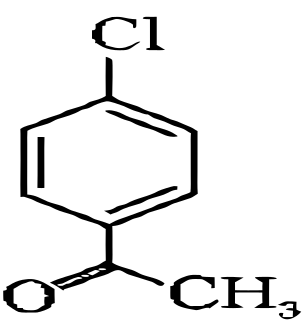
Write the structure of the major products in each of the following reactions:
Marking-scheme solution
(i)
\(\displaystyle \mathrm{C}_{6} \mathrm{H}_{5} \mathrm{MgBr} / \mathrm{Phenyl}\) magnesium bromide is formed.
(ii) ($\displaystyle 1$) \(\displaystyle \mathrm{CH}_{2}=\mathrm{CH}-\mathrm{CH}_{2}-\mathrm{Cl}\)
(2) \(\displaystyle \left(\mathrm{CH}_{3}\right)_{3} \mathrm{C}-\mathrm{Cl}\)
(iii) ($\displaystyle 1$)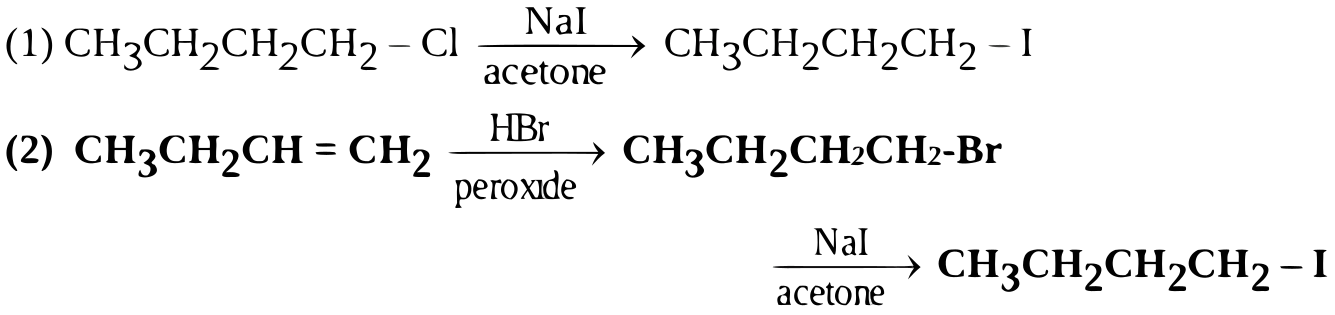
(iii)  (2)
(2)
(2)All Haloalkanes and Haloarenes questions2023 question paperNCERT solutions: Haloalkanes and HaloarenesPractice Haloalkanes and Haloarenes →
More from Haloalkanes and Haloarenes
- Why haloarenes are not reactive towards nucleophilic substitution reaction? Give two reasons.2023
- Account for the following: 1 × 3 Haloalkanes react with NaCN to form both cyanides and isocyanides. Haloarenes do not undergo nucleophilic…2024
- Reaction of 1-phenyl-2-chloropropane with alcoholic KOH gives mainly:2023
- The species that attacks benzene in following is:2023
- Write the major product in the following reactions: 1+1+1 Define Racemic mixture. p-dichlorobenzene has a higher melting point as compared to its…2026
- In the following pair of compounds, which compound undergoes S_N 1 reaction faster and why? OR Write the major product in the following:2024
- Write the IUPAC name of the given compound: Why are haloalkanes more reactive towards nucleophilic substitution reactions than haloarenes? What…2024
- Assertion: Bromination of benzoic acid gives m-bromobenzoic acid. Reason (R): Carboxyl group increases the electron density at the meta position.2023
CBSE Class 12 Chemistry past-paper question from the 2023 board exam, with the answer as CBSE’s own marking scheme gives it. Where our answers come from.